Gold Price History: Notable Highs and Lows Through the Years
Understanding gold's price movements: From historic lows to record-breaking highs.
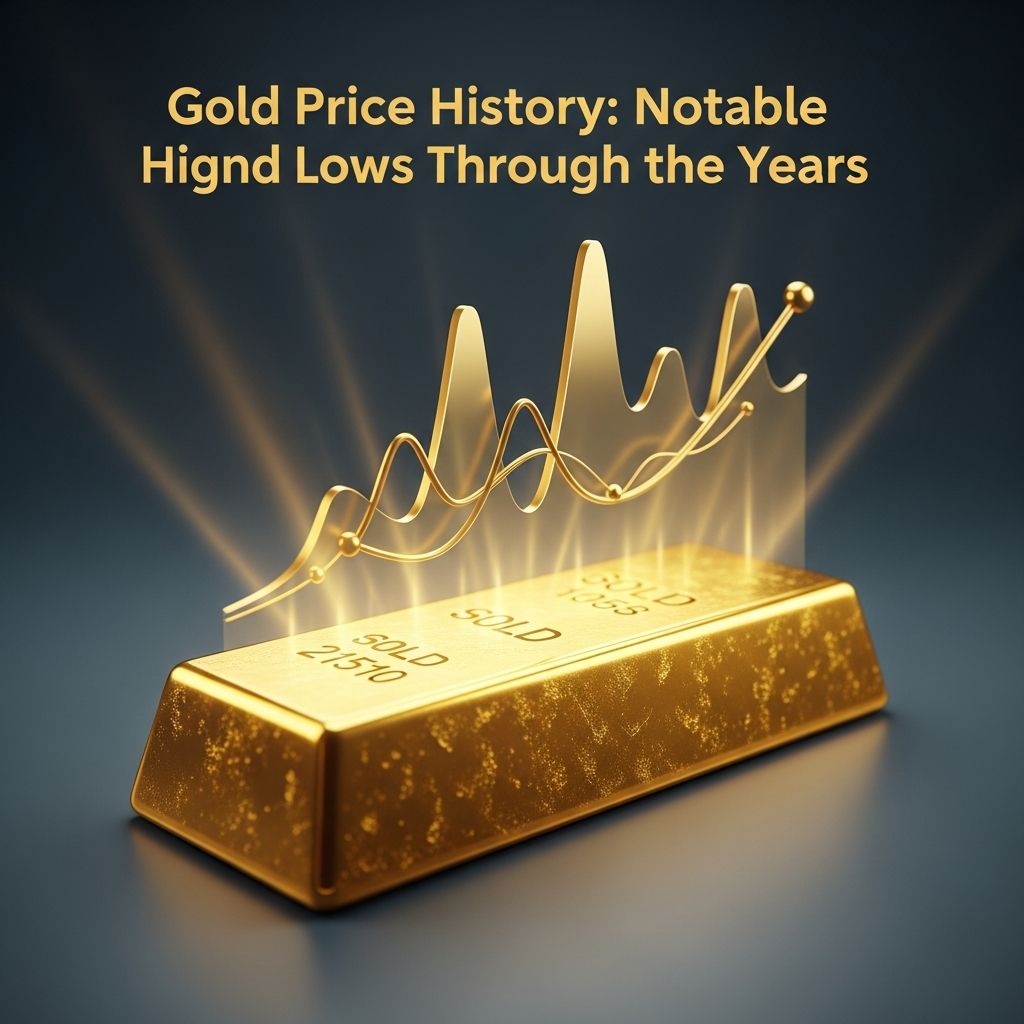
Gold Price History: Understanding Highs and Lows in the Precious Metal Market
Gold has held intrinsic value for thousands of years, serving as currency, jewelry, and a store of wealth across civilizations. Understanding the historical price movements of gold provides valuable insights for investors, economists, and financial professionals seeking to comprehend market dynamics and precious metal valuations. The price of gold fluctuates based on numerous factors including economic conditions, geopolitical events, inflation rates, and currency valuations. This comprehensive guide explores the significant price movements in gold’s modern trading history, examining both record-breaking highs and notable lows that have shaped investment strategies.
Understanding Gold Pricing and Market Fundamentals
Gold is primarily traded in U.S. dollars per troy ounce on international markets. The price of gold reflects the collective sentiment of investors, central banks, and financial institutions regarding economic stability, currency strength, and inflation expectations. Several key factors influence gold pricing decisions across global markets:
- Interest Rates: Higher interest rates typically reduce gold demand because investors receive better returns from interest-bearing securities. Conversely, lower interest rates increase gold’s attractiveness as a non-yielding asset provides value through price appreciation potential.
- Currency Strength: Since gold trades in U.S. dollars, a stronger dollar makes gold more expensive for international buyers, potentially reducing demand. A weaker dollar conversely increases gold’s appeal to foreign investors.
- Inflation Expectations: Investors often view gold as an inflation hedge, purchasing it during periods of rising price pressures to protect purchasing power. Economic uncertainty and inflationary concerns typically drive gold demand upward.
- Geopolitical Events: Political instability, military conflicts, and international tensions prompt investors to seek safe-haven assets like gold, driving prices higher during uncertain times.
- Market Sentiment: Overall investor risk appetite influences gold demand. During market volatility or recession concerns, investors increase gold holdings as a portfolio diversification strategy.
Historical Gold Price Overview: Key Eras and Milestones
The modern history of gold pricing can be divided into distinct eras, each characterized by particular economic conditions and market dynamics. Understanding these periods provides context for significant price movements and helps investors recognize patterns in precious metal valuations.
The Bretton Woods Era (1944-1971)
Following World War II, the Bretton Woods system established gold as the foundation of international currency exchange, fixing the U.S. dollar at $35 per troy ounce. This fixed price system provided currency stability but eventually became unsustainable as gold mining production failed to keep pace with expanding currency supplies. The system officially ended in 1971 when President Richard Nixon suspended the dollar’s convertibility into gold, allowing gold prices to fluctuate freely based on market forces.
The Free-Floating Era (1971-Present)
Once gold prices were freed from government controls, the precious metal entered a new phase of market-driven valuation. This transition marked the beginning of modern gold price discovery, where market forces—rather than government mandate—determined pricing.
Notable Gold Price Highs Throughout History
Gold has reached several historic price milestones that reflect changing economic conditions, market psychology, and investment demand. These peaks often coincide with periods of economic uncertainty, inflation concerns, or geopolitical instability.
The 1980 Peak
The early 1980s witnessed an extraordinary gold price surge, reaching approximately $850 per troy ounce in January 1980. This peak was primarily driven by high inflation rates exceeding 13%, Soviet military intervention in Afghanistan, and Iranian political upheaval. These converging crises created significant demand for safe-haven assets, propelling gold to unprecedented levels. However, aggressive Federal Reserve interest rate increases under Chairman Paul Volcker eventually tempered inflation and gold prices subsequently declined.
The 2008 Financial Crisis and Recovery
The global financial crisis of 2008 triggered significant gold price movements as investors fled to safety. Gold prices climbed from approximately $700 per ounce in early 2008 to over $900 by year-end. The crisis intensified demand for precious metals as confidence in financial institutions wavered and investors sought tangible assets with intrinsic value.
The 2011 Peak
Gold reached another significant milestone in September 2011, approaching $1,900 per troy ounce during the height of the European debt crisis. Concerns about sovereign debt defaults, currency devaluation fears, and massive central bank monetary stimulus programs drove investors toward gold as economic uncertainty mounted. This represented a multifold increase from 2008 prices and demonstrated gold’s appeal during sustained economic stress.
Recent Record Highs (2020-Present)
The COVID-19 pandemic triggered unprecedented monetary and fiscal stimulus globally, leading to new gold price records. In August 2020, gold surpassed $2,000 per troy ounce for the first time. This milestone reflected concerns about currency debasement, economic disruption, and inflation prospects following massive government spending programs. Subsequent years have witnessed continued price strength, with gold occasionally approaching $2,100 per ounce during 2024 amid persistent inflation concerns and geopolitical tensions.
Significant Gold Price Lows and Market Bottoms
While gold price peaks generate substantial investor attention, understanding price lows provides equally valuable insights into market cycles and investment opportunities. Gold price troughs typically occur during strong economic growth, rising interest rates, and optimistic market sentiment.
The 2001 Low Point
Following significant declines throughout the 1990s, gold bottomed around $250-260 per troy ounce in 2001. This low reflected strong U.S. economic growth during the technology boom, elevated interest rates, and a robust dollar. Despite the September 11 terrorist attacks occurring in 2001, gold prices initially declined as investors liquidated holdings to cover losses in declining equity markets—a phenomenon demonstrating gold’s imperfect safe-haven properties during acute liquidity crises.
Price Consolidation (2008-2010)
Despite financial market turbulence, gold prices established a more stable foundation around $700-800 per ounce during 2008-2010. This period represented a transition phase as investors gradually recognized gold’s safe-haven characteristics, driving sustained demand increases over subsequent years.
Factors Driving Gold Price Volatility
Examining gold’s historical price movements reveals several consistent patterns and driving factors that influence precious metal valuations across different market environments:
- Real Interest Rates: The most significant driver of gold valuations is the real interest rate (nominal rates minus inflation expectations). Negative real rates substantially increase gold demand, while positive real rates reduce precious metal attractiveness.
- Central Bank Policies: Decisions regarding monetary stimulus, quantitative easing, and interest rate changes profoundly impact gold prices. Expansionary policies typically support higher gold valuations.
- Inflation Trends: Both actual and anticipated inflation rates significantly influence gold demand. Periods of rising inflation or deflation concerns prompt increased precious metal purchasing.
- Risk Appetite Cycles: During risk-on market environments with strong equity performance, gold often underperforms. Conversely, risk-off periods characterized by equity market weakness typically support gold price appreciation.
- U.S. Dollar Dynamics: As the world’s reserve currency, dollar strength inversely correlates with gold prices, affecting international demand dynamics.
- Mining Production: Although not a primary driver in modern markets, changes in global gold mining production can influence longer-term supply dynamics and pricing trends.
Gold Price Trends and Market Cycles
Historical analysis reveals that gold prices tend to move in extended cycles rather than random patterns. Several distinct trends have emerged from examining decades of price data:
During the 1970s and 1980s, gold experienced a powerful bull market driven by high inflation and geopolitical tensions. The 1990s and early 2000s witnessed extended bear market conditions as strong economic growth and rising interest rates reduced precious metal demand. Beginning around 2001, gold entered another sustained bull market lasting approximately a decade, culminating in 2011. Following a multi-year consolidation period from 2012-2015, gold prices resumed appreciating from 2016 onward, accelerating significantly following the 2020 pandemic crisis.
Gold as an Investment and Portfolio Hedge
Understanding gold’s historical price patterns helps investors appreciate its portfolio role. Gold typically exhibits low or negative correlation with equities during market stress, providing diversification benefits. However, during normal economic conditions, this correlation may be neutral or even slightly positive. The precious metal’s effectiveness as a portfolio hedge depends on allocation size, time horizon, and economic environment.
Investors typically allocate 5-10% of diversified portfolios to gold and other precious metals. This allocation provides meaningful diversification without creating return drag during strong equity market performance. Historical data demonstrates that this modest allocation has enhanced risk-adjusted returns across most measurement periods.
Gold Price Comparison Table
| Period | Notable Price | Market Condition | Key Drivers |
|---|---|---|---|
| January 1980 | ~$850/oz | Peak | High inflation, geopolitical crisis |
| 2001 | ~$255/oz | Low | Strong economy, rising rates |
| September 2011 | ~$1,900/oz | Peak | Debt crisis, monetary stimulus |
| August 2020 | ~$2,000/oz | Peak | Pandemic, monetary expansion |
| 2024 (Current) | ~$2,050-2,100/oz | High Range | Inflation persistence, geopolitical risk |
Frequently Asked Questions About Gold Price History
Q: What was the highest price gold has ever reached?
A: Gold reached approximately $2,100 per troy ounce in late 2024, representing the highest nominal price in history. However, adjusting for inflation, the 1980 price of $850 per ounce would be equivalent to roughly $3,300 in 2024 dollars, making it historically more significant in real terms.
Q: Why does gold price fluctuate so much?
A: Gold prices fluctuate due to multiple factors including interest rate changes, inflation expectations, currency valuations, geopolitical events, and shifts in investor risk appetite. As a non-yielding asset, gold’s value depends primarily on investment demand rather than fundamental business earnings.
Q: Is gold a good investment during inflation?
A: Historically, gold has provided some inflation protection, though not perfectly. During periods of moderate inflation, gold typically appreciates, helping preserve purchasing power. However, during periods of severe deflation or rapid disinflation, gold prices may decline despite rising price levels earlier.
Q: How do interest rates affect gold prices?
A: Rising interest rates increase the opportunity cost of holding non-yielding gold, as investors can earn returns from bonds and savings accounts. Higher rates typically reduce gold demand and prices. Conversely, lower interest rates make gold more attractive relative to interest-bearing alternatives.
Q: What percentage of my portfolio should be in gold?
A: Financial advisors typically recommend allocating 5-10% of diversified portfolios to precious metals including gold. This allocation provides meaningful diversification during market stress without significantly impacting overall portfolio returns during normal market conditions.
Conclusion
Gold’s price history reveals a precious metal that responds dramatically to economic conditions, monetary policy, and investor sentiment. From the inflation-driven peaks of 1980 to the recent records established during the pandemic era, gold prices reflect broader economic narratives and investment psychology. Understanding this history helps investors appreciate gold’s role in diversified portfolios and recognize patterns that may guide future investment decisions. Whether viewed as inflation protection, geopolitical insurance, or portfolio diversification, gold’s historical performance demonstrates why this precious metal has captivated investors across centuries and continues to play a significant role in modern portfolio construction.
References
- Gold Prices: Historical Data and Market Analysis — U.S. Geological Survey. 2024. https://www.usgs.gov/faqs/what-gold-price-today
- Federal Reserve Economic Data: Gold Fixing Price — Federal Reserve Bank of St. Louis. 2024. https://fred.stlouisfed.org/series/GOLDAMND
- World Gold Council: Market Research and Precious Metal Trends — World Gold Council. 2024. https://www.gold.org/market-data
- The Bretton Woods System: Background and Significance — International Monetary Fund. 2023. https://www.imf.org/external/about/histend.htm
- Inflation and Gold Prices: Empirical Analysis — U.S. Bureau of Labor Statistics. 2024. https://www.bls.gov/data/
- Central Banking and Monetary Policy Effects on Precious Metals — Bank for International Settlements. 2023. https://www.bis.org/
Similar Articles








Read full bio of medha deb