Glass-Steagall Act: Definition, Purpose, and Repeal
Understanding the landmark banking legislation that shaped modern financial regulation and its eventual repeal.
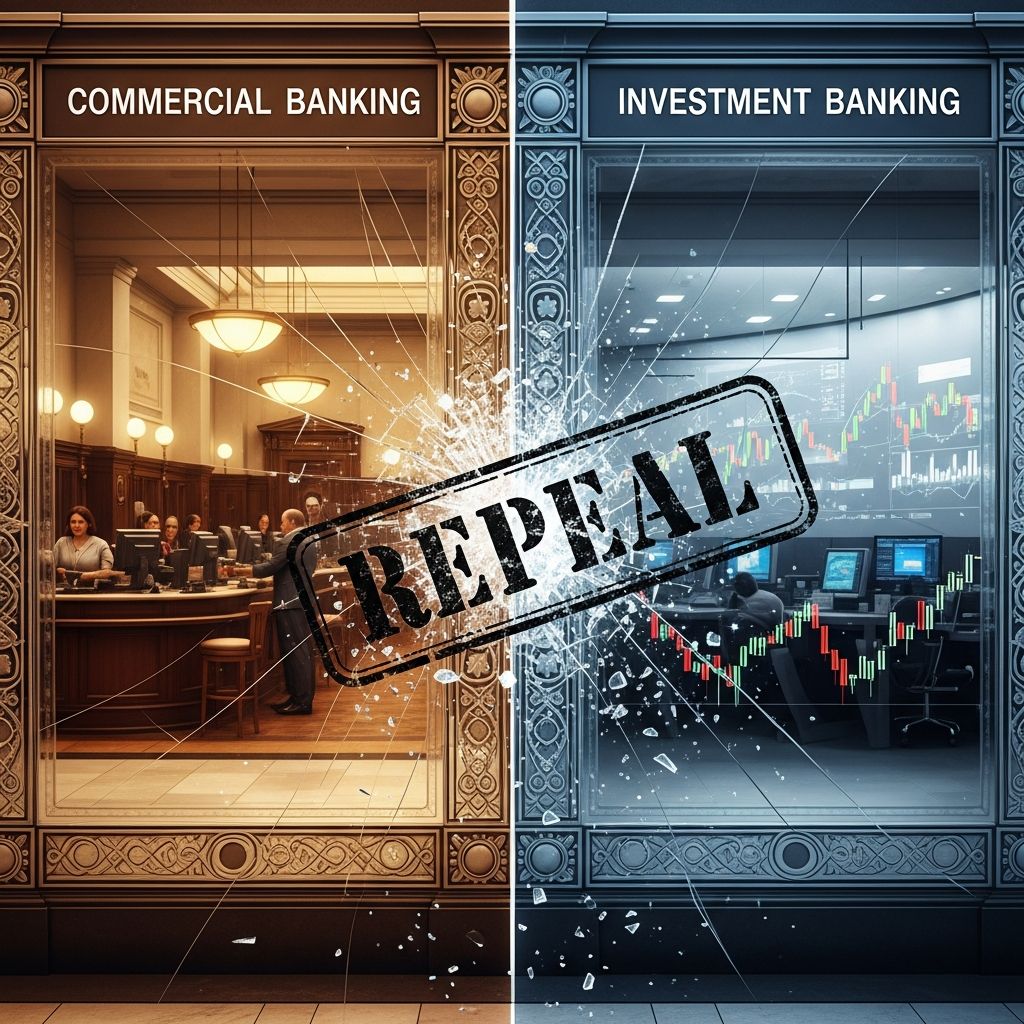
The Glass-Steagall Act, officially known as the Banking Act of 1933, stands as one of the most significant pieces of financial legislation in American history. Enacted during the depths of the Great Depression, this landmark law fundamentally reshaped the banking industry by creating a clear separation between commercial banking and investment banking activities. Named after its primary architects, Senator Carter Glass of Virginia and Representative Henry Steagall of Alabama, the act emerged as part of President Franklin D. Roosevelt’s ambitious New Deal program to restore stability and public confidence in the nation’s financial system.
What is the Glass-Steagall Act?
The Glass-Steagall Act is a comprehensive piece of legislation that fundamentally transformed the American banking landscape by separating commercial banking operations from investment banking activities. At its core, the act defined commercial banks as institutions that accept deposits from the public and make loans to individuals and businesses, while investment banks were defined as firms that underwrite, deal in, and distribute securities. By creating this legal firewall, the legislation aimed to prevent the risky practices that had contributed to the catastrophic financial collapse of 1929.
The act represented a direct response to widespread concerns that commercial banks were using depositor funds to engage in speculative securities trading, thereby jeopardizing the savings of ordinary Americans. Prior to the Great Depression, banks operated with minimal federal oversight, and many institutions combined commercial and investment banking operations under single ownership, creating dangerous conflicts of interest.
Historical Context and Purpose
The Glass-Steagall Act did not emerge suddenly but rather developed through years of legislative deliberation following the devastating stock market crash of 1929. Senator Glass first introduced banking reform legislation in January 1932, seeking to address the systemic vulnerabilities that had become apparent during the financial crisis. The act received extensive critiques and comments from bankers, economists, and Federal Reserve officials before finally gaining Congressional approval.
Key Problems the Act Addressed
The primary concerns motivating Glass-Steagall legislation included:
- Excessive speculation by commercial banks using depositor funds
- Lack of federal regulation over securities markets and banking operations
- Absence of deposit insurance protection for ordinary savers
- Conflicts of interest arising from combined commercial and investment banking
- Insufficient oversight of interbank control and financial affiliate relationships
In the wake of the 1929 stock market crash and the subsequent Great Depression, Congress recognized that commercial banking operations and the payments system were incurring significant losses from volatile equity markets. An important motivation for the act was the desire to restrict the use of bank credit for speculation and to direct bank credit into more productive uses, such as industry, commerce, and agriculture.
Main Provisions of Glass-Steagall
The Glass-Steagall Act contained several interconnected provisions designed to stabilize the banking system and protect depositors:
Separation of Commercial and Investment Banking
The central provision of Glass-Steagall required a strict separation between commercial banking and investment banking activities. Commercial banks, which took in deposits and made loans, were no longer allowed to underwrite or deal in securities. Conversely, investment banks, which underwrote and dealt in securities, were prohibited from taking deposits or having close connections to commercial banks, such as overlapping directorships or common ownership.
The law gave banks one year after passage to decide whether they would operate as commercial banks or investment banks. Once this election was made, the prohibition was nearly absolute. Commercial banks could only derive up to 10 percent of their income from securities-related activities, with an important exception: commercial banks retained the ability to underwrite government-issued bonds.
Creation of the Federal Deposit Insurance Corporation
One of Glass-Steagall’s most enduring and successful contributions to financial stability was the establishment of the Federal Deposit Insurance Corporation (FDIC). This government agency was created to insure deposits held in commercial banks, thereby protecting ordinary depositors from catastrophic losses if their bank failed. All Federal Reserve member banks were required to become stockholders of the FDIC by July 1, 1934, with mandatory membership for national banks and voluntary membership for state banks.
Deposit insurance proved to be a transformative innovation that has largely eliminated the financial panics that had regularly devastated Americans before the Civil War. While individual banks continued to fail occasionally after Glass-Steagall’s passage, their depositors escaped largely unscathed, fundamentally altering the relationship between American citizens and their financial institutions.
Enhanced Federal Reserve Regulation
Glass-Steagall gave tighter regulation of national banks to the Federal Reserve System, requiring holding companies and other affiliates of state member banks to make three reports annually to their Federal Reserve Bank and the Federal Reserve Board. Bank holding companies that owned a majority of shares of any Federal Reserve member bank had to register with the Fed and obtain its permit to vote their shares in the selection of directors of any member-bank subsidiary.
Regulation Q and Interest Rate Controls
The act introduced what later became known as Regulation Q, which mandated that interest could not be paid on checking accounts and gave the Federal Reserve authority to establish ceilings on the interest that could be paid on other kinds of deposits. The underlying philosophy was that payment of interest on deposits led to “excessive” competition among banks, causing them to engage in unduly risky investment and lending policies so that they could earn enough income to pay the interest.
Impact and Legacy of Glass-Steagall
The Glass-Steagall Act achieved its primary objective of stabilizing the American banking system. For decades following its enactment, the United States experienced unprecedented financial stability, with far fewer banking crises than had occurred during earlier periods of American history. The separation of commercial and investment banking created a more secure banking environment where the savings of ordinary Americans were protected from the speculative activities of investment divisions.
The act represented a fundamental shift in the relationship between government and financial institutions, establishing the principle that banking was a regulated industry in which public safety concerns justified significant governmental oversight and intervention. This regulatory framework remained largely intact for more than six decades, fundamentally shaping the structure and operations of American financial institutions.
The Repeal of Glass-Steagall
Despite its success in maintaining financial stability for decades, Glass-Steagall began to face serious challenges beginning in the 1980s and 1990s. Financial institutions argued that the separation of commercial and investment banking was obsolete and that modern financial markets required larger, more diversified financial conglomerates to compete internationally. Technological advances and globalization of financial markets created pressures to eliminate the regulatory barriers that Glass-Steagall had established.
Reasons for Repeal
Several factors contributed to the eventual repeal of Glass-Steagall:
- Financial institutions’ arguments that size and diversification were necessary for global competitiveness
- Technological changes that blurred traditional distinctions between commercial and investment banking
- Political pressure from the financial industry and some economic theorists who viewed the separation as economically inefficient
- Gradual erosion of Glass-Steagall through regulatory interpretation and legislative exceptions
- The belief among some policymakers that modern risk management made the firewall unnecessary
The Gramm-Leach-Bliley Act of 1999
Glass-Steagall was formally repealed through the Gramm-Leach-Bliley Act of 1999, legislation that allowed commercial banks, investment banks, securities firms, and insurance companies to consolidate under holding company structures. This repeal eliminated the regulatory firewall that had separated these different types of financial institutions for sixty-six years.
The repeal of Glass-Steagall allowed financial institutions to create massive financial conglomerates offering comprehensive services across commercial banking, investment banking, securities trading, and insurance. Proponents of repeal argued that such consolidation would create more efficient financial institutions and enhance American competitiveness in global financial markets.
Consequences and Controversies
The repeal of Glass-Steagall remains highly controversial among economists, policymakers, and financial analysts. Many observers argue that the elimination of the firewall between commercial and investment banking contributed to excessive risk-taking by financial institutions, ultimately contributing to the financial crisis of 2008. The megabanks that emerged after Glass-Steagall’s repeal engaged in increasingly risky trading activities while relying on government safety nets such as deposit insurance and access to Federal Reserve lending facilities.
Critics argue that Glass-Steagall’s repeal created “too-big-to-fail” institutions whose failure would threaten the entire financial system, necessitating government bailouts during times of crisis. The financial crisis of 2008 vindicated many of Glass-Steagall’s original concerns about conflicts of interest and excessive risk-taking within large financial conglomerates.
Frequently Asked Questions
Q: What is the primary purpose of the Glass-Steagall Act?
A: The Glass-Steagall Act’s primary purpose was to separate commercial banking from investment banking to prevent conflicts of interest and protect depositors’ funds from speculative activities. The act also established the Federal Deposit Insurance Corporation to insure bank deposits.
Q: When was the Glass-Steagall Act passed and when was it repealed?
A: The Glass-Steagall Act was passed on June 16, 1933, and went into effect on June 16, 1934. It was formally repealed through the Gramm-Leach-Bliley Act of 1999.
Q: What was the impact of repealing Glass-Steagall?
A: The repeal of Glass-Steagall allowed financial institutions to consolidate commercial and investment banking operations. Many economists argue that this consolidation contributed to excessive risk-taking and ultimately contributed to the 2008 financial crisis.
Q: How did Glass-Steagall address bank failures?
A: Glass-Steagall established the Federal Deposit Insurance Corporation (FDIC) to insure deposits in commercial banks. This innovation largely eliminated the financial panics that had historically devastated the American economy when banks failed.
Q: What is Regulation Q mentioned in Glass-Steagall?
A: Regulation Q was a Glass-Steagall provision that prohibited banks from paying interest on checking accounts and allowed the Federal Reserve to establish ceilings on interest rates for savings accounts. The regulation was based on the belief that excessive competition for deposits led to risky lending practices.
Comparative Analysis: Glass-Steagall vs. Post-Repeal Banking
| Aspect | Glass-Steagall Era (1933-1999) | Post-Repeal Era (1999-Present) |
|---|---|---|
| Banking Structure | Separated commercial and investment banking | Consolidated commercial and investment banking |
| Bank Size | Smaller, regional institutions | Megabanks with global operations |
| Regulatory Oversight | Stricter separation with Federal Reserve supervision | Consolidated regulation with multiple regulators |
| Risk Profile | Lower systemic risk from speculation | Higher systemic risk from interconnected activities |
| Financial Crises | Fewer major systemic crises | Major crisis in 2008; ongoing stability concerns |
| Deposit Protection | FDIC insurance protected depositors | FDIC insurance continues; broader financial safety net |
Modern Debates About Glass-Steagall
The Glass-Steagall Act continues to generate significant debate among policymakers and economists. Proponents of reinstatement argue that restoring the separation between commercial and investment banking would reduce systemic risk and prevent excessive speculation by banks holding consumer deposits. They point to the 2008 financial crisis as evidence that the combination of commercial and investment banking within single institutions creates dangerous conflicts of interest and moral hazard problems.
Opponents of reinstatement argue that modern financial markets are too complex for simple separations and that other regulatory tools, such as higher capital requirements and stress testing, are more effective at managing systemic risk. They contend that restoring Glass-Steagall would reduce the competitiveness and efficiency of American financial institutions in global markets.
Conclusion
The Glass-Steagall Act represents a pivotal moment in American financial history when policymakers recognized the dangers of allowing commercial banks to engage in speculative investment activities using depositor funds. The act’s provisions, particularly the creation of the FDIC and the separation of commercial and investment banking, successfully stabilized the American banking system for more than six decades. The repeal of Glass-Steagall through the Gramm-Leach-Bliley Act of 1999 reflected changing attitudes toward financial regulation and the influence of banking industry arguments for consolidation. However, the 2008 financial crisis renewed debates about whether Glass-Steagall’s fundamental insights about the dangers of combining commercial and investment banking remain valid in the modern financial system. Understanding Glass-Steagall’s history and legacy is essential for anyone seeking to comprehend contemporary debates about financial regulation and systemic risk in the American economy.
References
- Glass-Steagall Act — Fiveable. Accessed 2025. https://fiveable.me/key-terms/hs-honors-us-history/glass-steagall-act
- Banking Act of 1933 (Glass-Steagall) — Federal Reserve History. Accessed 2025. https://www.federalreservehistory.org/essays/glass-steagall-act
- The Glass-Steagall Act Separates US Commercial and Investment Banking — Goldman Sachs. Accessed 2025. https://www.goldmansachs.com/our-firm/history/moments/1933-glass-steagall-act
- Glass-Steagall Legislation — Wikipedia. Accessed 2025. https://en.wikipedia.org/wiki/Glass%E2%80%93Steagall_legislation
- A Brief History of the Glass-Steagall Act — Demos. Accessed 2025. https://www.demos.org/sites/default/files/publications/glass-steagall-history_Demos.pdf
Similar Articles








Read full bio of Sneha Tete