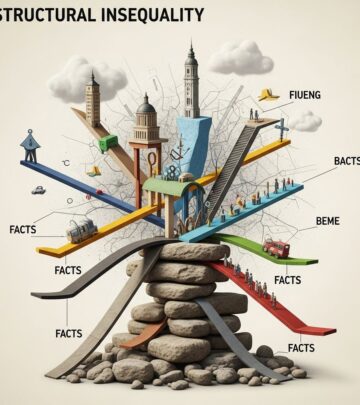
Glass Ceiling: Definition, History, and Impact
Understand the invisible barriers preventing women and minorities from career advancement in corporations.

What Is the Glass Ceiling?
The glass ceiling represents an invisible yet seemingly impenetrable barrier that prevents qualified individuals, particularly women and minorities, from advancing to the highest levels of organizational hierarchies. Unlike traditional glass, which is transparent and fragile, the metaphorical glass ceiling is not explicitly stated in company policies or discussed in formal business meetings. Instead, it operates as a covert, unspoken phenomenon rooted in attitudinal and organizational biases that systematically exclude certain demographic groups from reaching executive and senior management positions, regardless of their qualifications, experience, or achievements.
The concept emerged as a response to the observable pattern that while women and minorities could see elite positions and possessed the necessary skills to fill them, invisible barriers prevented their advancement. These barriers exist across industries and organizational levels, creating a situation where capable professionals remain stuck in mid-level management despite their efforts and dedication.
The Origin and Evolution of the Term
The term “glass ceiling” was first coined by Marilyn Loden during a speech in 1978, when she sought to articulate the obstacles preventing high-achieving women from reaching top-tier corporate positions. However, the concept didn’t gain widespread recognition until the mid-1980s. In 1984, Gay Bryant referenced the concept in a chapter of The Working Woman Report: Succeeding in Business in the 1980s, and Basia Hellwig used the term in another chapter of the same publication.
The breakthrough moment for widespread adoption came in March 1986 when the Wall Street Journal published a seminal article titled “The Glass Ceiling: Why Women Can’t Seem to Break The Invisible Barrier That Blocks Them From the Top Jobs.” Written by Carol Hymowitz and Timothy D. Schellhardt, this article introduced the concept to a broader audience and framed the glass ceiling as an invisible, covert, and unspoken phenomenon deliberately designed to maintain executive-level leadership positions in the hands of Caucasian males.
Formal Definitions and Characteristics
Multiple organizations have attempted to define the glass ceiling more precisely. The United States Federal Glass Ceiling Commission (1991–1996) provided an authoritative definition, describing the glass ceiling as “the unseen, yet unbreachable barrier that keeps minorities and women from rising to the upper rungs of the corporate ladder, regardless of their qualifications or achievements.”
Later, David Cotter and colleagues (2001) identified four distinctive characteristics that must be present to confirm the existence of a glass ceiling:
- A gender or racial difference that cannot be explained by other job-relevant employee characteristics
- A gender or racial difference that increases at higher levels within the organization compared to lower levels
- Gender or racial inequality in advancement opportunities into higher positions, not merely in the proportion of each demographic currently occupying those positions
- Evidence that the barrier has strengthened over time rather than weakened
The U.S. Labor Department’s Glass Ceiling Initiative further refined the definition, characterizing it as “artificial barriers based on attitudinal or organizational bias that prevent qualified individuals from advancing upward in their organization into management-level positions.”
The Glass Ceiling Commission and Research Findings
In response to growing concerns about workplace inequality, the Federal Glass Ceiling Commission conducted extensive research from 1991 to 1996. Their investigation included surveys, public hearings, and interviews with business leaders, employees, and experts. The commission’s comprehensive 1995 report, titled “Good for Business,” provided tangible guidelines and solutions for overcoming these barriers.
The commission issued 12 specific recommendations focused on improving workplace diversity and reducing discrimination through targeted policies. These recommendations emphasized that breaking the glass ceiling would create benefits not only for affected individuals but also for organizations and the broader economy. The commission’s work established that the glass ceiling was not a matter of individual choice or women’s dedication but rather a systemic issue embedded in organizational structures and culture.
Global Perspective: The Glass Ceiling Index
In 2017, The Economist developed and updated the Glass Ceiling Index, a comprehensive measure combining data on higher education participation, labor-force participation rates, gender pay gaps, child-care costs, maternity and paternity rights, business-school applications, and representation in senior positions. This global analysis revealed significant variations in gender equality across countries.
According to the index, countries with the lowest gender inequality in workplace advancement included Iceland, Sweden, Norway, Finland, and Poland. These nations demonstrated stronger policies supporting work-life balance, more equitable parental leave arrangements, and higher representation of women in senior management positions. The index demonstrated that while the glass ceiling remains a global phenomenon, some countries have made substantial progress in dismantling these barriers through deliberate policy interventions and cultural shifts.
How the Glass Ceiling Manifests in Practice
The glass ceiling operates through multiple mechanisms that prevent women and minorities from reaching leadership positions. One significant manifestation involves the “competent or warm” paradox, where women in leadership are frequently evaluated on a narrower spectrum than their male counterparts. Female leaders often face perceptions of being either competent or warm but rarely both, whereas male leaders are routinely perceived as possessing both qualities simultaneously. This double standard creates an impossible situation where women cannot satisfy organizational expectations regardless of their behavior.
Another manifestation appears in promotional opportunities and career trajectories. While women and minorities may advance through middle management levels relatively successfully, they encounter significantly steeper obstacles when attempting to reach executive ranks. This pattern has been documented across industries, from corporate America to healthcare, law, and academia.
The Glass Cliff: An Additional Challenge
Building on the glass ceiling concept, researchers identified an emerging phenomenon in the twenty-first century called the “glass cliff.” Unlike the glass ceiling, which prevents advancement, the glass cliff describes situations where women receive promotions to high-level positions during times of organizational crisis or significant difficulty.
This phenomenon appears to follow a problematic pattern: companies promote women to leadership during crises while simultaneously setting them up for failure. If the company navigates the crisis successfully, male leadership often reclaims credit and positions. If the company fails, the female leader becomes the scapegoat, enabling the organization to appoint a male successor without reputational damage. This pattern allows companies to signal commitment to diversity while maintaining male dominance in stable, high-status leadership positions.
However, not all women appointed to precarious positions succumb to this pattern. Mary Barra, who became CEO of General Motors in 2014 during a massive crisis involving 30 million vehicle recalls, demonstrated exceptional crisis management capabilities and successfully navigated the company toward recovery. Similarly, Jane Fraser, as CEO of Citi bank starting in March 2021, took over during a period of regulatory challenges and has been credited with helping the institution recover and strengthen its competitive position.
Breaking Through: Strategies and Solutions
Organizations seeking to dismantle the glass ceiling employ multiple strategies. These include establishing formal mentorship programs connecting senior leaders with emerging talent, implementing transparent promotion criteria and processes, conducting regular workplace audits to identify and address biased practices, and fostering inclusive organizational cultures.
Additionally, progressive organizations recognize the importance of flexible work arrangements, equitable parental leave policies, and addressing the gender pay gap. Leadership development programs specifically designed for women and minorities help prepare talented individuals for advancement opportunities. Some companies have found success by establishing diversity targets and holding managers accountable for progress toward these goals.
Addressing Common Arguments and Misconceptions
Despite substantial evidence supporting the glass ceiling’s existence, some critics have argued that the concept represents a myth, suggesting that women choose to leave the workforce or avoid advancement for personal reasons. This perspective overlooks systemic evidence and ignores the compounding effect of organizational bias, limited access to mentorship and networking, and unequal caregiving responsibilities.
Research demonstrates that qualified women actively seek advancement opportunities but encounter structural obstacles beyond individual choice. The issue is not women’s dedication or capability but rather organizational systems that systematically disadvantage certain demographic groups.
Impact on Organizations and the Economy
The glass ceiling carries significant consequences for organizations and broader economic performance. By limiting access to leadership positions based on demographic characteristics rather than merit, companies eliminate talented individuals from decision-making roles. This reduces organizational innovation, diversity of perspective, and decision-making quality.
Studies indicate that organizations with greater gender diversity in leadership demonstrate improved financial performance, stronger governance, and better employee satisfaction. By maintaining the glass ceiling, companies actively harm their competitive position and economic returns.
Frequently Asked Questions
Q: What exactly is meant by the “glass” in glass ceiling?
A: The word “glass” refers to the barrier’s transparent yet solid nature. It is transparent because women and minorities can see leadership positions and understand the requirements, yet it remains solid and difficult to penetrate because invisible biases prevent their advancement.
Q: Does the glass ceiling only affect women?
A: While the concept originated to describe barriers facing women, the glass ceiling also affects racial and ethnic minorities, members of the LGBTQ+ community, and other historically underrepresented groups in organizational leadership.
Q: Can the glass ceiling be completely eliminated?
A: Yes, though it requires deliberate organizational effort. Countries like Iceland and Sweden have substantially reduced glass ceiling effects through comprehensive policy changes, cultural shifts, and sustained commitment to diversity and inclusion initiatives.
Q: How does the glass cliff differ from the glass ceiling?
A: The glass ceiling prevents advancement to leadership positions. The glass cliff describes situations where women are promoted to precarious leadership positions during crises, potentially setting them up for failure and allowing companies to maintain male dominance while appearing diversity-conscious.
Q: What role do mentorship and networking play in addressing the glass ceiling?
A: Mentorship and networking are crucial for career advancement. Women and minorities often have limited access to informal networks where opportunities are discussed. Establishing formal mentorship programs and inclusive networking opportunities helps level the playing field and provides access to career-advancing information.
References
- Glass Ceiling — Wikipedia. Accessed November 2025. https://en.wikipedia.org/wiki/Glass_ceiling
- Breaking glass ceilings and glass cliffs to accelerate action on International Women’s Day 2025 — SAGE Publishing. March 3, 2025. https://www.sagepub.com/explore-our-content/blogs/posts/asia-pacific-insights
- Diversity in the Workplace: Glass Ceilings — EBSCO Research Starters. https://www.ebsco.com/research-starters/politics-and-government/diversity-workplace
Similar Articles








Read full bio of medha deb