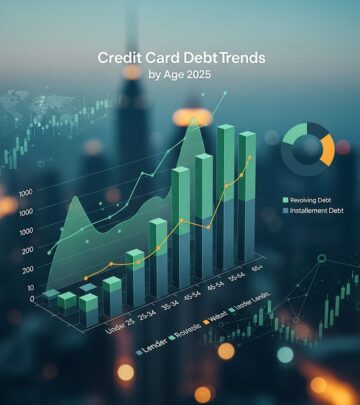
Generational Credit Card Habits
Uncover how Baby Boomers, Gen X, Millennials, and Gen Z approach credit cards differently in ownership, debt, and spending patterns.

Credit cards serve as essential financial tools for millions, enabling purchases, rewards accumulation, and credit building. However, usage patterns vary significantly across generations, influenced by life stages, economic conditions, and financial literacy. This analysis draws from recent data to compare Baby Boomers (born 1946-1964), Generation X (1965-1980), Millennials (1981-1996), and Generation Z (1997-2012) in terms of ownership, debt levels, spending behaviors, and utilization rates.
Ownership Rates: Who Holds the Cards?
Access to credit cards differs markedly by age group. Older generations tend to have higher ownership rates due to established credit histories and financial stability. For instance, 84% of Baby Boomers possess at least one credit card, reflecting decades of credit-building. Generation X follows closely at 72%, while Millennials match this at 72%. Gen Z lags behind with only 57% ownership among eligible adults, as many are just entering the credit market.
Broader trends confirm this pattern. Over 82% of U.S. adults held a credit card in 2023, with ownership rising with age: 65% for ages 18-29, climbing to 91% for those 60+. Among younger adults (under 25), 64% now have cards, up from 56% in 2013, signaling growing adoption. Demographic factors also play a role; suburban residents (77%) outpace urban (73%) and rural (69%) dwellers, while White Americans (77%) have higher rates than Black Americans (56%).
- Baby Boomers: Highest ownership at 84%, leveraging long-term financial security.
- Gen X: 72%, balancing peak earning years with family expenses.
- Millennials: 72%, increasing access amid economic recovery.
- Gen Z: 57%, limited by age and experience; 60% had cards in early 20s vs. 54.5% for Millennials at same age.
Average Number of Cards: More Means Experience
Older cohorts not only own more cards but hold multiple accounts. Baby Boomers and Gen X average over four cards each, benefiting from years of applications and approvals. In contrast, Gen Z adults (18-25) average just two cards, a modest rise from prior years. The national average stands at 3.9 active cards per American.
| Generation | Average Cards |
|---|---|
| Baby Boomers & Gen X | >4 |
| Millennials | ~3-4 |
| Gen Z (18-25) | 2 |
This disparity stems from credit history length; seasoned users like Boomers enjoy higher limits and better offers, encouraging additional cards for rewards optimization.
Debt Accumulation: Younger Generations Lead the Rise
Nearly half of cardholders (46%) carry debt, totaling over $1 trillion in balances by Q1 2024, up 11.3% year-over-year. Pandemic-era trends revealed stark divides: Gen Z balances surged 25.5% from $1,947 (April 2020) to $2,443 (Q1 2022), while Millennials rose 13.8%. Gen X saw minimal growth (0.5%), and older groups reduced debt.
Debt prevalence peaks mid-life: 54% of ages 45-59 and 53% of 30-44 carried balances recently, versus 45% (18-29) and 39% (60+). Gen X averages $7,000 in debt since 2020, amid peak earnings and expenses. High-income households ($100k+) own cards at 97% but rely on them heavily (89% of payments), though lower-income groups (<$25k) see 56% with debt.
Utilization Rates: Balancing Act by Age
Credit utilization—balances versus limits—reveals risk levels. Gen Z tops at 23% in Q1 2022, hampered by lower limits and scores. Boomers and Silent Generation use the least, aided by higher limits from experience. Adults 25-54 drive usage, with cards in 35% of transactions, the highest frequency.
Cash still matters (14% of 2024 payments), but credit/debit dominate at 35%/30%. Cards fuel 31% of retail spending.
| Generation | Avg. Utilization | Debt Growth (2020-2022) |
|---|---|---|
| Gen Z | 23% | +25.5% |
| Millennials | High | +13.8% |
| Gen X | Moderate | +0.5% |
| Baby Boomers | Low | Decrease |
Purposes and Preferences: Beyond the Basics
Generations prioritize cards differently. Boomers focus on convenience and rewards, paying balances to maintain high scores. Gen X juggles mortgages and education costs, using cards strategically. Millennials blend digital payments with debt for lifestyle needs, while Gen Z builds credit amid gig economies.
Peak users (25-54) integrate cards into daily life, but low-charging groups like retirees prefer cash. Neighborhoods influence habits: Rustbelt retirees charge under $111/month, while family-oriented areas shun high spending.
Risks and Realities: Delinquency and Debt Cycles
Delinquency hovers at 2.93%, with debt stressing households (average $14,478 in older data). Younger users face faster debt growth due to inexperience, but Boomers’ stability offers lessons in discipline.
Strategies for Each Generation
- Gen Z: Start small, pay fully, use for credit-building.
- Millennials: Prioritize high-interest payoff, seek balance transfers.
- Gen X: Optimize rewards, automate payments amid family costs.
- Baby Boomers: Maintain low utilization, review for better rates.
Future Outlook: Evolving Trends
As Gen Z matures, ownership will rise, but debt risks persist without education. Digital wallets and BNPL may shift dynamics, yet cards remain core. High-income reliance signals trust, but inequality in access endures.
Frequently Asked Questions
Which generation has the most credit card debt?
Gen X carries high averages (~$7,000), but Gen Z shows fastest growth.
Do older people use credit cards more?
Yes, 91% of 60+ own cards vs. 65% of 18-29.
How can Gen Z avoid debt traps?
Pay balances monthly, track spending, choose starter cards with low limits.
Is credit card usage increasing?
Yes, especially among under-25s, now at 64% ownership.
What drives generational differences?
Life stage, income, experience, and economic events like pandemics.
References
- Credit Card Ownership And Usage Statistics — Bankrate. 2024. https://www.bankrate.com/credit-cards/news/credit-card-ownership-usage-statistics/
- How Credit Card Usage Differs by Generation — Experian. 2022. https://www.experian.com/blogs/ask-experian/how-credit-card-usage-differs-by-generation/
- Credit Card Statistics 2026: 50 Key Facts to Know — Expensify. 2026. https://use.expensify.com/blog/credit-card-statistics
- U.S. Credit card statistics and trends 2025 — Helcim. 2025. https://www.helcim.com/guides/credit-card-statistics-and-trends/
- Credit Card Data, Statistics and Research — NerdWallet. 2024. https://www.nerdwallet.com/credit-cards/learn/credit-card-data
- 2025 Diary of Consumer Payment Choice — Federal Reserve Services. 2025. https://www.frbservices.org/news/fed360/issues/060325/cash-2025-findings-diary-consumer-payment-choice
Similar Articles








Read full bio of medha deb