Generational Credit Card Habits
Discover how Baby Boomers, Gen X, Millennials, and Gen Z approach credit cards differently amid rising debt and inflation pressures.

Credit cards serve as versatile financial tools, but their usage patterns reveal stark differences across generations. In 2026, with total U.S. credit card debt surpassing $1.3 trillion, younger cohorts like Millennials and Gen X grapple with higher balances driven by inflation, while older groups exhibit more conservative habits. This analysis draws from recent surveys and federal data to unpack these trends.
Overview of National Credit Card Landscape
The Federal Reserve reports credit card balances reached $1.277 trillion by late 2025, up 66% from pandemic lows and 38% above pre-2020 peaks. Average individual revolving debt hovers between $6,500 and $6,800, fueled by essentials like groceries and utilities amid persistent inflation. Nearly 55% of adults now rely on cards for basics, with 46% maxing out at least one card.
Demographic shifts highlight evolving reliance: Gen Z enters adulthood with cards earlier than prior generations, yet many avoid them altogether. Meanwhile, middle-aged users shoulder the heaviest loads.
The Silent Generation and Baby Boomers: Conservative Cardholders
Baby Boomers (born 1946-1964) and their predecessors prioritize paying balances in full. Only 14% of Boomers report maxed-out cards, far below younger peers. Surveys show 42% use cards for everyday purchases but express low debt concern—26% feel “not concerned at all.”
Boomers hold 57% with three or more cards, reflecting long-term credit-building. Their average balances range $4,000-$5,000, lowest alongside Gen Z, due to fixed incomes and home equity access. They favor rewards on gas (23.91% usage) and groceries (23.75%), paying off to avoid interest.
- Low max-out rates: 14% vs. 42% for Millennials.
- High multi-card ownership: 57%.
- Debt indifference: 26% unconcerned.
Gen X: The Debt Burden Bearers
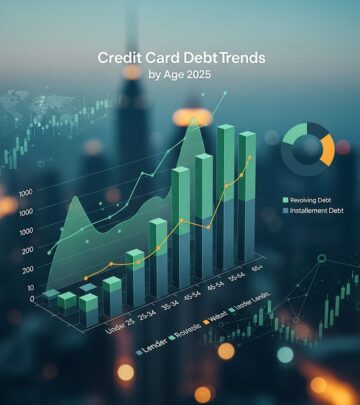
Generation X (born 1965-1980, ages 45-60 in 2026) carries the highest average balances, $8,000-$9,000 per Experian data. Inflation hits hard: 62% report heavier reliance, 39% have maxed cards, and 31% exceed $10,000 in debt.
Sandwiched between child-rearing and elder care, Gen X finances large expenses on cards. Men average mid-$6,000 balances, women slightly less but pay more frequently. They seek rate caps most urgently (43%).
| Generation | Avg. Balance | Max-Out Rate | >$10K Debt |
|---|---|---|---|
| Gen X | $8,000-$9,000 | 39% | 31% |
| Millennials | $6,500-$7,500 | 42% | 35% |
| Boomers | $4,000-$5,000 | 14% | N/A |
This table illustrates Gen X’s lead in debt metrics.
Millennials: Heavy Users in a High-Cost Era
Millennials (born 1981-1996, ages 30-44) mirror Gen X struggles, with 42% maxing cards and 66% using them to “get through the month.” Balances average $6,500-$7,500; 35% top $10,000.
49% own three-plus cards, favoring dining (23.46%) and grocery rewards (23.56%). Inflation forces 38% to eye rate relief, amid stagnant wages and housing costs.
- Reliance for month-end: 66%.
- High balances from essentials: Groceries up $200/month for families.
Gen Z: Cautious Entrants to Credit
Generation Z (born 1997-2012, young adults in 2026) shows restraint: 20% never use cards, only 29% have three or more. 60% obtained cards in early 20s, up from Millennials’ 54.5%.
- Non-users: 21%.
- Early adoption: 60% by early 20s.
- Desire flexibility: 35.7% want higher limits, 47.7% payment control.
Averages $4,000-$5,000 balances, but 56% tap cards for rising prices. Delinquencies rise fastest for 18-29 group due to rent and loans.
Beyond Generations: Gender, Race, and Income Factors
Men carry $300 more in balances than women, financing big-ticket items while women manage recurring bills. Racial gaps persist: White/Asian households $6,500-$8,000; Black/Hispanic $4,000-$6,000 but higher utilization.
Income plays key: Middle-income families newly exposed to revolving debt for food/housing. Single parents face elevated utilization from childcare/healthcare.
Rewards Preferences Across Age Groups
Younger users chase category rewards; Boomers spread broadly.
| Card Type | Gen Z | Millennials | Gen X | Boomers |
|---|---|---|---|---|
| Grocery | 19.36% | 27.77% | 23.56% | 23.75% |
| Gas | 19.97% | 27.48% | 23.72% | 23.91% |
| Dining | 18.96% | 27.65% | 23.30% | 23.46% |
Millennials lead rewards uptake.
Debt Management Challenges and Strategies
46% haven’t explored relief like transfers or counseling. Average American holds 3.9 cards; utilization drives 31% of retail spend. High rates (mid-20s) compound issues.
Strategies include balance transfers, budgeting apps, and rewards optimization. Gen Z prioritizes flexibility; Boomers focus payoff.
Future Outlook: Inflation’s Lasting Echo
With balances climbing, delinquencies up—especially young adults—experts urge education. BNPL rises 35.9% in 2026, tempting Gen Z alternatives. Proactive habits can mitigate risks.
Frequently Asked Questions
Which generation has the highest credit card debt?
Gen X, with averages $8,000-$9,000.
Do younger people use credit cards less?
Gen Z owns fewer cards (29% have 3+), 21% never use.
How has inflation affected card reliance?
56% Gen Z, 66% Millennials use for ends-meet.
What are average U.S. credit card balances by age?
Gen X highest; Boomers/Gen Z lowest at $4k-$5k.
Are men or women more indebted?
Men average $300 more.
References
- 2026 Survey: As Inflation Pressures Persist, Americans Are Increasingly Relying on Credit Cards — Debt.com via PR Newswire/Morningstar. 2026-03-16. https://www.morningstar.com/news/pr-newswire/20260316fl10002/…
- Credit Card Statistics 2026: 50 Key Facts to Know — Expensify. 2026. https://use.expensify.com/blog/credit-card-statistics
- The Average Credit Card Debt in America Hits a Record High — ElitePersonalFinance via Business Insider. 2026. https://markets.businessinsider.com/news/stocks/…
- FAQ on Credit Cards: Payment Networks, Generational Shifts — eMarketer. 2026. https://www.emarketer.com/content/faq-on-credit-cards…
- 2026 Credit Card Debt Statistics — LendingTree. 2026. https://www.lendingtree.com/credit-cards/study/credit-card-debt-statistics/
Similar Articles








Read full bio of Sneha Tete