Generational Auto Loan Trends
Discover how Baby Boomers, Gen X, Millennials, and Gen Z approach auto loans differently in terms of amounts, terms, rates, and debt burdens.
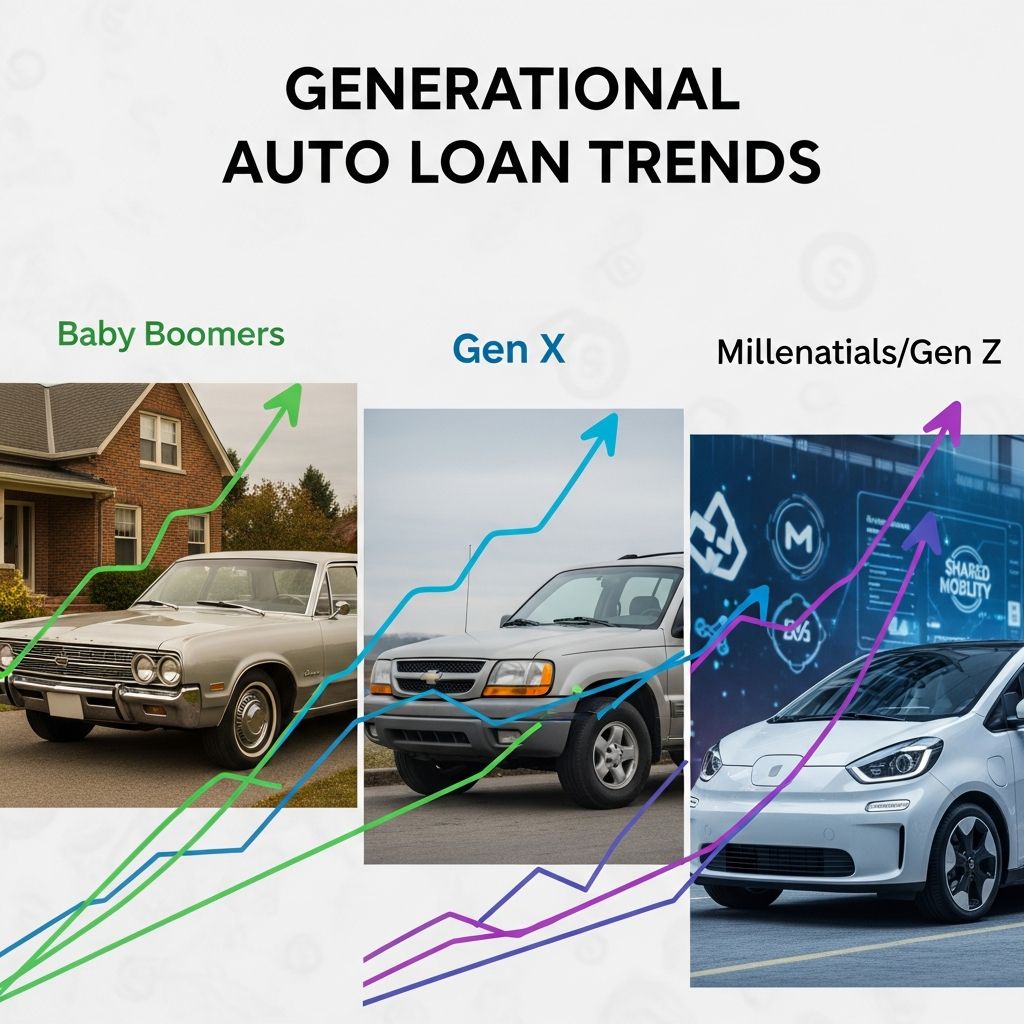
Auto loans represent a major portion of household debt, second only to mortgages, totaling $1.667 trillion in the U.S. as of late 2025. Borrowing patterns vary significantly across generations, influenced by life stages, economic conditions, and credit profiles. Younger cohorts like Gen Z and Millennials are driving higher volumes and payments, while older groups prioritize stability.
Current Landscape of Vehicle Financing
In Q4 2025, average new car loans reached $43,582, up from $42,332 the prior quarter, while used vehicle loans averaged $27,528. Monthly payments hit records: $767 for new cars, $537 for used, and $613 for leases. These figures reflect rising vehicle prices—new cars up 0.5% year-over-year per BLS data—and longer terms averaging 68.9 months for new vehicles.
Americans ages 18-49 originated $108.1 billion in auto debt in Q4 2025, outpacing the $72.3 billion from those 50+ by a wide margin. Those in their 30s ($39.4 billion) and 40s ($41.0 billion) led, followed by 18-29 year-olds ($27.7 billion), surpassing even 60+ borrowers.
Breaking Down Borrowing by Age Groups
Generational differences emerge clearly in loan volumes and preferences. Gen Z (born 1997-2012, roughly 14-29 in 2026) and younger Millennials (30-36) show aggressive borrowing tied to household formation and first major purchases.
- Younger Millennials saw average monthly payments rise nearly 60% since 2019, the steepest increase.
- Gen Z’s share of large payments (over $2,000 monthly) has grown over five years, signaling entry into vehicle ownership.
- 30s and 40s borrowers took the largest quarterly volumes, reflecting peak earning and family needs.
Baby Boomers (born 1946-1964, ages 62-80) and Gen X (1965-1980, ages 46-61) borrow less aggressively, often for replacements rather than upgrades.
Average Loan Amounts Across Credit Tiers
Credit scores heavily influence loan sizes. Prime and super-prime borrowers (661+) dominate 69.2% of financing. Here’s a comparison from Q4 2025 Experian data:
| Credit Score Range | New Vehicles | Used Vehicles |
|---|---|---|
| All | $43,582 | $27,528 |
| 781-850 (Super-Prime) | $41,695 | $29,836 |
| 661-780 (Prime) | $45,944 | $28,770 |
| 601-660 | $45,885 | $26,425 |
| 501-600 | $40,646 | $23,231 |
| 300-500 (Deep Subprime) | $36,236 | $21,427 |
Super-prime borrowers favor used vehicles with higher averages, while prime tiers lead new car loans. Subprime groups borrow less due to affordability constraints.
Payment Pressures by Generation
Monthly burdens have escalated unevenly. Younger Millennials’ payments are up 60% from 2019, Gen Z and older Millennials over 40%. The share of households paying over $500 monthly rose most for younger Millennials (33%), Gen Z (31%), versus 16% for Boomers.
New vehicle sales softened in early 2026 amid these pressures, with EV loans dropping sharply—Millennials pulling back most. Affordability challenges persist despite some rate relief; average 60-month new car rates fell from 7.9% peaks but stood at 6.98% in February 2026.
Leasing vs. Buying: Generational Preferences
Over 80% of purchase-intent consumers plan buys within 12 months, but leasing appeals more to youth: 17% of Gen Z/Millennials vs. 7% Boomers. This reflects desires for lower upfront costs and flexibility amid high prices (+39% for new cars over 8 years).
Leasing terms average 36.1 months with $613 payments, offering respite from ownership costs. Originations rose in 2025, led by super-prime and subprime segments anticipating tariffs and EV credit changes.
Impact on Credit and Debt Profiles
Auto debt is 8.9% of consumer obligations. Younger generations’ higher utilization strains scores, yet prime borrowers (661+) secure better rates. CFPB data shows origination volumes fluctuating by state, with recent upticks.
Equifax notes auto loans as the top non-mortgage debt, growing 5.1% YoY to August 2025 (+$22.6B), though pace slows amid affordability woes.
Market Outlook and Sales Projections
Despite headwinds, 2026 sales may hit 17 million units via incentives. Rates could ease if Fed cuts continue, reducing loan costs. Gen Z’s rising share signals long-term demand, but affordability remains key.
Factors Shaping Generational Choices
Economic Life Stages: Boomers refinance or downsize; Gen X balances family vehicles; Millennials upgrade for households; Gen Z enters market.
Rates and Prices: Rates doubled since 2021, amplifying payment hikes for youth financing larger cars.
EV and Alternatives: Younger groups show EV interest but retreat due to costs.
Strategies for Smarter Borrowing
- Shop rates across lenders; prime scores unlock best terms.
- Opt for shorter terms to cut interest, despite higher monthlies.
- Consider used/certified pre-owned to avoid new-car premiums.
- Build credit pre-purchase; avoid subprime pitfalls.
- Budget holistically—payments now exceed 10% of income for many youth.
Frequently Asked Questions
What generation borrows the most for cars?
Ages 18-49 originated $108.1B in Q4 2025, led by 30s/40s.
Are auto loan payments rising?
Yes, new car averages hit $767 in Q4 2025, up 2.8% YoY; youth see 40-60% hikes since 2019.
Do credit scores affect loan amounts?
Significantly—prime borrowers average $45K+ for new cars vs. $36K for deep subprime.
Is leasing popular with young buyers?
Yes, 17% of Gen Z/Millennials plan leases vs. 7% Boomers.
What’s the average auto loan term?
68.9 months new, 67.7 used, 36.1 leased.
Generational trends underscore the need for tailored financial planning in a high-cost auto market.
References
- Autos: Stuck in a lower gear? — Bank of America Institute. 2026. https://institute.bankofamerica.com/content/dam/economic-insights/auto-demand-update.pdf
- Average Car Payment and Auto Loan Statistics: 2026 — LendingTree. 2026. https://www.lendingtree.com/auto/debt-statistics/
- Consumer Auto Survey Feb 2026 — TransUnion Newsroom. 2026-02. https://newsroom.transunion.com/consumer-auto-survey-feb-2026/
- Origination Activity — Consumer Financial Protection Bureau. 2026. https://www.consumerfinance.gov/data-research/consumer-credit-trends/auto-loans/origination-activity/
- Auto Insights for 2026 — Equifax. 2026-01. https://assets.equifax.com/marketing/US/assets/auto-insights-jan-2026.pdf
- Historical auto loan rates in U.S. 2014-2026 — Statista. 2026. https://www.statista.com/statistics/290673/auto-loan-rates-usa/
- US Auto Market Trends 2026 — Morningstar. 2026. https://www.morningstar.com/business/insights/us-auto-market-trends
Similar Articles








Read full bio of medha deb