Gearing Ratio: Definition, Formula, and Financial Analysis
Master gearing ratios: Understand financial leverage, calculate debt-to-equity, and assess company risk.
What Is a Gearing Ratio?
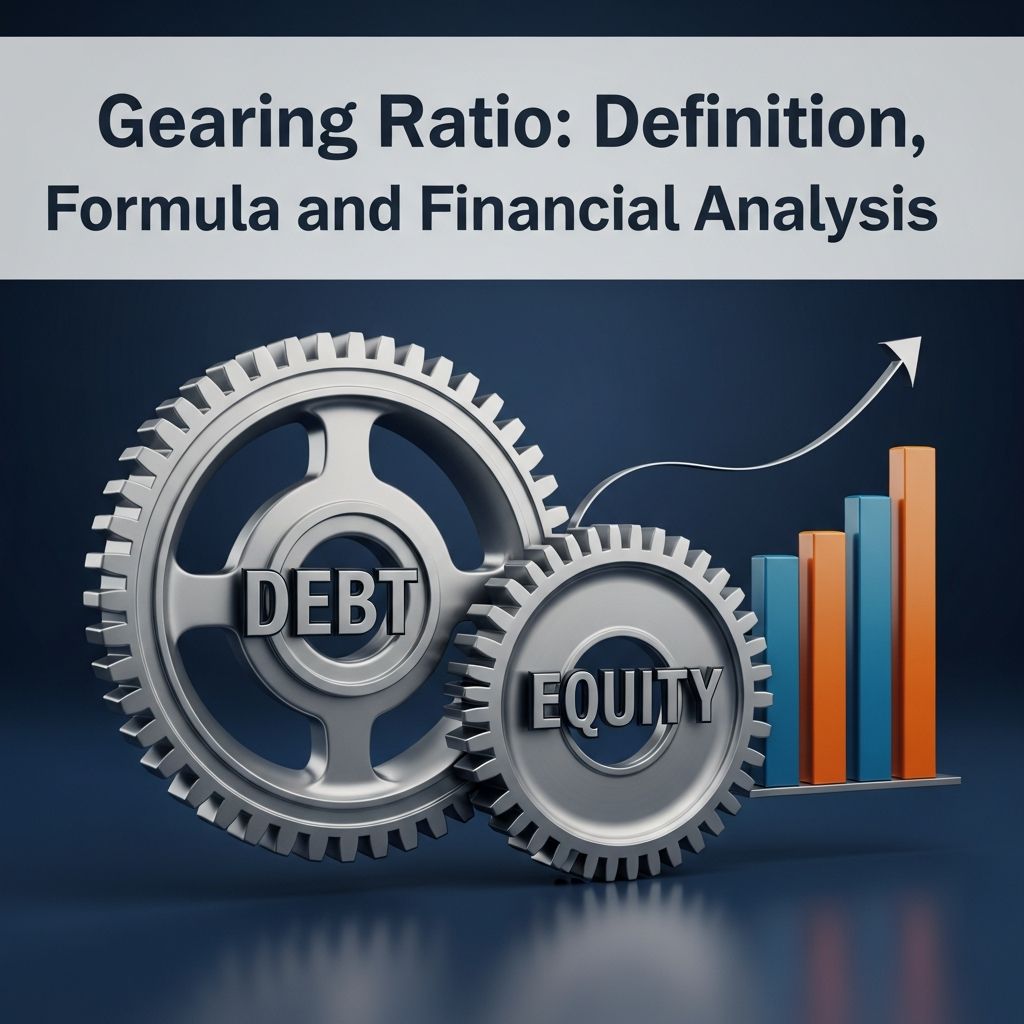
A gearing ratio is a financial metric that measures the proportion of debt and equity used to finance a company’s operations and assets. Also referred to as leverage ratios, gearing ratios represent the extent to which a company relies on borrowed money versus shareholder capital to fund its business activities. The term “gearing” originates from mechanical engineering, where gears amplify force; similarly, financial gearing amplifies returns—and risks—through the use of debt.
Gearing ratios serve as critical indicators of a company’s financial structure and risk profile. A high gearing ratio indicates that a company is heavily financed by debt relative to equity, which increases financial risk but may also amplify returns on equity. Conversely, a low gearing ratio suggests a more conservative capital structure with greater reliance on equity financing, typically indicating lower financial risk but potentially lower returns for shareholders.
Understanding gearing ratios is essential for investors, lenders, and company management when making decisions about capital allocation, lending, and investment strategies. These ratios provide insight into whether a company’s financing decisions are sustainable and aligned with industry standards.
Understanding Gearing Ratios and Financial Leverage
Financial leverage refers to the use of borrowed money to amplify investment returns. When a company takes on debt, it creates financial leverage that can either enhance or diminish shareholder returns depending on how effectively the borrowed funds are deployed. The gearing ratio quantifies this leverage by comparing debt to equity in the company’s capital structure.
The relationship between gearing and financial leverage is direct: higher gearing means greater financial leverage, which intensifies both potential gains and losses. During economic expansion, highly geared companies may generate substantial returns on equity. However, during economic downturns or periods of declining revenue, the fixed obligation to service debt becomes burdensome, potentially leading to financial distress.
Companies must balance the benefits of financial leverage—such as tax deductions on interest payments and the preservation of ownership through debt rather than equity issuance—against the risks of increased financial obligations and reduced flexibility during challenging times.
Common Types of Gearing Ratios
Several gearing ratios exist to evaluate a company’s capital structure from different perspectives. Each ratio provides unique insights into how a company finances its operations:
Debt-to-Equity (D/E) Ratio
The debt-to-equity ratio is perhaps the most widely used gearing metric. It divides total debt by total equity to show the proportion of debt and equity financing. The formula is:
D/E Ratio = Total Debt ÷ Total Equity
A D/E ratio of 1.0 means the company has equal amounts of debt and equity financing. A ratio above 1.0 indicates more debt than equity, while a ratio below 1.0 indicates more equity than debt. This ratio directly reflects the financial risk associated with the company’s capital structure.
Equity Ratio
The equity ratio measures the proportion of a company’s total assets financed by shareholders’ equity. The formula is:
Equity Ratio = Total Equity ÷ Total Assets
This ratio indicates what percentage of company assets are owned outright by shareholders versus financed through debt. A higher equity ratio suggests a stronger financial position and lower financial risk, as more assets are funded by equity capital rather than borrowed funds.
Debt Ratio
The debt ratio shows what proportion of a company’s total assets are financed through debt. The formula is:
Debt Ratio = Total Debt ÷ Total Assets
This metric provides a straightforward view of asset financing sources. A debt ratio of 0.4 means that 40% of assets are financed by debt, while 60% are financed by equity. Lower debt ratios generally indicate more conservative financing and reduced financial risk.
How to Calculate Gearing Ratios
Calculating gearing ratios requires accurate financial data from a company’s balance sheet. The process involves identifying total debt obligations, total equity, and total assets, then applying the appropriate formula.
Step-by-Step Calculation Process
Step 1: Gather Financial Data — Obtain the company’s balance sheet, which should include total debt (both short-term and long-term liabilities), total equity (shareholders’ equity), and total assets.
Step 2: Calculate Total Debt — Sum all debt obligations, including short-term loans, long-term bonds, mortgages, and other interest-bearing liabilities.
Step 3: Identify Total Equity — This represents the company’s net worth and includes common stock, retained earnings, and other shareholder contributions.
Step 4: Apply the Formula — Use the appropriate gearing ratio formula based on what aspect of capital structure you want to analyze.
Example Calculation
Consider a company with the following financial data:
- Total Debt: $100 million
- Total Equity: $150 million
- Total Assets: $250 million
D/E Ratio = $100 million ÷ $150 million = 0.67
Equity Ratio = $150 million ÷ $250 million = 0.60 or 60%
Debt Ratio = $100 million ÷ $250 million = 0.40 or 40%
These calculations show that the company finances 40% of its assets through debt and 60% through equity, with a debt-to-equity ratio of 0.67, indicating moderate financial leverage.
What Is a Good Gearing Ratio?
Determining whether a gearing ratio is “good” depends on multiple factors, including industry standards, company lifecycle stage, and economic conditions. There is no universal benchmark; instead, gearing ratios should be evaluated contextually.
Industry Considerations
Different industries have different optimal gearing ratios based on their operational characteristics. Capital-intensive industries such as utilities, telecommunications, and infrastructure typically operate with higher gearing ratios because they require substantial upfront investments and generate stable, predictable cash flows. These companies can safely handle higher debt levels.
Conversely, cyclical industries or those with volatile revenues, such as retail or technology startups, typically maintain lower gearing ratios to preserve financial flexibility during downturns. Software companies and professional services firms often operate with conservative capital structures.
General Guidelines
As a general rule, a lower gearing ratio indicates lower financial risk and greater financial stability. Most financial analysts consider D/E ratios below 1.0 to be relatively conservative, while ratios above 2.0 suggest aggressive leverage. However, these benchmarks are not absolute rules but rather guidelines that should be compared against industry peers.
A company with a D/E ratio of 0.5 generally has lower financial risk than one with a ratio of 1.5, assuming both operate in the same industry. Similarly, comparing a company’s current gearing ratio to its historical ratios reveals trends in financial strategy and capital structure evolution.
High vs. Low Gearing Ratios
| Aspect | High Gearing Ratio | Low Gearing Ratio |
|---|---|---|
| Financial Risk | Higher risk; company is vulnerable to economic downturns | Lower risk; company has more financial flexibility |
| Interest Obligations | Substantial fixed debt service costs that must be met | Minimal interest obligations; more cash available for operations |
| Return on Equity | Potentially higher ROE if investments are profitable | Lower ROE due to reduced financial leverage |
| Borrowing Capacity | Limited ability to raise additional debt financing | Greater capacity to borrow for growth opportunities |
| Investor Appeal | May be viewed as risky; attracts risk-tolerant investors | Generally attracts conservative investors seeking stability |
| Default Risk | Higher default risk during revenue shortfalls | Lower default risk; easier debt servicing |
How Lenders Use Gearing Ratios
Lenders rely heavily on gearing ratios when making credit decisions. Before extending loans or credit facilities, financial institutions assess whether borrowers can reliably service debt obligations from operational cash flows.
A company with a high existing gearing ratio presents higher default risk and may face difficulty obtaining new financing or may be offered credit only at higher interest rates. Conversely, companies with conservative gearing ratios are viewed as more creditworthy and typically secure favorable lending terms.
Lenders also monitor gearing ratios over time to ensure that borrowing companies maintain acceptable leverage levels. Loan covenants often include provisions that restrict gearing ratios, requiring companies to maintain ratios below specified thresholds to remain in compliance.
How Investors Use Gearing Ratios
Investors use gearing ratios to evaluate investment risk and potential returns. Equity investors particularly focus on gearing ratios because they affect both risk profile and return on equity.
A company with high gearing amplifies shareholder returns during profitable periods but also amplifies losses during downturns. Conservative investors typically prefer companies with lower gearing ratios and more stable capital structures. Growth-oriented investors may accept higher gearing if they believe the company can generate sufficient returns to justify the additional risk.
When comparing potential investments, investors often analyze gearing ratios alongside profitability metrics, growth rates, and cash flow generation capabilities to form comprehensive investment theses.
Gearing Ratios and Financial Risk
The primary purpose of gearing ratio analysis is to assess financial risk. A highly geared company faces several risks:
A highly geared company must generate sufficient cash flows to meet both operational expenses and debt service requirements. During economic contractions or industry downturns, revenue may decline while debt obligations remain fixed, creating cash flow shortages. This situation may force companies to reduce capital investments, cut dividends, or in severe cases, default on debt obligations.
Companies with high gearing ratios have less financial flexibility to respond to unexpected challenges or pursue strategic opportunities. They cannot easily access additional financing because lenders view them as higher-risk borrowers, and they may be unable to pay shareholders dividends if cash is needed for debt service.
When Companies Increase Gearing
Companies strategically increase gearing in several situations where the benefits of additional leverage outweigh the risks:
Preserving Ownership
Company owners often prefer debt financing over equity because debt does not dilute ownership stakes. By issuing debt rather than stock, founders and existing shareholders maintain their proportional ownership and control of the company.
Financing Major Acquisitions
When pursuing significant acquisitions or investments, companies may temporarily increase gearing to rapidly access large amounts of capital. Profitable companies can use borrowed funds to generate additional revenues and service debt from returns on investments.
Taking Advantage of Low Interest Rates
During periods of historically low interest rates, companies may strategically increase leverage to finance growth initiatives at favorable borrowing costs, particularly if they expect investment returns to exceed borrowing costs.
Comparing Gearing Ratios Across Companies
Gearing ratios are most meaningful when compared against industry benchmarks and competitor ratios. A company with a 60% gearing ratio might appear high in isolation, but if industry competitors average 75% to 80%, the company is actually performing conservatively relative to peers.
When comparing gearing ratios, ensure that companies use consistent accounting methods and that you’re analyzing comparable periods. International companies may present financial statements using different accounting standards, potentially affecting gearing ratio calculations.
Limitations of Gearing Ratios
While gearing ratios provide valuable insights, they have limitations that should be recognized:
Gearing ratios provide only a snapshot of capital structure at a specific point in time. They don’t reflect seasonal variations, planned refinancing activities, or expected changes in the business. Additionally, gearing ratios don’t directly measure cash flow generation capabilities; a company with moderate gearing but weak operational performance may be riskier than a highly geared company with strong cash generation.
Different accounting treatments for items like operating leases or pension obligations can affect reported debt levels and therefore gearing ratios. Analysts should adjust for these differences when comparing companies across regions or industries.
Frequently Asked Questions (FAQs)
Q: What is the difference between gearing ratio and debt-to-equity ratio?
A: Gearing ratio is an umbrella term for leverage ratios that measure financial structure, while the debt-to-equity ratio is the most common specific gearing ratio. The D/E ratio divides total debt by total equity and is frequently used interchangeably with the term “gearing ratio.”
Q: Is a gearing ratio of 50% considered high or low?
A: A 50% gearing ratio (where debt equals 50% of assets) is generally considered moderate and reasonable for most industries. Whether it’s high or low depends on industry norms; utilities might consider 50% conservative while technology companies might view it as aggressive.
Q: How does gearing ratio affect stock price?
A: High gearing can increase financial risk, potentially leading to lower stock valuations as investors demand higher risk premiums. However, moderate gearing combined with strong profitability can enhance returns on equity, supporting higher stock prices.
Q: Can a company have zero gearing?
A: Yes, a company financed entirely through equity has zero gearing and zero financial leverage. However, most established companies use some debt in their capital structure because debt financing offers tax advantages and is often cheaper than equity.
Q: Why is gearing ratio important for creditworthiness assessment?
A: Gearing ratios reveal how much of a company’s asset base is financed through debt, which directly indicates the company’s ability to service debt obligations. Lenders use these ratios to determine default risk and appropriate lending terms.
References
- Gearing – Definition, Ratio, Risk, Uses, Example — Corporate Finance Institute. 2025. https://corporatefinanceinstitute.com/resources/accounting/gearing/
- Gearing Ratio: Definition, Types, & Calculation Method — Allianz Trade. 2025. https://www.allianz-trade.com/en_US/insights/gearing-ratio.html
- Gearing Ratio | Formula + Calculator — Wall Street Prep. 2025. https://www.wallstreetprep.com/knowledge/gearing-ratio/
Similar Articles








Read full bio of Sneha Tete