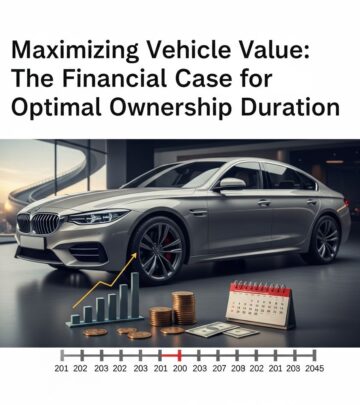
Frugal Transportation Choices Enable Early Retirement
How strategic vehicle ownership decisions accelerate wealth accumulation and retirement timelines.

The journey toward early retirement requires intentional decisions across multiple spending categories. While many people focus on dramatic lifestyle changes or investment strategies, one of the most overlooked opportunities lies in transportation decisions. By adopting a deliberate approach to vehicle ownership—choosing reliable, established models and maintaining them properly—individuals can redirect thousands of dollars annually toward wealth-building activities. This seemingly modest decision creates a compounding effect that substantially accelerates retirement timelines.
Understanding the True Cost of Vehicle Ownership
Most people underestimate the total financial burden of vehicle ownership. The purchase price represents only a fraction of the lifetime cost. According to transportation analysis, vehicle ownership encompasses depreciation, fuel consumption, insurance premiums, maintenance, repairs, registration fees, and potentially financing charges. For individuals pursuing early retirement, these accumulated expenses can easily consume 15-20% of household income.
When targeting financial independence, every dollar matters. Transportation expenses that could instead flow into tax-advantaged retirement accounts, index funds, or other investment vehicles represent lost compounding opportunities. Over a 20-30 year accumulation period, this distinction becomes profound.
The Strategic Case for Older, Reliable Vehicles
Conventional wisdom suggests that newer vehicles are more reliable and cost-effective. However, this reasoning overlooks a critical factor: depreciation. New vehicles lose 20-30% of their value within the first year and continue depreciating significantly for the first five years. Someone purchasing a $35,000 vehicle new will see it worth approximately $18,000-20,000 after five years.
By contrast, an 8-18 year old vehicle with established reliability records has already experienced the steepest depreciation curve. While such vehicles do have higher mileage, modern automotive engineering has extended vehicle lifespans considerably. Many vehicles regularly exceed 200,000 miles when properly maintained. The depreciation curve flattens substantially at this age range, meaning annual value loss becomes minimal.
This economic reality creates an opportunity: purchase a vehicle with a proven track record of reliability, maintain it diligently, and avoid the wealth destruction associated with new vehicle depreciation.
Calculating the Retirement Impact of Transportation Choices
To understand the magnitude of this impact, consider two scenarios over a 20-year accumulation period:
Scenario A: Purchasing new vehicles every 5-7 years
- Average vehicle purchase price: $35,000
- Residual value after ownership: $18,000
- Net cost per vehicle: $17,000
- Vehicles purchased in 20 years: 3 units
- Total depreciation loss: $51,000
- Average annual maintenance and repairs: $1,200
- Insurance premiums (new vehicle rates): $1,400/year
- Total 20-year transportation costs: $75,000+
Scenario B: Purchasing an older reliable vehicle and maintaining it long-term
- Purchase price for established 8-year-old model: $12,000
- Residual value after 12-year ownership: $4,000
- Net cost: $8,000
- Annual maintenance and repairs (higher for older vehicle): $1,800
- Insurance premiums (lower for older vehicle): $900/year
- Total 20-year transportation costs: $44,000+
The difference: approximately $31,000 over 20 years. When invested at conservative 7% annual returns, that $31,000 redirected from transportation to investments grows to approximately $120,000 by retirement. This calculation excludes opportunity costs from financing new vehicles, which further widens the gap.
Selecting Vehicles Built for Longevity
Not all older vehicles represent equal opportunities. Certain manufacturers and models have demonstrated exceptional longevity when properly maintained. Japanese automakers particularly excel in this regard, with models specifically engineered for durability and efficient operation across high mileage ranges.
When evaluating an older vehicle purchase, research becomes essential. Examine reliability ratings from independent sources, review common failure points for specific models, and inspect maintenance records. A vehicle that cost less initially but requires expensive transmission repairs at 120,000 miles erases any savings advantage.
The optimal strategy involves purchasing a vehicle when it reaches the 6-10 year age range, after initial depreciation but before major component failures become likely. At this point, you benefit from significantly lower purchase prices while retaining the vehicle’s productive lifespan.
Maintenance: The Foundation of Long-Term Vehicle Economics
Proper maintenance transforms older vehicle ownership from a financial gamble into a reliable strategy. Preventive maintenance costs far less than emergency repairs. An engine that receives regular oil changes and filter replacements operates reliably for hundreds of thousands of miles. Conversely, neglected maintenance leads to cascading failures that rapidly exhaust a vehicle’s economic utility.
Essential maintenance practices include:
- Oil and filter changes at manufacturer-recommended intervals (typically 5,000-10,000 miles)
- Fluid level checks and replacements (coolant, transmission fluid, brake fluid)
- Tire rotation and replacement to ensure even wear
- Brake inspection and service before components fail
- Air filter and cabin filter replacements
- Battery testing and replacement as needed
- Timing belt replacement at manufacturer intervals (critical for certain engines)
These routine costs—typically $1,500-2,500 annually—preserve asset value and prevent catastrophic failures. For context, a transmission replacement can cost $3,000-5,000. A single deferred maintenance decision can eliminate years of savings benefits.
Insurance and Registration Economics
Older vehicles typically qualify for substantially lower insurance premiums. Insurance companies base rates partially on replacement cost; a vehicle worth $4,000 generates lower liability exposure than one worth $35,000. Additionally, comprehensive and collision coverage becomes less economically necessary for older vehicles, allowing owners to increase deductibles or eliminate optional coverage entirely.
Registration fees also decline with vehicle age. Many jurisdictions base registration costs on vehicle value, creating additional annual savings. These cumulative insurance and registration benefits can exceed $5,000-8,000 over the vehicle’s ownership period.
Fuel Efficiency Considerations
One legitimate concern about older vehicles involves fuel efficiency. Modern engines incorporate technology that older models lack, sometimes achieving 10-15% better fuel economy. However, this advantage must be weighed against purchase price and depreciation differences.
Even accounting for higher fuel consumption, the economics often favor older vehicles. A 15% fuel efficiency penalty costs approximately $300-500 annually for average drivers. This pales compared to the depreciation savings from avoiding new vehicle purchases.
Psychological Factors and Lifestyle Alignment
Beyond pure financial calculations, adopting a long-term vehicle ownership strategy aligns with the psychological aspects of successful early retirement. Individuals focused on financial independence typically embrace intentional consumption patterns. They recognize that vehicle brand status or newness provides marginal lifestyle improvements that don’t justify significant financial costs.
This mindset extends throughout the retirement journey. People comfortable driving an 14-year-old vehicle comfortably have typically already reframed their relationship with consumption. They prioritize experiences, relationships, and financial security over status symbols. This psychology becomes increasingly valuable as retirement approaches, since sustainable retirement requires contentment with simpler consumption patterns.
The Reinvestment Multiplier Effect
The true power of transportation cost reduction emerges through reinvestment. Money not spent on vehicle depreciation, insurance premiums, and financing charges flows into tax-advantaged retirement accounts. According to advanced retirement planning strategies, maximizing contributions to tax-deferred accounts like 401(k)s and Roth IRAs creates powerful compounding opportunities.
In 2026, maximum 401(k) contributions reach $24,500, with additional $8,000 catch-up provisions for those 50 and older. Individuals pursuing early retirement benefit enormously from maximizing these contribution limits. Transportation savings directly enable higher retirement account contributions that grow tax-free or tax-deferred for decades.
For someone in their 40s with 20-25 years until traditional retirement, redirecting $1,500 annually from transportation costs into retirement accounts creates compounding effects that genuinely accelerate retirement timelines by years.
Addressing Common Objections
Reliability concerns: Modern vehicles, even those 10-15 years old, demonstrate exceptional reliability when maintained properly. Catastrophic failures occur rarely in well-maintained vehicles.
Repair costs: While individual repairs may cost more on older vehicles, the total repair spending remains lower than depreciation and financing costs on new vehicles, particularly when preventive maintenance occurs consistently.
Safety technology: Newer safety features provide genuine benefits, but prioritizing safety doesn’t require purchasing new vehicles. Selecting inherently safe models from reputable manufacturers addresses safety concerns effectively.
Environmental impact: Manufacturing vehicles generates substantial environmental costs. Operating an existing reliable vehicle typically produces lower total environmental impact than manufacturing and disposing of newer models more frequently.
Integration with Comprehensive Retirement Planning
Transportation decisions represent just one component of comprehensive early retirement planning. However, they exemplify how attention to seemingly mundane spending categories creates genuine acceleration toward financial independence. Someone who reduces transportation costs by $30,000-40,000 while also optimizing other spending categories can potentially accelerate retirement by several years.
According to early retirement analysis, financial flexibility proves critical for navigating market risks and economic uncertainty. By reducing fixed expenses through strategic vehicle ownership, early retirees create greater flexibility in their retirement withdrawals, reducing portfolio stress during market downturns.
Getting Started with Strategic Vehicle Ownership
Implementing this strategy involves several concrete steps. First, research vehicle models known for reliability and longevity, particularly focusing on Japanese manufacturers with established track records. Second, identify your current transportation needs honestly—avoid purchasing capacity you don’t genuinely require. Third, locate a well-maintained vehicle in the 6-12 year age range matching your needs. Fourth, establish a disciplined maintenance schedule and budget, treating maintenance as non-negotiable investment rather than optional expense.
Finally, commit to owning the vehicle for the long term. The strategy’s benefits accumulate over extended ownership periods. Someone who purchases an older vehicle but replaces it every 3-4 years fails to capture the full benefit of eliminated depreciation costs.
Conclusion: Small Decisions, Substantial Outcomes
Transportation represents one of the largest controllable expenses in most household budgets. By approaching vehicle ownership strategically—selecting reliable models, maintaining them diligently, and holding them long-term—individuals pursuing early retirement can redirect tens of thousands of dollars toward wealth-building activities. This relatively simple decision, sustained over decades, can accelerate retirement timelines by years while simultaneously reducing the financial stress of vehicle ownership. In the context of comprehensive early retirement planning, few decisions offer better returns on the mental and financial effort required to implement them.
References
- Strategies for Retirement Planning in 2026 — Commons LLC. 2026. https://www.commonsllc.com/insights/strategies-for-retirement-planning
- 7 Smart Money Moves for 2026 Retirement Planning — Fidelity Learning Center. 2026. https://www.fidelity.com/learning-center/personal-finance/retirement/2026-money-moves
- 5 New Retirement Rules Taking Effect in 2026 — Kiplinger. 2026. https://www.kiplinger.com/retirement/retirement-planning/new-retirement-rules-taking-effect-in-2026-whats-different-for-your-money
- Early Retirement Planning 2026: Flexibility Key to Navigating Market Risks — IndexBox. 2026. https://www.indexbox.io/blog/navigating-early-retirement-financial-flexibility-and-market-risks-in-2026/
Similar Articles








Read full bio of Sneha Tete