Free Enterprise: Definition, Principles, and Economic Impact
Understanding free enterprise: Market-driven economies, capitalism, and the role of government.

Understanding Free Enterprise: The Foundation of Market-Driven Economics
Free enterprise represents an economic system where market forces—rather than government intervention—determine the prices, supply, and demand of goods and services. Also known as a free market system, free enterprise empowers the private sector to make independent economic decisions about what to buy, sell, produce, and how much to work or invest. This system operates on the principle of laissez-faire economics, which suggests that markets function optimally with minimal government interference.
The concept of free enterprise has shaped economic policy across the globe, influencing how businesses operate, how consumers make purchasing decisions, and how wealth is distributed throughout society. Unlike centrally planned economies where government officials determine production and consumption patterns, free enterprise systems allow individuals and organizations to pursue their own economic interests, theoretically leading to greater innovation, efficiency, and prosperity.
The Four Core Components of Free Enterprise
Free enterprise is built upon four fundamental economic units, each playing a distinct role in sustaining the system:
- Consumers: Individuals who purchase goods and services based on their preferences and purchasing power
- Producers: Businesses and entrepreneurs who create goods and services to meet consumer demand
- Workers: Employees who provide labor in exchange for wages and compensation
- Investors: Capital providers who fund business ventures with the expectation of returns
These four components interact dynamically within free enterprise systems. Consumers express their preferences through purchasing decisions, producers respond by creating desired goods and services, workers enable production through their labor, and investors provide the capital necessary for business expansion and innovation. This interconnected system creates a self-regulating mechanism where supply naturally adjusts to meet demand.
The Four Basic Principles of American Free Enterprise
The American economic system is founded on several key principles that define how free enterprise operates:
- Economic Freedom: Individuals and businesses have the right to make their own economic choices without coercion from government or other entities
- Voluntary Exchange: All transactions are based on mutual agreement, with both parties benefiting from the exchange
- Private Property Rights: Individuals and organizations can own, control, and profit from their assets
- Competition: Multiple producers compete to meet consumer needs, driving innovation and efficiency
These principles work together to create an environment where personal freedom drives economic activity. No individual is forced to buy or sell anything against their will. Both sellers and buyers benefit from transactions—sellers earn profits while buyers obtain desired goods or services. This mutual benefit creates incentives for entrepreneurialism and business development.
Personal Freedom and Market Expression
At its core, free enterprise is built upon personal freedom. Individuals maintain the liberty to make economic decisions that align with their values, preferences, and circumstances. This freedom extends beyond simple purchasing decisions to include career choices, investment decisions, and business ventures.
Free markets benefit society by allowing households to express individual tastes and preferences. Rather than having a central authority determine what gets produced or consumed, consumers vote with their dollars, signaling to producers which products and services have value. This decentralized decision-making process often results in greater innovation, as producers constantly seek new ways to attract consumers and differentiate themselves from competitors.
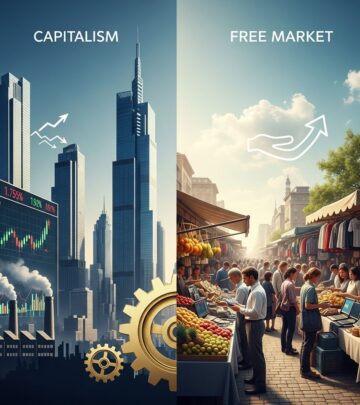
Free Enterprise vs. Capitalism: Understanding the Distinction
A common misconception equates free enterprise with capitalism, but these terms represent distinct concepts with important differences:
| Aspect | Free Enterprise | Capitalism |
|---|---|---|
| Definition | Economic system based on free, open markets without government interference | Economic system where individuals pursue profit through privately owned capital assets |
| Government Role | Minimal government intervention in markets | Can coexist with government controls and restrictions |
| Market Freedom | Requires open competition and market access | Can exist even with state-guided controls limiting sectors |
| Focus | System structure emphasizing freedom and open markets | Ownership model emphasizing private capital deployment |
Free enterprise is fundamentally an economic system based on open markets and minimal government interference. Capitalism, by contrast, is an ownership model where capitalists deploy privately owned capital assets—such as factories, mines, and equipment—to generate profits for themselves. While these concepts often coexist, they can exist independently.
Throughout history, economists have recognized that capitalism can thrive even without free enterprise. John Maynard Keynes argued in 1936 that state intervention and capitalism can successfully coexist. State-guided capitalism represents an extreme example, where governments control which economic sectors are permitted to grow while maintaining private ownership of capital assets. In essence, free enterprise allows for capitalism to exist, but the opposite is not always true—capitalism can and does flourish even without free enterprise or truly free markets.
The Reality of Free Enterprise in Modern Economies
While many countries claim to embrace free enterprise principles, no economy operates with a completely hands-off, purely free market system. In practice, most economies occupy a middle ground, combining market forces with varying degrees of government intervention.
Why Pure Free Enterprise Doesn’t Exist
Governments typically implement various controls and restrictions to achieve important social objectives. Countries may restrict certain imports or exports to protect domestic industries, implement environmental regulations to safeguard natural resources, or establish consumer protection laws to ensure product safety. Additionally, governments employ fiscal and monetary policies to influence economic growth rates and stability.
The United States, often perceived as the epitome of free enterprise, is actually better described as a hybrid economy. While most American industries are dominated by private enterprises operating with substantial freedom, the economy includes government subsidies, tariffs, environmental regulations, and financial rules that restrict pure competition. These interventions exist despite theoretical free enterprise ideals, reflecting the practical reality that some government involvement serves important public interests.
Three Levels of Free Market Economies
Economists generally categorize free market economies into three levels based on the degree of government intervention:
- Highly Free Economies: Minimal government intervention with strong property rights protection and low regulatory burden
- Moderately Free Economies: Balanced government intervention with regulations designed to protect consumers, workers, and the environment while maintaining competitive markets
- Controlled Economies: Substantial government involvement in market decisions, production planning, and price controls, though still maintaining elements of private enterprise
Most developed nations fall within the moderately free category, implementing strategic government involvement while preserving market competition and private enterprise.
The Benefits and Challenges of Free Enterprise
Theoretical Advantages
Free enterprise systems offer compelling theoretical benefits. Market competition drives innovation as producers continually seek ways to improve products and reduce costs. Consumer choice ensures that resources flow toward products and services people actually want. Individual economic freedom allows people to pursue careers and investments aligned with their talents and interests. The profit motive incentivizes productive behavior and efficiency.
Practical Challenges Without Government Intervention
While theoretically appealing, pure free enterprise systems face real-world challenges that necessitate some government involvement:
- Market Failures: Without incentives, certain economically important activities may not occur. For example, during the COVID-19 pandemic, many countries lacked adequate domestic pharmaceutical manufacturing capacity. Governments intervened to build these critical facilities, recognizing that private markets alone wouldn’t make the necessary investments
- Underserved Populations: In a completely free market, certain consumer groups may remain underserved. Internet service providers, for instance, might decline to invest in infrastructure for remote areas where small populations don’t justify the expenditure, leaving those communities without essential services
- Consumer Safety Issues: Without regulation, some enterprises might prioritize short-term profits over consumer welfare. The 2008 tainted milk powder scandal in China demonstrated how unregulated greed can endanger public health when manufacturers cut corners on safety standards
- Systemic Economic Risks: Pure free markets lack mechanisms to address systemic financial crises. During the 2009 European Sovereign Debt Crisis, intervention from other nations and supranational organizations prevented economic collapse. In a truly free enterprise system with no government interference, such crises could spiral catastrophically
The Role of Government in Modern Free Enterprises
Contemporary economies recognize that strategic government involvement enhances rather than undermines free enterprise. Governments establish frameworks that enable markets to function effectively while protecting essential public interests. Antitrust laws prevent monopolistic practices, environmental regulations ensure sustainable business practices, labor laws protect workers’ rights, and financial regulations prevent systemic economic breakdowns.
This balanced approach allows free enterprise principles to flourish within guardrails that prevent exploitation and market failures. Rather than viewing government as inherently opposed to free enterprise, modern economies understand that appropriate regulation creates conditions where free markets can operate most effectively and sustainably.
Free Enterprise in the Global Context
International commerce has become increasingly integrated, with free enterprise principles shaping trade relationships and foreign investment policies. However, even as globalization promotes market opening, countries maintain selective protections for strategic industries, national security interests, and emerging domestic sectors. Trade agreements balance commitments to market opening with flexibility for countries to implement policies serving their national interests.
The evolution of free enterprise globally demonstrates that economies are pragmatic, adapting market principles to local circumstances, cultural values, and development stages. Developing nations often implement more government involvement to build industrial capacity, while wealthy nations with established markets can afford greater economic freedom.
Frequently Asked Questions
Q: Is the United States a pure free enterprise economy?
A: No. While the U.S. economy is heavily driven by private enterprise and market forces, it incorporates significant government involvement through subsidies, tariffs, environmental regulations, financial regulations, and other interventions. It’s more accurately described as a mixed or hybrid economy rather than a pure free enterprise system.
Q: What’s the difference between free enterprise and capitalism?
A: Free enterprise is an economic system emphasizing minimal government intervention in markets. Capitalism is an ownership model where private capital is deployed to generate profits. While often linked, capitalism can exist with substantial government controls, while free enterprise requires open markets. Free enterprise allows capitalism to flourish, but capitalism doesn’t require free enterprise.
Q: Does any country have a completely free enterprise economy?
A: No. All modern economies incorporate some level of government intervention through regulations, taxes, trade policies, and other mechanisms. Pure free enterprise remains a theoretical concept rather than a practiced reality, as governments necessarily implement rules protecting consumers, workers, the environment, and financial stability.
Q: Why do governments intervene in free enterprise systems?
A: Governments intervene to address market failures, protect consumers and workers, safeguard the environment, ensure financial stability, prevent monopolies, and provide essential services that private markets may not supply profitably. Strategic intervention enhances rather than undermines free enterprise functionality.
Q: How do free markets benefit society?
A: Free markets allow individuals to express preferences through purchasing decisions, driving innovation and efficiency. Competition encourages businesses to improve products and reduce costs. Consumer choice ensures resources flow toward valued goods and services. Individual economic freedom promotes entrepreneurship and allows people to pursue aligned careers and investments.
References
- Free Enterprise – Definition, How It Works, Characteristics — Corporate Finance Institute. 2024. https://corporatefinanceinstitute.com/resources/economics/free-enterprise/
- Capitalism and the Mixed Economy — U.S. Bureau of Labor Statistics. 2024. https://www.bls.gov/
- Market Economies and Government Intervention — International Monetary Fund. 2024. https://www.imf.org/
- Understanding Laissez-Faire Economics — Federal Reserve System. 2024. https://www.federalreserve.gov/
Similar Articles








Read full bio of medha deb