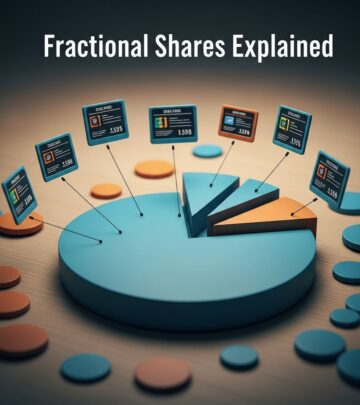
Understanding Fractional Shares in Modern Investing
Democratizing stock ownership through partial share purchases for all investors.

The landscape of stock market investing has undergone significant transformation in recent years, primarily due to innovations that lower barriers to entry for everyday investors. One of the most impactful developments is the emergence of fractional share investing, a mechanism that fundamentally changes how people can participate in equity markets. Rather than requiring thousands of dollars to own a piece of a high-priced company, investors can now allocate whatever amount they have available and receive proportional ownership. This shift democratizes wealth building and makes sophisticated investment strategies accessible to individuals with modest capital.
The Core Concept of Partial Stock Ownership
At its foundation, a
fractional share
is simply a portion of a company’s stock that represents less than one complete unit. Instead of the traditional model where investors must purchase whole shares, fractional share investing inverts the equation—investors decide on a dollar amount they wish to deploy, and the brokerage executes that dollar-based order by purchasing the corresponding fractional quantity. This distinction may seem subtle, but it represents a fundamental shift in how stock markets operate at the retail level.Consider a practical example: if a company’s stock trades at $1,000 per share and an investor has $200 available to invest, traditional models would prevent that investment entirely since the investor cannot afford a full share. With fractional shares, that same investor can deploy their $200 and receive 0.2 shares of the company, gaining proportional ownership in the business. The value of that fractional holding moves in lockstep with the underlying stock price. If the company’s stock rises to $1,200 per share, the investor’s 0.2 shares are now worth $240, reflecting the same percentage gain as a full-share owner would experience.
How Fractional Shares Come Into Existence
Fractional shares emerge through several distinct mechanisms, each reflecting different market events or investor actions:
- Brokerage-Facilitated Purchases: Modern brokers actively divide whole shares internally to accommodate client orders for specific dollar amounts or fractional quantities. These broker-created fractional shares exist within the brokerage ecosystem and are tracked through their internal systems rather than on public exchanges.
- Dividend Reinvestment Plans (DRIPs): When investors elect to automatically reinvest cash dividends rather than receive them as payment, their dividends often purchase fractional shares when the dividend amount is insufficient for a complete share. This mechanism supports long-term wealth accumulation through compounding returns.
- Stock Split Events: When companies execute stock splits to make share prices more accessible, the adjustments sometimes result in fractional holdings, particularly for investors holding odd numbers of shares. A shareholder with one share might receive five shares in a 5-for-1 split; however, if fractional adjustments occur during the split, fractional quantities could emerge.
- Corporate Reorganizations: Mergers and acquisitions frequently result in fractional shares when acquiring companies exchange stock using mathematical ratios that don’t produce whole numbers. If Company A acquires Company B and exchanges 1.5 shares of A for every share of B held, shareholders of Company B receive fractional positions in Company A.
Access Routes and Implementation Across Platforms
Not all brokerages offer fractional share investing, and implementation varies considerably across platforms. Participating brokerage firms are the gatekeepers of this service, and their policies differ regarding how fractional shares are ordered, executed, and managed. Some platforms accept orders denominated in dollar amounts (such as $250), while others accept share quantities to three decimal places (such as 0.125 shares).
Execution methods also diverge across brokers. Most fractional shares are rounded down to the nearest decimal to ensure conservative ordering, and investors experience bid-ask spreads proportional to those affecting whole-share trading. This means that while fractional share investors pay somewhat wider spreads than they would on large block trades, their costs scale appropriately with their position size.
It’s important to recognize that fractional shares created by brokers internally typically cannot transfer between platforms. An investor holding 0.5 shares of a company through Broker A cannot move that specific fractional position to Broker B. Instead, they would need to sell the fractional shares at Broker A and repurchase the equivalent dollar amount at Broker B. This limitation reflects the operational reality that fractional shares exist as accounting entries within each brokerage system rather than as securities transferable on public exchanges.
Income Distribution and Dividend Participation
A common question among fractional share investors concerns dividend eligibility. The answer is straightforward:
fractional shares participate in dividend distributions on the same proportional basis as whole shares.
If a company pays $2.00 per share in dividends and an investor holds 0.5 shares, that investor receives $1.00 in dividends. If the holding is 0.3 shares, the dividend payment is $0.60.Dividend payments to fractional share holders typically arrive as cash credited to the brokerage account, though some platforms offer the option to automatically reinvest dividends into additional fractional shares. This reinvestment capability creates a powerful compounding mechanism for long-term investors, particularly those building positions over decades.
Portfolio Construction Advantages
The practical benefits of fractional share investing extend beyond simply making expensive stocks affordable. For investors crafting diversified portfolios with limited capital, fractional shares transform what was previously impossible into routine practice. Consider an investor with $5,000 who wishes to build a diversified portfolio across ten positions. Traditional whole-share investing might force them to hold fewer positions or concentrate capital in lower-priced stocks. With fractional shares, they can allocate $500 to each of ten companies regardless of individual share prices, creating intentional, balanced exposure.
This accessibility proves particularly valuable for index investing and exchange-traded fund (ETF) positions. Expensive ETFs can trade at prices that exclude modest investors, but fractional shares make even premium positions achievable with small allocations. Investors can now build index-fund-like diversification without needing sufficient capital for whole units of multiple securities.
Operational Considerations and Limitations
Despite their advantages, fractional shares involve certain operational realities worth understanding. Orders are typically executed in batches rather than in real-time, particularly for dollar-based orders, which means execution timing differs from traditional whole-share trading. Investors should understand their broker’s specific execution windows and any associated fees or commissions.
Additionally, the ability to place orders with precision to three decimal places (0.001 shares) means that extremely small positions become possible. While this flexibility offers advantages, investors should verify that minimum order values align with their brokerage requirements—most platforms specify a minimum order size such as $1.00 to ensure administrative efficiency.
Transferability limitations deserve emphasis: fractional shares represent claims within a specific brokerage ecosystem and typically cannot be moved to alternative brokers as fractional quantities. This is not a deficiency but rather a structural characteristic of how fractional shares function in modern markets.
Frequently Asked Questions
- Can fractional shares be sold before a company goes public?
- Fractional shares trade during the same hours as whole shares at their respective brokerages. Sales instructions function identically whether liquidating fractional or whole positions.
- Do fractional share owners have voting rights?
- Voting rights associated with fractional shares depend on brokerage policies and corporate bylaws. Generally, fractional share holders may have proportionally reduced or no voting rights at shareholder meetings, though this varies by platform and issuer.
- What happens to fractional shares during corporate actions?
- Fractional shares participate in stock splits, dividend distributions, and other corporate actions proportionally. During a 2-for-1 stock split, a 0.5 share becomes 1.0 share, and share prices adjust accordingly.
- Are there tax implications specific to fractional shares?
- Fractional shares are taxed identically to whole shares—capital gains, dividends, and wash sales all apply proportionally. Brokers report fractional share activity to tax authorities using the same mechanisms as whole-share positions.
Strategic Applications for Different Investor Types
Fractional shares serve distinct purposes across investor demographics. New investors with limited capital can begin equity investing immediately rather than saving until they accumulate $1,000+ for their first purchase. Dollar-cost averaging strategies benefit from fractional shares, allowing consistent monthly investments regardless of current market prices. Rebalancing portfolios becomes more efficient when investors can adjust positions in precise dollar increments rather than being constrained by whole-share price points.
For dividend-focused investors, DRIPs generating fractional shares create compounding returns without requiring reinvestment as cash. Long-term investors benefit from the ability to commit specific dollar amounts rather than calculating how many whole shares available capital permits.
The Evolution of Accessible Investing
The widespread adoption of fractional share investing represents market infrastructure responding to investor needs. As technology enables brokerages to track fractional positions efficiently and as competitive pressures encourage firms to lower barriers to entry, fractional shares have transitioned from rare offerings to standard features. This democratization aligns with broader trends toward financial accessibility and wealth-building opportunity regardless of starting capital.
Understanding how fractional shares function—their creation mechanisms, dividend treatment, and operational characteristics—equips investors to use them effectively within broader investment strategies. Whether building a first portfolio with modest capital or refining a sophisticated allocation strategy, fractional shares provide flexibility that traditional whole-share models cannot match.
References
- What are Fractional Shares? — TD Direct Investing. 2024. https://www.td.com/ca/en/investing/direct-investing/articles/fractional-shares
- Investing in Fractional Shares — FINRA. 2024. https://www.finra.org/investors/insights/investing-fractional-shares
- Fractional Share Investing – Buying a Slice Instead of the Whole Share — U.S. Securities and Exchange Commission (Investor.gov). 2024. https://www.investor.gov/introduction-investing/general-resources/news-alerts/alerts-bulletins/investor-bulletins/fractional-share-investing-buying-slice-instead-whole-share
- What are Fractional Shares and How do They Work? A Complete Guide — Saxo Group. 2024. https://www.home.saxo/en-sg/learn/guides/equities/what-are-fractional-shares-and-how-do-they-work-a-complete-guide
- Fractional Shares — Fidelity Learning Center. 2024. https://www.fidelity.com/learning-center/trading-investing/fractional-shares
- Dollar-Based Trading-Fractional Shares — Vanguard Investor Resources. 2024. https://investor.vanguard.com/investor-resources-education/article/what-is-dollar-based-investing
Similar Articles








Read full bio of medha deb