Four Types of Economic Utility in Business
Understand how economic utility creates value and drives consumer satisfaction in markets.
Understanding Economic Utility: The Foundation of Consumer Value
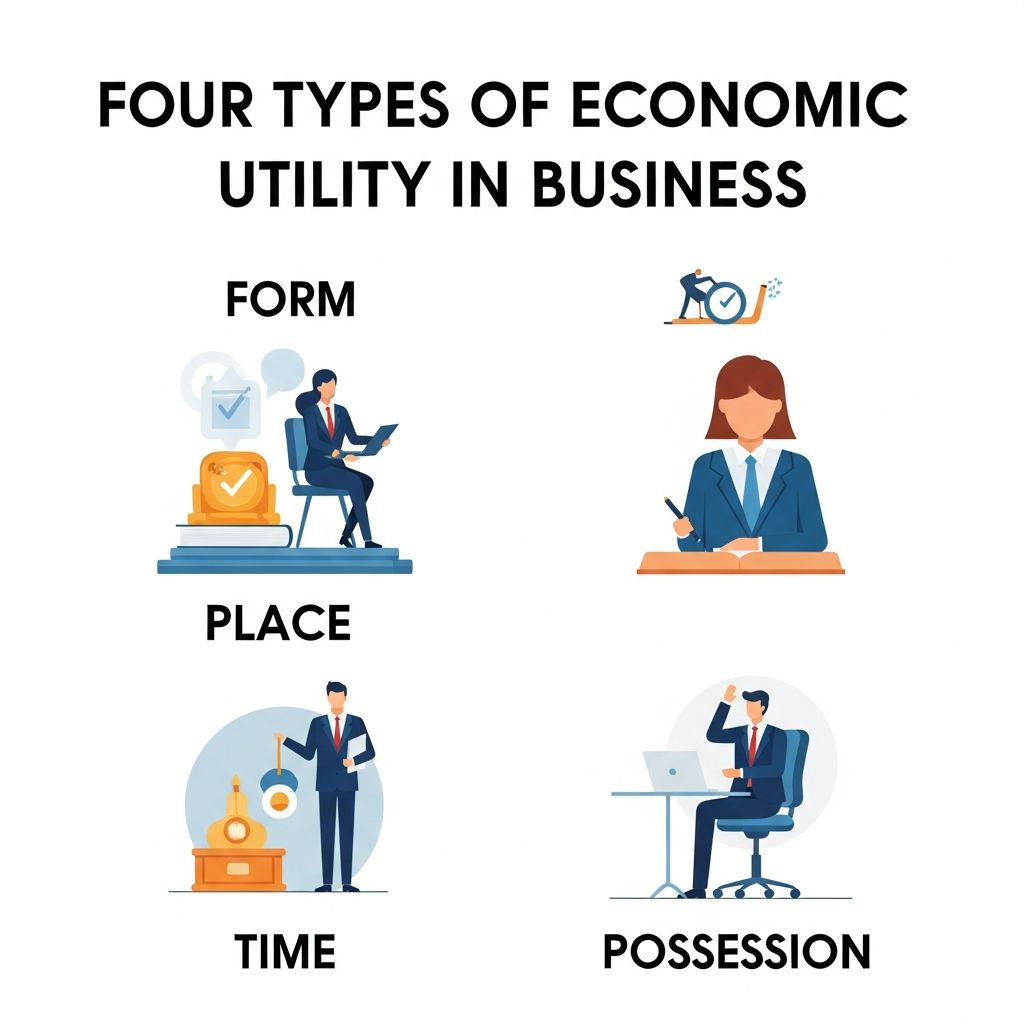
Economic utility represents the satisfaction or benefit that a consumer derives from consuming a good or service. It is a fundamental concept in economics that helps explain why people purchase products and how businesses create value in the marketplace. Utility is subjective and varies from person to person, meaning what provides high satisfaction to one consumer may provide less satisfaction to another. The four main types of economic utility—form utility, place utility, time utility, and possession utility—work together to create comprehensive value propositions that drive purchasing decisions and consumer satisfaction.
What is Economic Utility?
Economic utility is the capacity of a good or service to satisfy human wants and needs. It is the primary reason consumers are willing to exchange money for products. Understanding utility helps businesses identify what customers truly value and how to position their offerings to maximize satisfaction. Utility is not intrinsic to a product but rather depends on the consumer’s perception and circumstances. For example, an umbrella has high utility on a rainy day but minimal utility on a sunny day. The concept of utility drives all economic decisions and forms the basis of consumer behavior analysis.
The Four Types of Economic Utility
Businesses create value through four distinct dimensions of utility. Each type addresses different aspects of consumer needs and preferences, and together they form a complete framework for understanding how products and services gain market value.
1. Form Utility
Form utility refers to the value created by converting raw materials into finished goods and services that consumers want to purchase. This type of utility is generated through the manufacturing and production processes that transform resources into tangible or intangible products. For instance, a timber company creates form utility by processing raw wood into furniture, flooring, or construction materials. Similarly, a clothing manufacturer creates form utility by converting fabric into wearable garments. The design, quality, and functionality of the final product all contribute to its form utility.
Form utility is arguably the most visible type of utility because it directly involves changing the physical or functional properties of materials. It requires investment in manufacturing equipment, skilled labor, research and development, and quality control processes. Businesses that excel at creating form utility typically have strong competitive advantages because they can produce products that precisely meet consumer specifications and preferences. For example, smartphone manufacturers create form utility by assembling electronic components into devices that provide communication, entertainment, and productivity capabilities.
2. Place Utility
Place utility is the value created by making products available to consumers in convenient locations. This type of utility involves the distribution and logistics infrastructure that brings goods from producers to consumers. Without place utility, even the most desirable products would have limited value if they were unavailable where consumers need them. A grocery store creates place utility by stocking shelves with products from multiple suppliers, allowing customers to shop conveniently in one location rather than visiting individual manufacturers.
Place utility has become increasingly important in the modern economy, particularly with the rise of e-commerce and global supply chains. Companies invest heavily in distribution networks, warehouses, retail locations, and delivery systems to ensure products reach consumers efficiently. Amazon, for example, has revolutionized place utility by developing an extensive network of fulfillment centers that enable rapid delivery of products to customers’ homes. Similarly, international shipping companies create place utility by transporting goods across borders and continents, making products from around the world accessible to local consumers. The COVID-19 pandemic highlighted the critical importance of place utility as businesses rapidly adapted their distribution channels to meet changing consumer demand patterns.
3. Time Utility
Time utility is the value created by making products available when consumers want them. This type of utility ensures that goods and services are accessible at the right moment to satisfy consumer needs. A convenience store creates time utility by remaining open 24 hours, allowing customers to purchase items outside traditional business hours. Similarly, fast-food restaurants create time utility by providing quick service during busy lunch and dinner periods when consumers need meals immediately.
Time utility has become a major competitive factor in many industries. Businesses recognize that meeting consumer needs quickly often matters as much as where or how products are delivered. On-demand services like ride-sharing platforms exemplify modern time utility by providing transportation immediately when requested. Subscription services also create time utility by making content available whenever consumers want to access it. In the agricultural sector, companies that can get perishable products to market quickly create significant time utility. Financial services firms offer after-hours trading and mobile banking to ensure customers can access their money whenever needed. The increasing expectation for rapid service and instant gratification has made time utility a critical differentiator in competitive markets.
4. Possession Utility
Possession utility is the value created by transferring ownership of a product from seller to consumer. This type of utility involves the transaction and payment mechanisms that allow customers to take ownership of goods and services. A real estate agent creates possession utility by facilitating the transfer of property ownership from sellers to buyers. Similarly, banks create possession utility by enabling customers to access credit, which allows them to purchase goods they otherwise couldn’t afford immediately.
Possession utility extends beyond simple ownership transfer to include financing options, warranties, and customer support services that enhance the value of ownership. Automobile dealerships create possession utility not just by transferring vehicle ownership but also by offering financing options, trade-in opportunities, and maintenance agreements. Online retailers create possession utility through secure payment systems, clear return policies, and customer service support. Insurance companies create possession utility by providing protection and peace of mind associated with product ownership. In the digital age, possession utility has expanded to include intellectual property rights, licensing agreements, and digital access rights that define what consumers can do with products they purchase.
How the Four Types of Utility Work Together
While each type of utility serves a distinct purpose, they work synergistically to create comprehensive consumer value. Consider a smartphone manufacturer that understands all four types of utility. The company designs and manufactures products that precisely meet consumer specifications (form utility), distributes them through various retail channels and online platforms (place utility), ensures availability during launch dates and holiday shopping seasons (time utility), and facilitates ownership transfer through financing and warranty programs (possession utility). Consumers benefit from each dimension, and the business successfully captures market share by addressing all aspects of utility simultaneously.
The Importance of Utility in Business Strategy
Understanding the four types of economic utility is essential for developing effective business strategies. Companies that recognize where consumers derive value can allocate resources more efficiently and create competitive advantages. Some businesses differentiate themselves primarily through form utility by offering superior product design and quality. Others compete on place utility by building extensive distribution networks that competitors cannot easily replicate. Many retailers focus on time utility by offering extended hours or rapid delivery. Financial services companies emphasize possession utility through favorable terms and comprehensive customer support.
Successful businesses often excel across multiple dimensions of utility. However, resource constraints usually require companies to prioritize which types of utility offer the greatest competitive advantages in their specific markets. Understanding consumer preferences and market dynamics helps businesses make these strategic decisions. The rise of online retailers has disrupted traditional retail by fundamentally changing how place and time utility are delivered, demonstrating that innovation in utility creation can reshape entire industries.
Utility in Different Industries
Retail and Consumer Goods
Retail businesses must excel across all four types of utility. Supermarkets create form utility through private-label products, place utility by locating stores in convenient neighborhoods, time utility by offering extended shopping hours, and possession utility through checkout systems and loyalty programs.
Technology and Software
Technology companies create form utility through innovative product features, place utility through multiple distribution channels (direct sales, app stores, cloud platforms), time utility through continuous updates and services, and possession utility through licensing and user accounts.
Healthcare and Pharmaceuticals
Healthcare providers create form utility through medical treatments and services, place utility through clinics and hospitals in accessible locations, time utility through emergency services and appointment scheduling, and possession utility through insurance coverage and payment plans.
Food and Beverage
Food service businesses create form utility through recipe development and food preparation, place utility through restaurant locations or delivery networks, time utility through quick service or convenient hours, and possession utility through takeout containers and easy payment options.
Measuring and Enhancing Utility
Businesses measure utility indirectly through consumer behavior metrics such as purchase frequency, customer satisfaction scores, and market share. Companies enhance utility by gathering consumer feedback, conducting market research, and monitoring competitor offerings. Digital analytics now allow companies to understand precisely what aspects of utility matter most to different customer segments, enabling more targeted strategies.
Companies that successfully enhance utility typically invest in understanding their customers deeply. They ask questions about pain points, preferences, and unmet needs. They analyze purchasing patterns to identify which aspects of utility drive purchasing decisions. Many businesses use customer surveys, focus groups, and user testing to gather insights about utility. The most innovative companies often discover new ways to create utility by thinking creatively about consumer needs and how their offerings can address them.
Frequently Asked Questions
Q: What is the difference between utility and value?
A: Utility refers to the satisfaction a consumer derives from consuming a product, while value refers to the monetary worth assigned to that satisfaction. A product might have high utility but be perceived as low value if consumers believe the price is too high.
Q: Can a product have utility without having economic value?
A: Yes, a product can have utility but no economic value. For example, water from a clean stream has utility but typically has no economic value because it is freely available. However, bottled water has both utility and economic value.
Q: How does marginal utility relate to the four types of utility?
A: Marginal utility describes how satisfaction changes as consumers consume additional units of a product. All four types of utility contribute to the total and marginal utility consumers experience from a product.
Q: Which type of utility is most important for online retailers?
A: Online retailers must excel at place and time utility by offering convenient access and rapid delivery. However, possession utility (secure payments, clear return policies) is also critical for building consumer trust.
Q: How can businesses create utility in service industries?
A: Service businesses create form utility through service design and quality, place utility through convenient locations or remote access, time utility through availability and responsiveness, and possession utility through contracts and customer agreements.
Q: Does increasing one type of utility always increase total utility?
A: Not necessarily. If businesses improve one type of utility at the expense of others, total utility might decrease. For example, expanding place utility through many small stores might reduce time utility if staff at each location is limited.
Conclusion
The four types of economic utility—form, place, time, and possession—form the foundation of how businesses create value and meet consumer needs. Understanding these concepts helps explain why consumers make purchasing decisions and how companies can build sustainable competitive advantages. Successful businesses recognize that creating comprehensive utility across all four dimensions is often essential for long-term success. Whether through superior product design, extensive distribution networks, convenient availability, or favorable ownership terms, companies that excel at utility creation build strong customer loyalty and capture greater market share. As consumer expectations continue to evolve and markets become more competitive, the ability to innovate in how utility is delivered will remain central to business success and economic value creation.
References
- Principles of Economics — N. Gregory Mankiw. Cengage Learning, 2020. https://www.cengage.com/
- Consumer Behavior and Marketing Strategy — J. Paul Peter and Jerry C. Olson. McGraw-Hill Education, 2010. https://www.mheducation.com/
- Supply Chain Management and Logistics — Council of Supply Chain Management Professionals (CSMP). Professional Standards, 2023. https://cscmp.org/
- Economic Utility Theory in Practice — Journal of Economic Theory, 2023. https://www.journals.elsevier.com/journal-of-economic-theory
- Business Model Innovation and Value Creation — Harvard Business School Publishing, 2022. https://www.hbs.edu/
Similar Articles








Read full bio of Sneha Tete