Four Investment Objectives Define Your Strategy
Master growth, income, stability, and speculation to build your perfect investment strategy.
When you decide to invest your money, one of the most critical decisions you’ll make is determining what you want that money to accomplish. Your investment objectives form the foundation of your entire financial strategy, guiding every decision you make about where to place your capital. Rather than investing randomly or following market trends without purpose, successful investors start by clearly defining their investment objectives. These objectives help you create a roadmap toward financial success and ensure that your investments align with your personal goals and circumstances.
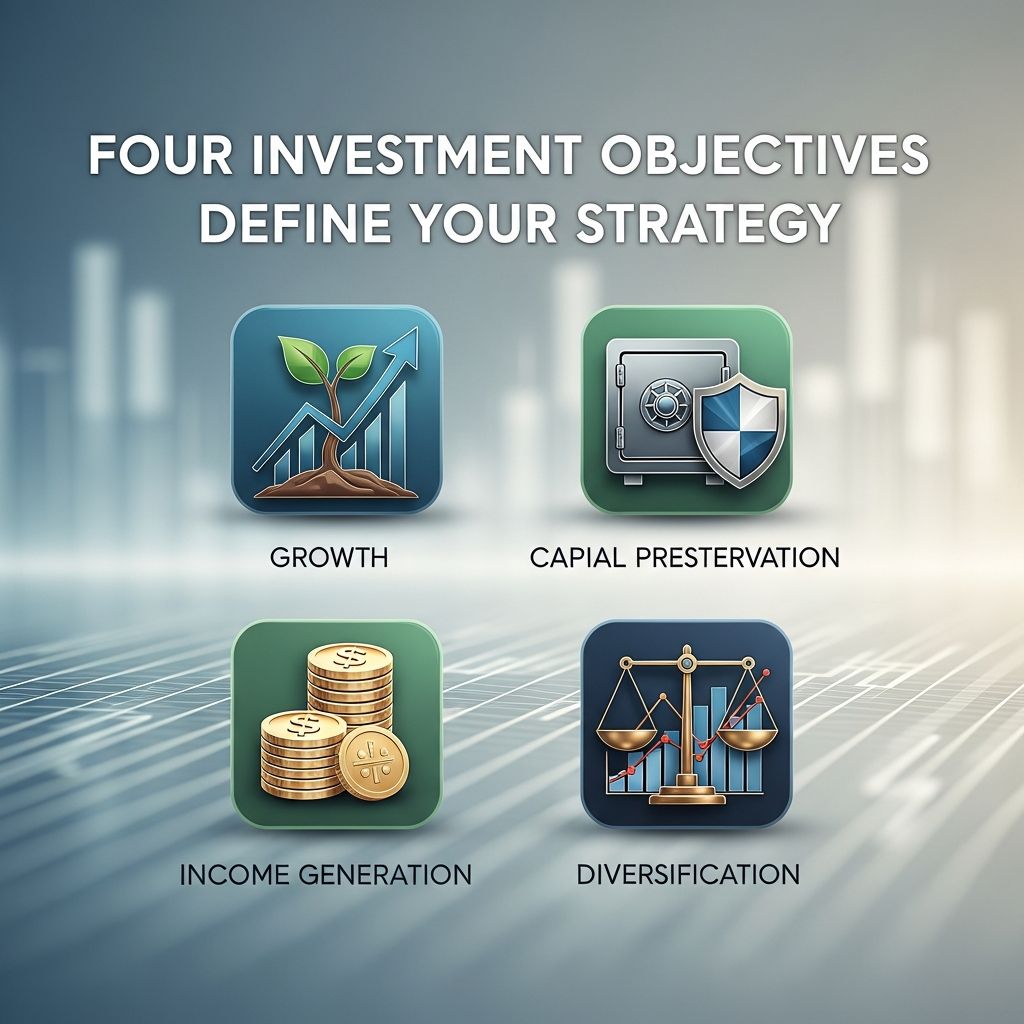
The investment world often categorizes objectives into four primary categories: growth, income, stability, and speculation. Understanding each of these objectives and how they work together is essential for developing an effective investment strategy. Your personal investment mix will depend on factors such as your age, timeline, risk tolerance, financial situation, and specific financial goals. This comprehensive guide explores each objective in detail and shows you how to balance them for optimal results.
Understanding Investment Objectives
Investment objectives are the specific financial outcomes you’re trying to achieve through your investments. They serve as the north star for your investment decisions, helping you determine which types of investments make sense for your situation. Without clear objectives, you might find yourself making emotional decisions or following investment trends that don’t align with your actual needs.
Your investment objectives work in conjunction with your time horizon, risk tolerance, and liquidity needs to shape your overall investment strategy. Time horizon refers to how long you have until you need to access your invested money. Risk tolerance indicates how comfortable you are with fluctuations in your investment value. Liquidity needs determine how quickly you might need to convert your investments back into cash. When you combine these factors with your specific objectives, you create a personalized investment approach that serves your unique circumstances.
Objective One: Growth
Growth investing focuses on increasing the value of your investments over time, also known as capital appreciation. When you pursue growth as an objective, you’re buying assets you expect to increase in value significantly. The essence of growth investing is the belief that certain investments will appreciate substantially if given enough time.
How Growth Investing Works
Growth investors typically purchase stocks, growth-oriented mutual funds, or exchange-traded funds with the expectation that these assets will increase in value over extended periods. For example, if you had invested $1,000 in certain technology companies decades ago, that investment could potentially be worth significantly more today due to the compounding effect of appreciation over many years.
Growth investing requires patience and a long-term perspective. This objective is particularly suitable for investors who have many years before they need to access their money, such as younger professionals saving for retirement. The longer your time horizon, the more you can typically afford to wait for your investments to grow, which allows you to weather short-term market volatility.
Growth vs. Value Investing
Within the growth category, investors often distinguish between pure growth investing and value investing. Growth investors seek companies they believe will experience rapid expansion and profit growth. Value investors, by contrast, look for companies trading below their intrinsic value—assets that have temporarily fallen out of favor in the market. Both approaches aim for appreciation, but they employ different strategies to find promising investments. Many successful portfolios combine both growth and value strategies for a more balanced equity allocation.
When to Emphasize Growth
Growth should be your primary focus if you’re young, have a long time horizon before retirement, and can tolerate the volatility that often comes with growth-oriented investments. Growth investments typically experience larger price fluctuations than stable investments, but this volatility is the trade-off for the potential to achieve higher returns over time. If losing money temporarily would cause you significant stress, you may want to balance growth with other objectives.
Objective Two: Income
Income investing focuses on generating regular cash payments from your investments. These payments typically come in the form of dividends from stocks or interest payments from bonds and other fixed-income securities. Rather than waiting for your investments to appreciate in value, income investors prioritize receiving periodic payments they can either spend or reinvest.
Understanding Investment Income
When you invest in income-generating assets, you receive regular distributions. For example, if you own dividend-paying stocks, you receive quarterly dividend payments. If you own bonds, you receive interest payments at specified intervals. These payments provide a steady cash flow that can be particularly valuable for people no longer earning regular paychecks from employment.
Income investors often choose mature, established companies that generate consistent profits and return portions of those profits to shareholders. They might also invest in bonds issued by corporations or governments, rental properties, or other assets that produce regular cash flows. The predictability of income investments makes them attractive to those who need reliable cash flow from their portfolio.
Income Investing in Retirement
Income investing becomes increasingly important as you approach and enter retirement. Throughout your working years, you may have focused primarily on growth, but as retirement approaches, the ability to generate income from your portfolio becomes crucial. Retirees typically cannot tolerate the volatility of a pure growth portfolio because they need to withdraw money regularly to cover living expenses. An income-focused portfolio provides the stability and predictability they need.
Balancing Income and Growth
Even if you’re not yet retired, incorporating some income-focused investments into your portfolio can help balance the higher volatility of growth investments. A portfolio combining both growth and income investments provides a more stable overall experience while still offering the potential for appreciation. This balanced approach can make investing feel less stressful while maintaining reasonable return potential.
Objective Three: Stability
Stability, also called capital preservation or protection of principal, focuses on protecting the money you’ve invested rather than growing it significantly. With stability as your objective, the primary goal is avoiding losses, and any gains are secondary considerations.
The Purpose of Stability
Stability-focused investments prioritize safety and predictability over growth potential. These investments typically experience minimal price fluctuations and offer lower returns than growth investments. However, they provide the reassurance that your principal investment will be protected. Stability is essential when your investment timeline is short or when you cannot afford to lose the money you’ve invested.
When Stability Is Critical
Stability becomes your primary objective in several situations. If you’re planning to buy a home within two years, you need your down payment to be safe from market volatility. If your child will start college in three years, you want those funds protected. If you’re retired and facing unexpected expenses, you need funds you can access without worrying about market downturns. In all these scenarios, stability takes priority over seeking higher returns.
Stability Investments and Options
Investors seeking stability typically turn to low-risk investments such as high-yield savings accounts, money market funds, certificates of deposit, and high-quality bonds. These investments offer protection of principal while still providing modest returns. Though the returns may be lower than growth investments, the predictability and safety make them appropriate for specific financial goals with shorter timelines.
Objective Four: Speculation
Speculation represents the most aggressive investment objective, involving higher-risk investments pursued in hopes of achieving substantial returns quickly. Speculative investments accept significant volatility and the possibility of substantial losses in exchange for the potential of outsized gains.
Understanding Speculation
Speculative investments might include penny stocks, high-volatility growth stocks, options trading, futures contracts, or emerging market investments. These investments can experience dramatic price movements in short periods. Speculators are willing to accept the possibility of losing a significant portion of their investment for the chance to achieve exceptional returns.
Who Should Consider Speculation
Speculation should only constitute a small portion of a well-rounded portfolio, and only for investors who can genuinely afford to lose the money invested. Speculators must have sufficient wealth from other sources to cover their living expenses and financial obligations, even if their speculative investments fail completely. For most individual investors, speculation should represent only a small percentage of their total portfolio.
The Role of Speculation in Diversification
While speculation carries significant risk, a small speculative component might be appropriate for some investors seeking diversification and the possibility of exceptional returns. The key is ensuring that speculation doesn’t undermine your overall financial security or distract you from pursuing your primary investment objectives.
How Investment Objectives Work Together
The four investment objectives don’t exist in isolation. Instead, they represent a spectrum of possible investment approaches, and your overall strategy typically involves combining multiple objectives in varying proportions. The specific mix depends on your personal circumstances, goals, and preferences.
The Trade-off Reality
A fundamental principle of investing is that emphasizing one objective typically means compromising on others. If you focus heavily on growth, you must accept higher volatility and lower current income. If you prioritize stability, you accept lower growth potential. If you pursue income, you may have less opportunity for capital appreciation. There are no free lunches in investing—every choice involves trade-offs.
Creating Your Personalized Mix
The art of successful investing involves creating the right mix of objectives for your specific situation. A younger investor with 40 years until retirement might allocate 80% of their portfolio to growth, 15% to income, and 5% to stability. Someone five years from retirement might shift to 40% growth, 40% income, and 20% stability. A retiree might emphasize income and stability while maintaining perhaps 30% in growth investments for long-term inflation protection.
Multiple Goals, Multiple Timelines
Many people have multiple financial goals with different timelines. You might be saving for a house down payment (short-term), your children’s education (medium-term), and retirement (long-term). Rather than trying to achieve all these objectives with a single portfolio, you can use different investment accounts for different goals. Your house fund might be nearly 100% stable investments, your education fund might mix stability and income, and your retirement account might emphasize growth with some income components.
Factors That Shape Your Investment Objectives
Your Time Horizon
Your time horizon—how long until you need your money—significantly influences which objectives should dominate your strategy. Short-term goals (less than 3 years) typically call for stability-focused investments. Medium-term goals (3-10 years) often benefit from a balanced approach mixing stability, income, and moderate growth. Long-term goals (10+ years or more) can emphasize growth since you have time to recover from market downturns.
Your Risk Tolerance
Risk tolerance refers to your emotional and financial ability to withstand investment losses. Some people sleep soundly during market downturns; others become anxious. Your risk tolerance should guide how much emphasis you place on growth versus stability. There’s no point pursuing aggressive growth if market volatility causes you so much stress that you make poor decisions.
Your Financial Situation
Your overall financial security influences appropriate objectives. If you have substantial savings, stable income, and no urgent financial needs, you can afford to emphasize growth and even speculation in portions of your portfolio. If you’re living paycheck to paycheck or facing major expenses soon, stability must take priority.
Your Life Stage
Your age and life circumstances naturally influence your objectives. Young professionals typically emphasize growth. People in their peak earning years might balance growth with income. Those approaching retirement shift toward income and stability. Retirees often prioritize income and stability while maintaining some growth for inflation protection.
Building a Balanced Investment Strategy
Creating an effective investment strategy begins with clearly articulating your financial goals and priorities. Ask yourself: What am I investing for? When will I need this money? How much risk can I tolerate? How much might I need to access quickly?
Once you’ve answered these questions, you can determine the appropriate allocation among growth, income, stability, and perhaps speculation. Consider working with a financial advisor who can help you assess your situation and create a personalized strategy. Regularly review and adjust your strategy as your circumstances change—life events like marriage, children, job changes, and approaching retirement all warrant strategy reviews.
Remember that your investment objectives should drive your investment decisions, not the other way around. Don’t choose investments first and then try to fit them into your strategy. Instead, define your objectives clearly, then select investments that align with those objectives.
Frequently Asked Questions
Q: What is the difference between investment objectives and investment goals?
A: Investment goals are specific targets (like saving $100,000 for a house down payment), while investment objectives are the broader categories of outcomes you’re seeking (growth, income, stability, or speculation). Your goals determine which objectives matter most for your strategy.
Q: Can I change my investment objectives over time?
A: Yes, absolutely. As your life circumstances change—through aging, achieving goals, or experiencing major life events—your investment objectives should shift accordingly. Regular strategy reviews help ensure your investments continue serving your evolving needs.
Q: How should I allocate my portfolio among different objectives?
A: Your allocation should reflect your time horizon, risk tolerance, and specific goals. A common rule suggests your stability allocation should roughly equal your time horizon in years. For example, if you need money in 5 years, consider about 5% in high-growth investments. However, individual circumstances vary, so consider consulting a financial advisor.
Q: Is speculation ever appropriate for individual investors?
A: For some investors with sufficient financial resources and appropriate risk tolerance, a small speculative portion of a diversified portfolio might be appropriate. However, speculation should never comprise the core of your portfolio or threaten your financial security.
Q: How does inflation affect investment objectives?
A: Inflation erodes the purchasing power of stable, low-return investments over time. Even retirees typically maintain some growth investments to combat inflation. This is why a balanced approach addressing multiple objectives often makes sense throughout your life.
Q: What role does diversification play in achieving investment objectives?
A: Diversification—spreading investments across different asset types, sectors, and geographies—helps you achieve multiple objectives simultaneously. A diversified portfolio can pursue growth through stocks while pursuing income through bonds and stability through cash equivalents, all within a single portfolio.
References
- 3 Key Investment Goals: Growth, Income and Stability — FBG Financial Services. 2025. https://www.fbfs.com/learning-center/3-key-investment-goals-growth-income-and-stability
- Investing Goals: Help Planning Your Financial Goals — Vanguard Investor Resources. 2025. https://investor.vanguard.com/investor-resources-education/investing-goals
- Why Having a Goal Is Key to Investing — Morgan Stanley. 2025. https://www.morganstanley.com/articles/investing-goals-achieving-your-objectives
- Investment Goal: Growth, Income, Or Both? — Wings for Widows. 2025. https://www.wingsforwidows.org/popular-articles/investment-goal-growth-income-or-both
- The Golden Rules of Investing — Financial Conduct Authority. 2025. https://www.fca.org.uk/investsmart/golden-rules-investing
Similar Articles








Read full bio of medha deb