Forwards vs Futures: Key Differences Explained
Understanding the critical distinctions between forward and futures contracts in derivative markets.
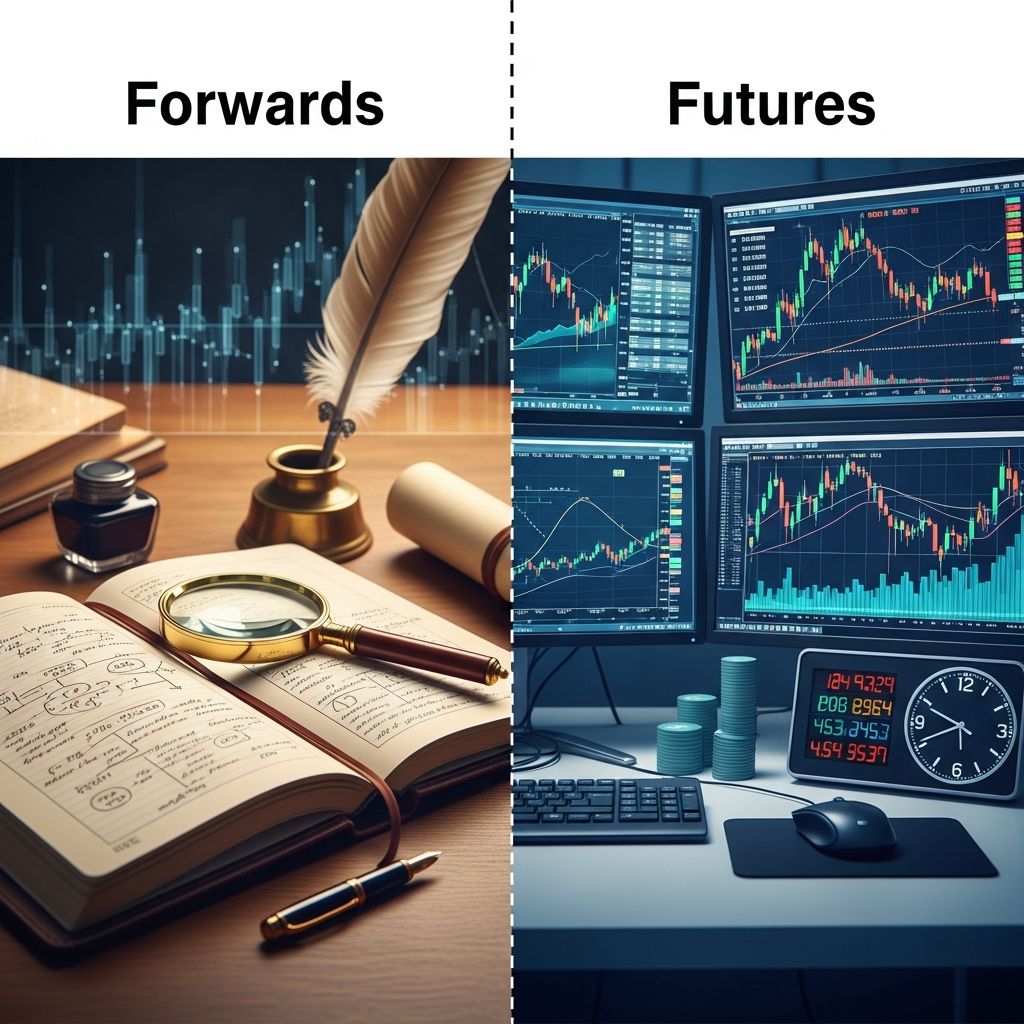
Forwards vs Futures: Understanding the Differences
In derivative markets, forwards and futures are two fundamental types of contracts that allow investors and businesses to hedge risk, speculate on price movements, or lock in future prices. While these instruments serve similar purposes, they differ significantly in structure, trading mechanisms, regulation, and risk profiles. Understanding these distinctions is crucial for anyone involved in financial markets, whether as an investor, trader, or risk manager.
What Are Forward Contracts?
A forward contract is a customized agreement between two parties to buy or sell an asset at a predetermined price on a future date. These contracts are negotiated privately between counterparties and are not standardized. Forwards are traded over-the-counter (OTC), meaning they exist outside of formal exchanges. The buyer agrees to purchase the underlying asset, while the seller agrees to deliver it at the specified future date and price.
Forward contracts are widely used in foreign exchange markets, commodities trading, and interest rate markets. For example, a European company expecting to receive payment in US dollars in six months might enter into a forward contract to lock in an exchange rate today, protecting itself from currency fluctuations.
Key Characteristics of Forwards:
- Customization: Terms are tailored to meet the specific needs of both parties
- OTC Trading: Negotiated privately between counterparties without exchange involvement
- No Standardization: Contract sizes, dates, and specifications vary by agreement
- Counterparty Risk: Both parties face credit risk if the other defaults
- Settlement: Physical delivery or cash settlement typically occurs at contract maturity
- No Upfront Margin: Usually no money changes hands until settlement
What Are Futures Contracts?
Futures contracts are standardized agreements to buy or sell a specific quantity of an underlying asset at a predetermined price on a future date. Unlike forwards, futures are traded on organized exchanges such as the Chicago Mercantile Exchange (CME), the New York Mercantile Exchange (NYMEX), or other regulated platforms worldwide. These contracts are standardized in terms of quality, quantity, delivery dates, and price quotation methods.
Futures contracts are available for a wide range of underlying assets, including commodities (oil, gold, wheat), financial instruments (stock indices, Treasury bonds), currencies, and interest rates. They are widely used by hedgers, speculators, and arbitrageurs to manage risk or profit from expected price movements.
Key Characteristics of Futures:
- Standardization: Contract specifications are uniform across all participants
- Exchange-Traded: Bought and sold on regulated commodity and financial exchanges
- Daily Settlement: Marked-to-market daily, with gains and losses settled each trading day
- Margin Requirements: Initial margin and maintenance margin required; participants must post collateral
- Liquidity: Highly liquid; easy to enter and exit positions
- Clearing House: A centralized clearinghouse guarantees contract performance, reducing counterparty risk
- Limited Counterparty Risk: The exchange’s clearinghouse stands between buyer and seller
Major Differences Between Forwards and Futures
| Feature | Forwards | Futures |
|---|---|---|
| Trading Venue | Over-the-counter (OTC) | Organized exchanges |
| Standardization | Customized terms | Standardized contracts |
| Counterparty Risk | High (bilateral) | Low (guaranteed by clearinghouse) |
| Margin Requirement | Typically none upfront | Initial and maintenance margin required |
| Price Discovery | Negotiated between parties | Transparent, market-determined pricing |
| Liquidity | Lower; less liquid | High; very liquid |
| Settlement | At contract expiration | Daily mark-to-market settlement |
| Regulation | Minimal regulation | Heavily regulated |
| Contract Flexibility | High flexibility | Limited flexibility |
Counterparty Risk: A Critical Distinction
One of the most significant differences between forwards and futures is the level of counterparty risk involved. With forward contracts, both parties face credit risk because there is no intermediary to guarantee contract performance. If one party defaults, the other party bears the loss. This was dramatically illustrated during the 2008 financial crisis when many financial institutions and corporations found themselves exposed to significant losses due to counterparty defaults on forward contracts.
In contrast, futures contracts are backed by a clearinghouse, which acts as both buyer to every seller and seller to every buyer. This structure virtually eliminates counterparty risk because the clearinghouse guarantees contract performance. If a market participant defaults, the clearinghouse absorbs the loss and uses margin deposits to cover any shortfall, protecting all other participants.
Margin and Daily Settlement in Futures
Futures contracts require participants to post margin, which serves as collateral and a good-faith deposit. This includes an initial margin (the amount required when opening a position) and a maintenance margin (the minimum amount that must be maintained). Each trading day, futures contracts are marked-to-market, meaning positions are repriced based on the day’s closing price. Gains are credited to the trader’s account, while losses are debited, ensuring that losses are collected immediately rather than accumulating until contract expiration.
Forward contracts, by contrast, typically have no margin requirement. Cash changes hands only at settlement, when the contract expires. This means losses can accumulate over the life of the contract, and a party’s exposure to its counterparty continues to grow if the market moves against them.
Standardization and Customization
Forwards are highly customizable. Parties can negotiate any terms they wish: the exact quantity of the underlying asset, the specific delivery date, the delivery location, the price, and any other conditions relevant to their transaction. This flexibility makes forwards ideal for businesses with unique hedging needs that cannot be met by standardized exchange-traded contracts.
Futures, being exchange-traded, are highly standardized. The contract specifications—including the underlying asset, contract size, delivery dates, minimum price increments, and settlement procedures—are all predetermined by the exchange. This standardization facilitates price transparency and liquidity but means that participants must accept the terms set by the exchange or look for alternative instruments.
Liquidity and Exit Strategies
The standardization and exchange-based trading of futures contracts create significant liquidity advantages. Most futures contracts can be easily bought or sold at any time during trading hours, allowing traders to quickly enter or exit positions. The high trading volume on major futures exchanges ensures that bids and asks are often very tight, minimizing transaction costs.
Forward contracts, trading in the OTC market, typically have much lower liquidity. Exiting a forward position before maturity can be difficult and expensive. A trader holding a forward contract might need to negotiate a new offsetting forward with a different counterparty or wait until the contract matures. This lack of liquidity makes forwards less suitable for traders who may need to adjust their positions frequently.
Price Discovery and Transparency
Futures markets provide transparent, continuous price discovery through open outcry or electronic trading on exchanges. The prices of actively traded futures are publicly available and widely disseminated, allowing all market participants to see current prices and historical trends. This transparency helps ensure fair pricing and allows traders to make informed decisions.
Forward prices, being negotiated privately between counterparties, are not publicly disclosed. Price discovery for forwards relies on the expertise and negotiating power of the participants involved. This lack of transparency can sometimes result in less efficient pricing, though it also provides privacy for parties who wish to keep their trading intentions confidential.
Regulation and Oversight
Futures markets are heavily regulated. In the United States, the Commodity Futures Trading Commission (CFTC) oversees futures markets and exchanges, establishing rules to protect market participants and ensure market integrity. These regulations cover matters such as position limits, reporting requirements, margin rules, and standards for contract specifications.
Forward markets have historically received minimal regulatory oversight, operating largely in the shadows of formal market infrastructure. However, regulatory reforms following the 2008 financial crisis have increased transparency and oversight in certain segments of the forward market, particularly for standardized derivatives that are increasingly cleared through central counterparties.
When to Use Forwards vs Futures
Forwards Are Preferred When:
- Customized terms are necessary to match specific hedging or business needs
- The underlying asset is not actively traded on an exchange (e.g., specific grades of commodities)
- The party wants to avoid the daily margin calls associated with futures
- Privacy and confidentiality are important considerations
- The contract size is larger than what standard futures contracts allow
Futures Are Preferred When:
- High liquidity and the ability to easily exit positions are important
- Standardized contract terms meet the hedger’s or trader’s needs
- Lower counterparty risk is a priority
- Transparent, market-determined pricing is desired
- The party wants to avoid complex negotiations over contract terms
- Regulatory oversight and exchange guarantees are valuable
Real-World Applications
Forward Contracts in Practice:
Multinational corporations frequently use forward contracts to hedge foreign exchange risk. For example, a US-based company expecting to receive euros in three months might enter into a forward contract to sell those euros at a fixed rate today, protecting itself from euro depreciation. Similarly, farmers and commodity producers often use forwards to lock in prices for their products before harvest.
Futures Contracts in Practice:
Commodity producers and users rely heavily on futures. An airline company might purchase crude oil futures to hedge against rising fuel prices, while a baker might purchase wheat futures to secure stable input costs. Investors also use stock index futures for portfolio hedging or to gain leveraged exposure to equity markets. Financial institutions use interest rate futures to manage interest rate risk and treasury traders use them to position for expected changes in the yield curve.
Advantages and Disadvantages Summary
Forwards Advantages:
- Complete customization to meet specific needs
- No daily margin calls or forced daily settlement
- Privacy of negotiations
- Flexible terms regarding quantities and dates
Forwards Disadvantages:
- High counterparty risk
- Low liquidity and difficulty exiting positions
- Potential for disputes over terms and conditions
- Limited regulatory oversight and protection
Futures Advantages:
- Minimal counterparty risk through clearinghouse guarantee
- High liquidity and easy position exit
- Transparent, fair pricing through exchange trading
- Strong regulatory framework and oversight
- Low transaction costs on major exchanges
Futures Disadvantages:
- Limited customization; must accept standardized terms
- Daily mark-to-market can trigger margin calls
- Trading restricted to exchange hours
- Contract specifications may not perfectly match hedging needs
Frequently Asked Questions
Q: Can an individual investor trade forward contracts?
A: Yes, individuals can trade forwards, particularly in foreign exchange and commodities markets through brokers. However, forwards are predominantly used by institutional investors and corporations due to the complexity of negotiations and higher minimum contract sizes.
Q: What happens if a futures contract isn’t closed before expiration?
A: If a futures contract reaches expiration without being closed, it typically results in either physical delivery of the underlying asset or cash settlement, depending on the specific contract terms set by the exchange.
Q: Are forwards binding contracts?
A: Yes, forward contracts are legally binding agreements between the two parties. Breaking a forward contract can result in legal action and liability for any losses incurred by the other party.
Q: Why do futures have daily settlement?
A: Daily settlement in futures ensures that losses are collected immediately, reducing systemic risk and protecting the clearinghouse and other market participants from the buildup of large uncollected losses.
Q: Can forwards and futures be used together?
A: Yes, sophisticated traders and companies sometimes use a combination of forwards and futures to achieve their desired risk management or trading objectives, leveraging the advantages of each instrument.
Q: How are futures prices different from forward prices for the same underlying asset?
A: While theoretically similar under certain conditions, futures and forward prices can differ due to daily settlement in futures, different interest rates, and varying degrees of liquidity. Generally, futures prices are more transparent and efficiently discovered through continuous exchange trading.
Q: What is marking-to-market in futures trading?
A: Marking-to-market means repricing a futures contract daily based on the settlement price. Profits and losses are calculated and settled each trading day, with winners receiving credits and losers having debits applied to their margin accounts.
References
- Commodity Futures Trading Commission (CFTC): Futures and Options — U.S. Commodity Futures Trading Commission. 2024. https://www.cftc.gov/
- Hull, J. C. (2018). Options, Futures, and Other Derivatives (10th ed.) — Pearson Education. This academic standard text comprehensively covers derivative pricing and market mechanics for both forwards and futures.
- Federal Reserve: Over-the-Counter Derivatives — Board of Governors of the Federal Reserve System. 2023. https://www.federalreserve.gov/
- Dodd-Frank Wall Street Reform and Consumer Protection Act — U.S. Congress. 2010. https://www.govinfo.gov/content/pkg/PLAW-111publ203/pdf/PLAW-111publ203.pdf
- International Swaps and Derivatives Association (ISDA): Derivatives FAQs — ISDA. 2024. https://www.isda.org/
Similar Articles








Read full bio of medha deb