Form 8949: Sales of Capital Assets Explained
Complete guide to Form 8949: Report capital gains and losses from asset sales accurately.
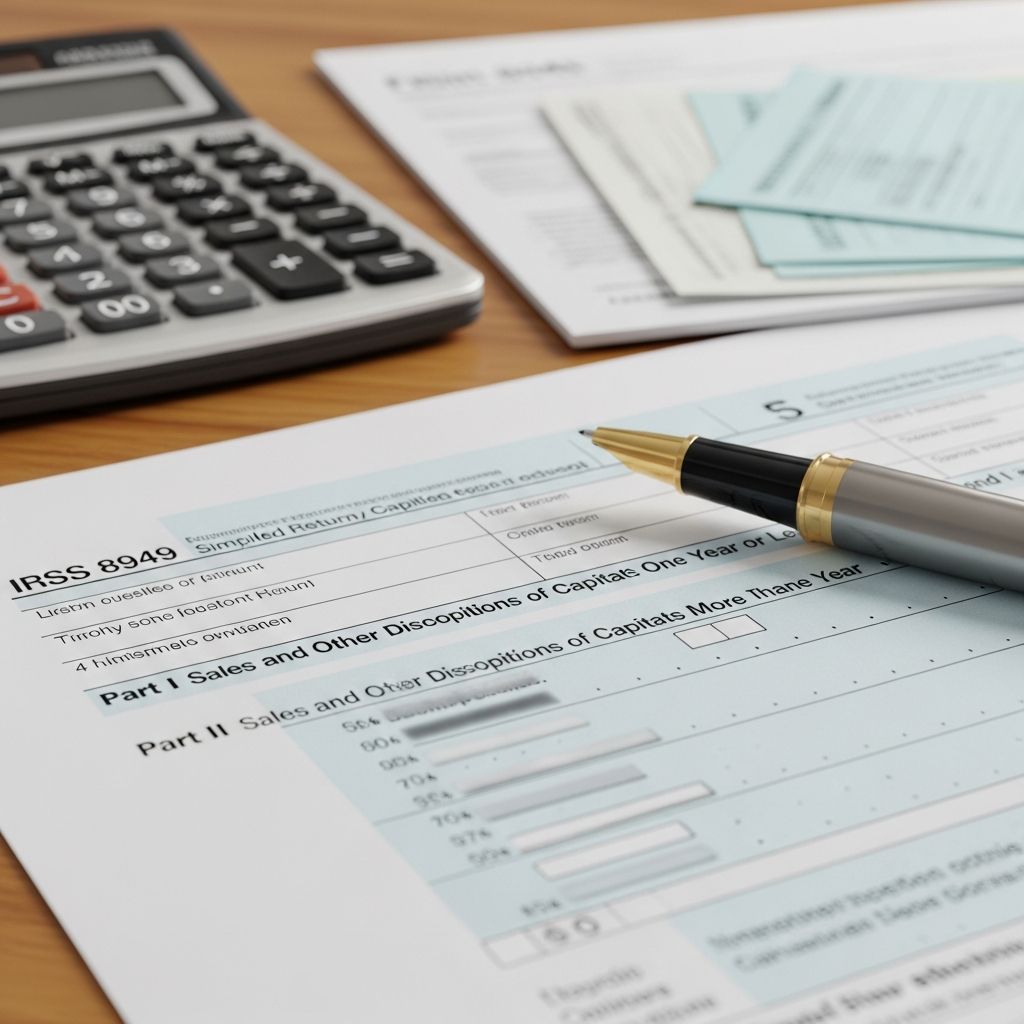
Form 8949: Sales of Capital Assets
Form 8949, officially titled “Sales of Capital Assets,” is a critical tax document that allows taxpayers to report the sale or exchange of capital assets. Whether you are an active investor or someone who occasionally sells investment property, understanding how to properly complete Form 8949 is essential for accurate tax reporting and compliance with Internal Revenue Service regulations.
The form serves as a detailed record that enables the IRS to reconcile the amounts reported on Forms 1099-B and 1099-S with the amounts you actually report on your tax return. This reconciliation process helps ensure that both taxpayers and the IRS have consistent information about capital transactions.
What Is Form 8949?
Form 8949 is used to report sales and exchanges of capital assets on your tax return. A capital asset is generally any property you own that is not for personal use, including stocks, bonds, mutual funds, cryptocurrencies, and real estate investment properties. The primary purpose of this form is to provide detailed documentation of your capital transactions, which are then summarized and transferred to Schedule D (Form 1040).
The form allows you and the IRS to reconcile amounts that were reported to you on Forms 1099-B or 1099-S with the amounts you report on your actual tax return. This reconciliation is crucial because the cost basis information reported to the IRS may differ from your actual cost basis, and Form 8949 allows you to explain and document these differences.
When to Use Form 8949
You must use Form 8949 whenever you sell or exchange capital assets during the tax year. Common scenarios requiring Form 8949 include:
Stock Sales — One of the most common reasons for using Form 8949 is reporting stock transactions. Whenever you sell shares of stock, whether from your brokerage account or through any other means, you need to report the transaction on this form.
Cryptocurrency Transactions — The IRS treats cryptocurrency as property, which means gains or losses from buying and selling digital assets must be reported on Form 8949. This includes Bitcoin, Ethereum, and other cryptocurrencies.
Real Estate Sales — If you sell property that is not your primary residence, such as investment property or a vacation home, you will need to use Form 8949 to report any capital gains or losses from the transaction.
Bond and Mutual Fund Sales — Sales of bonds, mutual funds, and exchange-traded funds (ETFs) must also be reported on Form 8949.
Other Capital Assets — Form 8949 also covers the sale of artwork, collectibles, precious metals, and other capital assets not reported on another form or schedule.
Understanding the Two Parts of Form 8949
Form 8949 is divided into two main sections: Part I and Part II. Each part serves a specific purpose depending on how long you held the asset.
Part I: Short-Term Capital Gains and Losses
Part I of Form 8949 is used to report short-term capital gains and losses. A short-term holding period applies when you own an asset for one year or less. Short-term capital gains are taxed at ordinary income tax rates, which are typically higher than the preferential rates applied to long-term capital gains. This means your short-term gains can be taxed at rates ranging from 10% to 37%, depending on your tax bracket.
On Part I, you will enter transactions in boxes labeled A, B, and C, with box C representing the calculation of your net short-term gain or loss.
Part II: Long-Term Capital Gains and Losses
Part II of Form 8949 is used to report long-term capital gains and losses. A long-term holding period applies when you own an asset for more than one year. Long-term capital gains benefit from preferential tax rates, which are generally 0%, 15%, or 20%, depending on your income level. This preferential treatment makes holding assets long-term more tax-efficient for many investors.
On Part II, you will enter transactions in boxes labeled D, E, and F, with box F representing the calculation of your net long-term gain or loss.
Required Information for Each Transaction
To accurately complete Form 8949, you must gather specific information for each capital asset transaction you report. Having this information organized before you begin filling out the form will make the process more efficient and help prevent errors.
Description of the Asset — You need to provide a clear description of the property being sold. For stocks, you can use the stock ticker symbol or company name. For cryptocurrency, use the name of the digital asset. For real estate, include the property address.
Date Acquired — Record the date you originally purchased or otherwise acquired the asset. This date is critical for determining whether the holding period is short-term or long-term.
Date Sold — Enter the date you sold or exchanged the asset. Combined with the acquisition date, this determines your holding period.
Proceeds from Sale — This is the total amount you received from selling the asset, including any cash and the fair market value of any property received in exchange.
Cost Basis — Record the original purchase price of the asset, adjusted for any improvements, stock splits, or depreciation. Cost basis is essential for calculating your capital gain or loss.
Adjustment to Basis — Some transactions may require adjustments to your cost basis. Document any of these adjustments that apply to your specific situation.
Gain or Loss — This is calculated by subtracting your adjusted cost basis from the proceeds of the sale. A positive number indicates a capital gain; a negative number indicates a capital loss.
Brokerage Information — Include the name and identification number of the broker or institution that handled the transaction.
How to Calculate Capital Gains and Losses
The fundamental calculation for capital gains and losses is straightforward: subtract your cost basis from your proceeds to determine your gain or loss.
For example, if you purchased 100 shares of a stock at $50 per share (cost basis of $5,000) and later sold those shares at $75 per share (proceeds of $7,500), your capital gain would be $2,500.
Conversely, if you sold those shares at $40 per share (proceeds of $4,000), your capital loss would be $1,000.
When you have multiple transactions, Form 8949 allows you to aggregate all short-term gains and losses in Part I and all long-term gains and losses in Part II. The net totals from each part are then transferred to Schedule D.
Transferring Totals to Schedule D
Once you have completed Form 8949 and calculated your net short-term and long-term capital gains or losses, these totals are transferred to Schedule D (Form 1040). Schedule D is where the IRS combines all your capital gains and losses to determine your overall capital gain or loss for the tax year.
Your Form 8949 totals go into specific lines on Schedule D:
Part I of Schedule D — Your net short-term capital gain or loss from Form 8949, Part I
Part II of Schedule D — Your net long-term capital gain or loss from Form 8949, Part II
Schedule D also allows you to report other types of gains, such as gains from Form 6252 (installment sales) and gains from certain involuntary conversions.
Capital Loss Deductions and Carryforwards
If your total capital losses exceed your total capital gains, you can deduct the excess losses against other income. The annual capital loss deduction limit is $3,000 per year for individual taxpayers ($1,500 if married filing separately).
If your total capital losses exceed the annual deduction limit, the remaining unused losses do not disappear. Instead, they can be carried forward to future tax years indefinitely until they are fully utilized. This carryforward provision allows you to offset future capital gains or use additional deductions against other income in subsequent years.
For example, if you have $8,000 in capital losses in the current year, you can deduct $3,000 against other income. The remaining $5,000 loss carries forward to future tax years, where you can continue using it until depleted.
Common Errors to Avoid When Completing Form 8949
Many taxpayers make mistakes when completing Form 8949, which can lead to penalties and audits. Being aware of these common errors can help you avoid them.
Failing to Report All Transactions — Omitting capital gains or losses from your tax return can result in underreporting income and trigger IRS penalties and interest charges.
Incorrect Holding Period Calculation — Misclassifying transactions as short-term when they should be long-term, or vice versa, can significantly affect your tax liability since the two categories are taxed differently.
Cost Basis Errors — Incorrectly calculating your cost basis is one of the most common mistakes. Remember to adjust your basis for stock splits, dividends, and other corporate actions.
Mathematical Mistakes — Simple arithmetic errors can propagate through your entire return and trigger IRS examination.
Missing Documentation — Failing to keep records supporting the information on Form 8949 can result in audit problems.
Incorrect Form 1099-B Reconciliation — Not properly reconciling discrepancies between your Form 1099-B and your reported basis can raise red flags with the IRS.
Penalties and Consequences for Errors
The consequences of errors on Form 8949 can be severe. The IRS actively monitors capital gains and losses reported on tax returns, and discrepancies can trigger examination and penalties.
If the IRS discovers that you underreported capital gains or failed to report transactions altogether, you may face:
– Accuracy-related penalties of 20% on the underpayment
– Fraud penalties of 75% if the IRS determines the error was intentional
– Interest charges on any unpaid taxes, calculated from the original due date
– Potential audit of multiple prior years
– In egregious cases, criminal tax evasion charges
Best Practices for Form 8949 Compliance
To ensure accurate and compliant tax reporting, follow these best practices when dealing with Form 8949:
Maintain Detailed Records — Keep comprehensive documentation of all your capital transactions, including confirmation statements from your broker, purchase receipts, and sale confirmations.
Organize by Transaction Type — Separate your transactions into short-term and long-term categories before completing the form.
Verify Form 1099-B — When you receive your Form 1099-B from your broker, carefully review it for accuracy. Report any discrepancies to your broker immediately.
Use Tax Software or Professional Help — Consider using tax preparation software or consulting with a tax professional to help ensure your Form 8949 is completed correctly.
Double-Check All Calculations — Review all mathematical calculations on your Form 8949 before submitting your return.
Keep Records for Seven Years — Maintain copies of Form 8949 and supporting documentation for at least seven years in case the IRS questions your return.
Form 8949 and Different Investment Types
Different types of investments have specific considerations when completing Form 8949.
Stocks and Mutual Funds — Report the number of shares, cost per share, and sale price per share. Account for any stock splits or mergers that affect your basis.
Cryptocurrencies — Include the type of cryptocurrency, the amount held, acquisition date, and sale date. Remember that the IRS taxes each transaction separately.
Real Estate — For investment or business property, include the property address as the description. Adjust your basis for any capital improvements or depreciation claimed.
Bonds and Fixed Income Securities — Report the bond issuer, coupon rate, and maturity date. Adjust basis for any amortized premium or discount.
Frequently Asked Questions
Q: What is the difference between cost basis and proceeds?
A: Cost basis is what you paid for an asset (plus any improvements), while proceeds is what you received when you sold it. The difference between proceeds and basis equals your capital gain or loss.
Q: Do I need to file Form 8949 if I have no capital gains or losses?
A: No, you only need to file Form 8949 if you have reportable capital asset sales or exchanges during the tax year.
Q: How long must I keep records supporting Form 8949?
A: The IRS recommends keeping tax records for at least seven years, though three years is the standard statute of limitations for most returns.
Q: Can I use Form 8949 for personal property like my home?
A: No, sales of your primary residence are generally not reported on Form 8949. Instead, they may qualify for the capital gains exclusion if certain conditions are met.
Q: What should I do if my Form 1099-B contains errors?
A: Contact your broker immediately to request a corrected Form 1099-B. Report the correct information on Form 8949 and use box C or F to indicate a correction.
Q: Are cryptocurrency transactions treated the same as stock sales on Form 8949?
A: Yes, the IRS treats cryptocurrency as property, so transactions are reported on Form 8949 using the same process as stock sales.
References
- Instructions for Form 8949 (2024) — Internal Revenue Service. 2024. https://www.irs.gov/pub/irs-pdf/i8949.pdf
- Form 8949: Sales of Capital Assets — Internal Revenue Service. 2024. https://www.irs.gov/forms-pubs/form-8949
- Publication 550: Investment Income and Expenses — Internal Revenue Service. 2023. https://www.irs.gov/publications/p550
- Topic No. 409: Capital Gains and Losses — Internal Revenue Service. 2024. https://www.irs.gov/taxtopics/tc409
- Schedule D (Form 1040): Capital Gains and Losses — Internal Revenue Service. 2024. https://www.irs.gov/forms-pubs/schedule-d-form-1040
Similar Articles








Read full bio of medha deb