Forex Basics: Complete Guide to Currency Trading
Master the fundamentals of forex trading: Learn how currency markets work and start your trading journey today.
What Is Forex Trading?
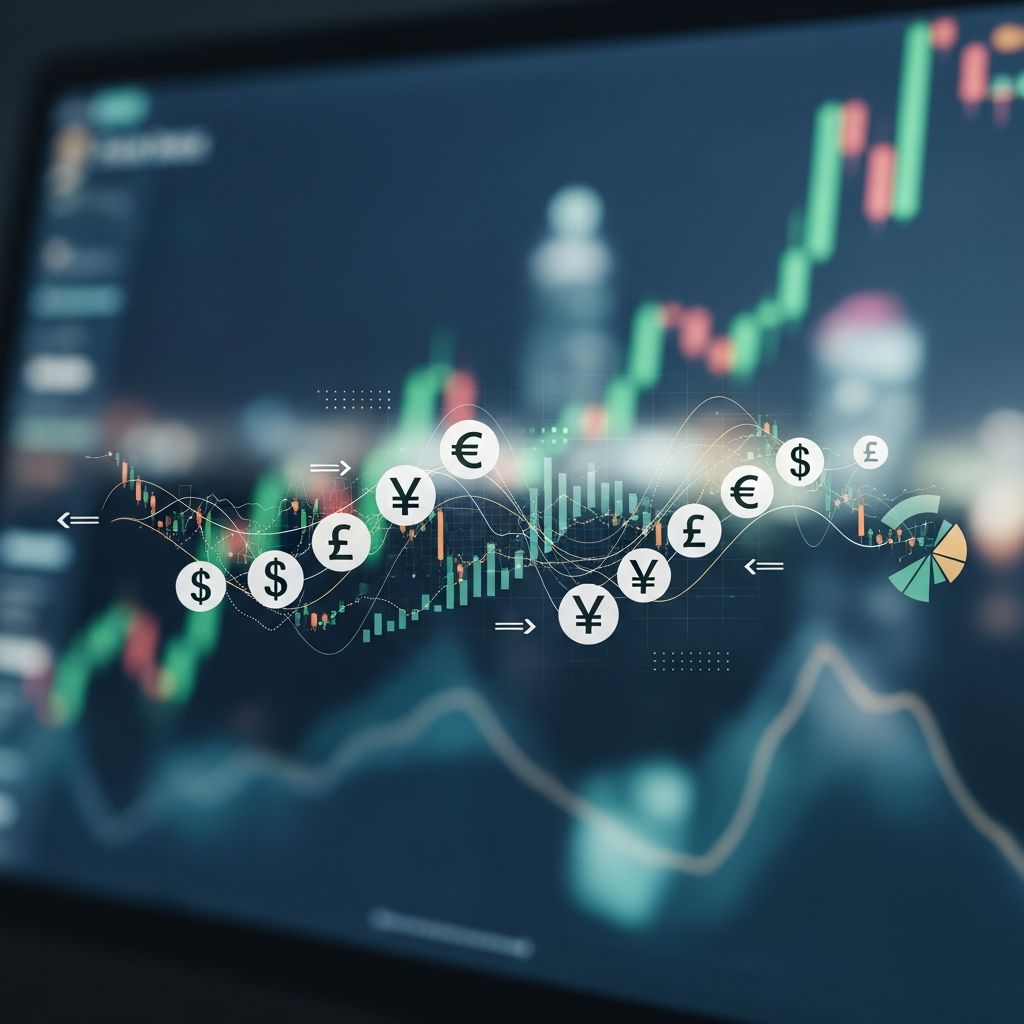
Forex trading, also known as foreign exchange trading or FX trading, involves the buying and selling of currencies in pairs. Unlike stock markets where you purchase ownership in companies, forex trading is the exchange of one currency for another with the goal of making a profit from fluctuations in exchange rates. The forex market is the largest and most liquid financial market globally, with trillions of dollars traded daily across a decentralized network of banks, brokers, and financial institutions.
When you trade forex, you’re not investing in a physical asset or ownership stake. Instead, you’re speculating on whether one currency will strengthen or weaken relative to another. For example, if you believe the Euro will rise in value against the U.S. Dollar, you would buy the EUR/USD pair. Conversely, if you think the Euro will decline, you would sell the pair. This fundamental principle makes forex trading accessible to anyone willing to learn the mechanics and risks involved.
Understanding Currency Pairs
Every forex transaction involves two currencies working together in what’s called a currency pair. The structure of these pairs is crucial to understanding how forex trading operates. Currency pairs are always displayed with a specific notation, such as EUR/USD or GBP/USD, where each currency is represented by a three-letter international code.
Base Currency and Quote Currency
Each forex pair consists of two components: the base currency and the quote currency. The base currency is the first currency listed in the pair, while the quote currency is the second currency listed. The exchange rate indicates how much of the quote currency you need to purchase one unit of the base currency.
For instance, in the EUR/USD pair, the Euro is the base currency and the U.S. Dollar is the quote currency. If the exchange rate shows 1.1200, this means one Euro equals $1.1200. When this rate increases to 1.1300, the Euro has strengthened because you can now purchase more dollars with one Euro. Conversely, if the rate drops to 1.1100, the Euro has weakened relative to the Dollar.
Most Traded Currency Pairs
The most frequently traded currency pair globally is EUR/USD, representing the Euro and the U.S. Dollar. This pair dominates forex trading volume due to the economic significance of both the European Union and the United States. Other major currency pairs include GBP/USD (British Pound/Dollar), USD/JPY (Dollar/Japanese Yen), and USD/CHF (Dollar/Swiss Franc). These major pairs typically offer tighter spreads and higher liquidity, making them ideal for traders seeking more predictable trading conditions.
How the Forex Market Works
The forex market operates fundamentally differently from traditional stock exchanges. Rather than trading on a centralized physical location like the New York Stock Exchange, forex trades in a decentralized market known as the over-the-counter (OTC) market. This decentralized structure means that forex transactions occur through a global network of banks, brokers, and financial institutions connected electronically.
The Interbank Market
At the core of the forex market lies the interbank market, where large financial institutions, central banks, and currency dealers trade with one another. This network operates continuously across major financial centers including London, New York, Tokyo, and Singapore. Because the market operates around the clock across different time zones, trading opportunities exist 24 hours a day, five days a week, making it accessible to traders across the globe.
Market Bid and Ask Prices
In forex trading, you’ll encounter two prices for any currency pair: the bid price and the ask price. The bid price is what buyers are willing to pay, while the ask price is what sellers are asking for. The difference between these two prices is called the “spread,” measured in pips. A pip, or percentage in point, typically represents the smallest price movement in a currency pair, usually 0.0001 for most major pairs. For example, if EUR/USD shows a bid of 1.1200 and an ask of 1.1202, the spread is two pips. This spread represents the cost of entering a trade and is one of the primary ways that forex brokers profit from facilitating trades.
Going Long vs. Going Short
Forex traders employ two basic trading strategies to profit from currency movements: going long or going short. Understanding these directional positions is essential for executing any forex trade.
Going Long
Going long means buying a currency pair with the expectation that the base currency will appreciate in value relative to the quote currency. When you buy a pair like GBP/USD, you’re purchasing British Pounds while simultaneously selling U.S. Dollars. Your profit materializes if the exchange rate increases, allowing you to sell the pair later at a higher price than your purchase price. For instance, if you buy GBP/USD at 1.3000 and the rate rises to 1.3100, you’ve made a profit of 100 pips on that position.
Going Short
Going short means selling a currency pair with the expectation that the base currency will weaken against the quote currency. When you sell GBP/USD, you’re betting that the British Pound will decline in value relative to the Dollar. Your profit occurs if the exchange rate decreases, allowing you to buy back the pair at a lower price. If you sell GBP/USD at 1.3000 and the rate drops to 1.2900, you’ve made a profit of 100 pips by repurchasing at the lower rate.
Leverage and Margin in Forex Trading
One of the distinguishing features of forex trading is the availability of leverage, which allows traders to control large currency positions with relatively small capital deposits. This leverage mechanism operates through a margin requirement system.
Understanding Margin Requirements
Margin represents a good-faith deposit that brokers require to hold open positions. Rather than requiring the full notional value of a trade, brokers allow traders to deposit only a percentage. For example, with a 3% margin requirement, a trader could control $100,000 in the forex market by depositing only $3,000. This leverage amplifies both potential profits and potential losses, making risk management absolutely critical in forex trading.
Free Margin and Equity
Two important concepts related to margin are equity and free margin. Your equity represents your account balance plus or minus any unrealized profits or losses from open positions. Your free margin is the available capital remaining after accounting for margin requirements on open positions. If you have an account balance of $10,000, open a position requiring $4,800 in margin, and the position shows a $2,280 loss, your equity becomes $7,720, and your free margin equals $2,920. Maintaining adequate free margin is essential to avoid margin calls, where your broker forces position closures if available capital falls below required levels.
Key Factors Influencing Currency Values
Currency prices fluctuate based on numerous economic and geopolitical factors. Understanding these drivers helps traders make more informed predictions about future price movements.
Economic Indicators
Central banks closely monitor economic indicators including GDP growth, unemployment rates, inflation, and trade balances. Positive economic data typically strengthens a currency as investors become more confident in that nation’s economy. Conversely, weak economic performance generally weakens a currency. For instance, strong U.S. employment data might strengthen the Dollar, while economic contraction could weaken it.
Interest Rates and Central Bank Policy
Central bank decisions regarding interest rates profoundly impact currency values. Higher interest rates attract foreign investment seeking better returns, increasing demand for that currency and strengthening its value. Conversely, lower interest rates reduce the appeal of that currency to international investors. Forward guidance from central banks about future policy changes also influences currency movements as traders anticipate future economic conditions.
Geopolitical Events
Political instability, trade disputes, elections, and international conflicts can dramatically affect currency values. Investors typically move capital toward safe-haven currencies like the U.S. Dollar or Swiss Franc during times of uncertainty. Natural disasters, changes in trade policies, or diplomatic tensions can create sudden currency movements that traders must navigate.
Forex vs. Other Investment Types
| Factor | Forex Trading | Stock Investing | Bonds |
|---|---|---|---|
| Ownership | No ownership of physical assets | Ownership of company shares | Debt obligations with fixed interest |
| Market Structure | Decentralized (OTC) | Centralized exchanges | Over-the-counter or exchanges |
| Trading Style | Active, short-term trading | Passive or long-term investing | Buy-and-hold investing |
| Risk Level | Generally high | Typically lower to moderate | Generally lower |
| Profit Potential | Both rising and falling prices | Primarily from rising prices | Fixed interest payments |
| Main Influencing Factors | Interest rates, central bank policies | Company performance, market sentiment | Central bank policy, inflation, credit ratings |
Getting Started with Forex Trading
Entering the forex market requires careful preparation and realistic expectations. Successful traders invest time in education before risking real capital.
Develop a Trading Strategy
Effective forex traders develop strategies based on technical analysis, fundamental analysis, or a combination of both. Technical analysis involves studying historical price patterns and using indicators to identify potential entry and exit points. Many profitable traders focus on recognizable candlestick patterns like pin bars, hammers, and shooting stars that form at support and resistance levels identified through historical price movement analysis.
Risk Management
Never risk capital you cannot afford to lose. Implement stop-loss orders to limit potential losses on individual trades. Many experienced traders recommend risking no more than 1-2% of your account on any single trade. This approach ensures that even a series of consecutive losses won’t devastate your trading account.
Practice with Demo Accounts
Before deploying real capital, practice extensively using demo accounts provided by most brokers. Demo accounts simulate real market conditions using virtual money, allowing you to develop your trading skills and test your strategies without financial risk.
Common Mistakes Forex Traders Make
Understanding common pitfalls helps new traders avoid preventable losses. Overusing leverage remains the most frequent mistake, with traders controlling positions far too large for their account size. Poor risk management, including failure to use stop-loss orders, frequently results in catastrophic losses. Trading based on emotions rather than a predetermined strategy undermines consistent profitability. Finally, inadequate market research and jumping into trades without proper analysis often leads to poor entry and exit decisions.
Frequently Asked Questions
Q: What is the minimum amount needed to start forex trading?
A: Minimum deposit requirements vary by broker but can be as low as $1 to $100. However, starting with a larger account provides better risk management flexibility, as risking appropriate percentages becomes more practical with larger capital bases.
Q: Can you make money trading forex?
A: Yes, but forex trading is risky and requires significant skill, education, and discipline. Many traders lose money, particularly beginners who underestimate the complexity and volatility of currency markets. Success requires consistent strategy implementation and emotional discipline.
Q: What are pips and why do they matter?
A: Pips represent the smallest standard price movement in a currency pair, typically 0.0001. They matter because all forex profits and losses are calculated in pips. For a mini lot (10,000 units), one pip equals approximately $1, making pip calculations essential for position sizing and profit projections.
Q: Is forex trading suitable for beginners?
A: Forex trading can be suitable for beginners willing to invest time in education and start with small position sizes. However, the leverage available in forex trading amplifies both gains and losses, making it riskier than many alternative investments for inexperienced traders.
Q: What time should I trade forex?
A: The forex market trades 24 hours daily, but trading volume and volatility vary by session. The London and New York overlapping sessions typically offer the highest volume and tightest spreads. Trading during high-volume periods often provides better execution prices and more predictable price movements.
Q: How do I choose a forex broker?
A: Evaluate brokers based on regulation, spreads, available leverage, customer support quality, and trading platform features. Ensure your broker is regulated by a reputable financial authority and offers transparent fee structures.
Conclusion
Forex trading offers opportunities for profit through currency speculation, but success requires comprehensive understanding of market mechanics, disciplined strategy implementation, and rigorous risk management. The decentralized nature of the forex market provides continuous trading opportunities across global time zones, while leverage amplifies both potential returns and risks. Beginning traders should start with extensive education, demo account practice, and small position sizes until they develop consistent profitability. Understanding currency pairs, market structure, and the factors influencing currency values forms the foundation for more advanced trading strategies. Remember that past performance does not guarantee future results, and all trading involves substantial risk.
References
- What Is Forex Trading and How Does It Work? — Charles Schwab. 2025. https://www.schwab.com/learn/story/what-is-forex-trading
- Forex Trading for Beginners — NerdWallet. 2025. https://www.nerdwallet.com/investing/learn/forex-trading
- What is Forex Trading? Beginner’s Guide to How FX Works — Trading 212. 2025. https://www.trading212.com/learn/cfd-trading/forex-trading
- 5-Step Guide to Winning Forex Trading — Corporate Finance Institute. 2025. https://corporatefinanceinstitute.com/resources/foreign-exchange/the-5-step-guide-to-winning-forex-trading/
Similar Articles








Read full bio of medha deb