FOB Shipping Point vs Destination: Key Differences
Understand FOB shipping terms and how they affect costs, liability, and risk in international trade.
FOB Shipping Point vs. FOB Destination: Understanding Key Distinctions
When engaging in international or domestic trade, understanding shipping terms is crucial for both buyers and sellers. Free on Board (FOB) is one of the most commonly used Incoterms in commercial transactions, yet many business professionals remain unclear about its various applications. The distinction between FOB shipping point and FOB destination fundamentally affects who bears the costs, assumes the risk, and holds liability for goods in transit. This comprehensive guide explores these critical differences and their implications for your business.
What Is FOB (Free on Board)?
FOB, which stands for “Free on Board,” is a term used in international commercial law that specifies at what point respective obligations, costs, and risks involved in the delivery of goods transfer from the seller to the buyer. When FOB terms appear in a sales agreement, they determine the exact moment when liability responsibility for the goods passes from one party to the other. FOB is specifically used for sea and inland waterway transport, and it indicates that the seller delivers the goods on board a vessel nominated by the buyer at a named port of shipment.
The critical feature of FOB is that the buyer takes over risk and costs, including import clearance and duties, as soon as the goods are loaded onto the transport vessel at the port of departure. Until that precise moment, the seller bears all responsibility for the cargo. Understanding whether you are operating under FOB shipping point or FOB destination terms is essential because it dramatically affects your financial obligations and potential liabilities.
FOB Shipping Point: Definition and Implications
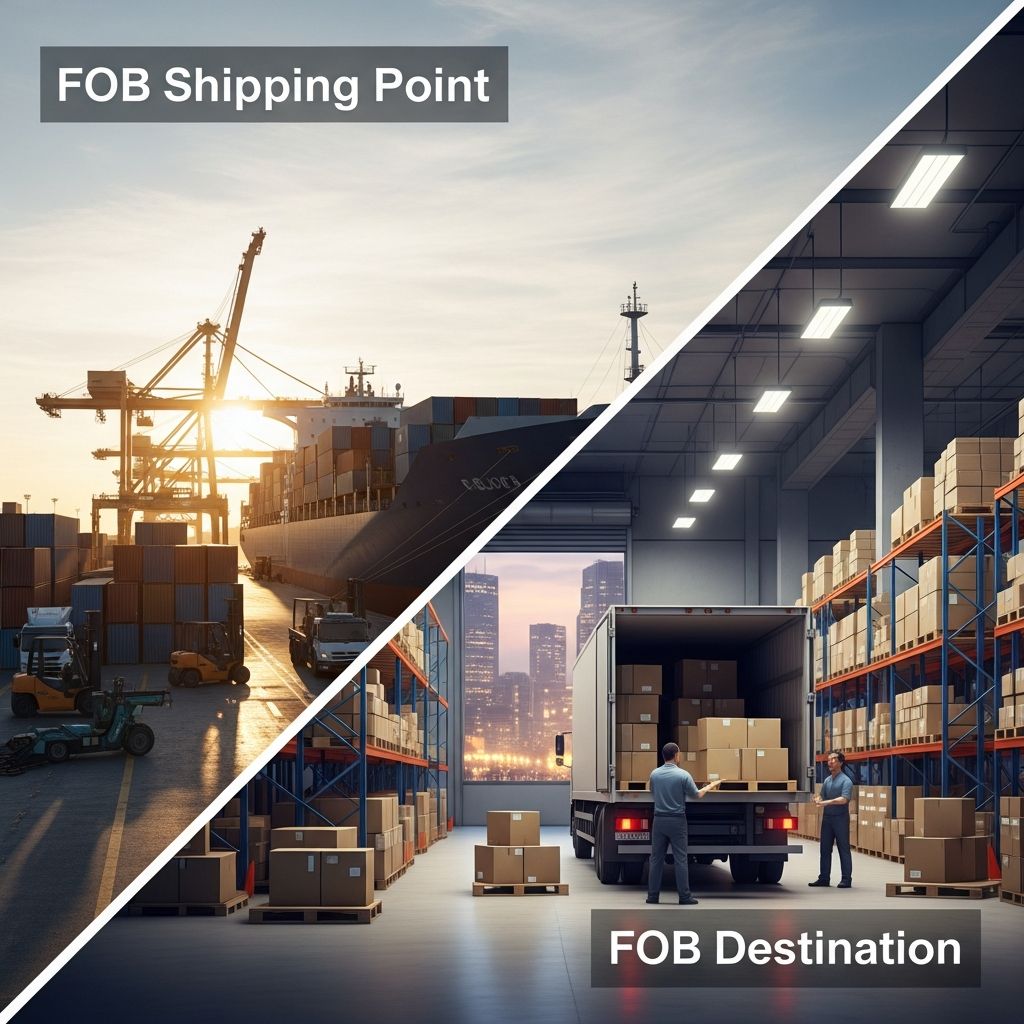
FOB shipping point, also known as FOB origin, means that the buyer assumes ownership, risk, and liability of the goods the moment they are placed on board the shipping vessel at the port of origin (the seller’s location). In this arrangement, the seller is responsible for loading the cargo onto the vessel, but once the goods cross the ship’s rail, all responsibility transfers to the buyer.
Seller’s Responsibilities Under FOB Shipping Point
Under FOB shipping point terms, the seller’s obligations are clearly defined and limited to activities occurring before the goods board the vessel. The seller must:
- Prepare the goods for shipment, including proper packaging and marking
- Arrange export documentation and obtain necessary export licenses
- Perform customs clearance at the origin country
- Arrange transportation from their warehouse to the port of shipment
- Cover all loading charges at the origin port
- Load the goods onto the nominated vessel
- Provide proof of delivery to the carrier
- Cover the costs of pre-shipment inspection
Buyer’s Responsibilities Under FOB Shipping Point
The buyer, having assumed ownership upon loading, bears extensive responsibilities from that point forward:
- Pay for the goods as specified in the sales contract
- Arrange and pay for the main ocean carriage
- Assume all risk of loss or damage during transit
- Pay for discharge services and unloading at the destination port
- Arrange final delivery from the destination port to their facility
- Handle all import formalities and pay customs duties and taxes
- Cover any additional costs for pre-shipment inspection for import clearance
FOB Destination: Definition and Implications
FOB destination represents the opposite arrangement from FOB shipping point. Under FOB destination terms, the seller retains ownership, risk, and liability for the goods until they arrive at the buyer’s destination location. This means the seller remains responsible for the cargo throughout the entire ocean voyage and maintains liability if anything goes wrong during transit.
Seller’s Responsibilities Under FOB Destination
When operating under FOB destination terms, the seller’s obligations are significantly more extensive and continue throughout the shipping process:
- Prepare the goods with proper packaging and marking for export
- Obtain all necessary export licenses and documentation
- Perform export customs clearance
- Arrange transportation to the port of shipment
- Pay for all loading charges at the origin port
- Arrange and pay for the entire ocean freight to the destination
- Maintain insurance throughout the voyage
- Arrange for discharge and unloading at the destination port
- Handle any import customs clearance procedures
- Bear full risk of loss or damage until delivery
Buyer’s Responsibilities Under FOB Destination
The buyer’s obligations under FOB destination are comparatively minimal, as the seller retains control and responsibility:
- Pay for the goods according to the sales contract terms
- Take delivery of the goods at the agreed destination location
- Arrange for final receipt and unloading if not included in seller’s obligations
Key Differences Between FOB Shipping Point and FOB Destination
| Aspect | FOB Shipping Point | FOB Destination |
|---|---|---|
| Risk Transfer Point | Upon loading at origin port | Upon delivery at destination |
| Liability for Damage | Buyer assumes risk after loading | Seller bears risk throughout transit |
| Freight Payment Responsibility | Buyer pays freight charges | Seller pays freight charges |
| Ownership Transfer | At origin port after loading | At destination after delivery |
| Insurance Responsibility | Buyer arranges and pays for insurance | Seller arranges and pays for insurance |
| Seller’s Involvement | Limited to pre-shipment activities | Extends through entire delivery process |
| Cost Advantage | Generally lower costs for seller | Higher costs for seller |
Financial Implications and Cost Allocation
The choice between FOB shipping point and FOB destination has significant financial consequences for both parties involved in the transaction. Understanding these cost allocations is essential for accurate budgeting and pricing strategies.
FOB Shipping Point Cost Structure
Under FOB shipping point arrangements, the buyer typically faces higher total costs because they assume responsibility for all activities after loading. The buyer must budget for ocean freight, maritime insurance, unloading fees, import duties, and final delivery transportation. However, buyers with strong relationships with shipping companies or those with high-volume shipping needs may negotiate favorable freight rates that offset these additional responsibilities. The advantage for sellers is that their financial exposure ends at the loading point, making their accounting and forecasting more straightforward.
FOB Destination Cost Structure
FOB destination arrangements typically result in higher costs for the seller because they must cover all freight, insurance, and delivery expenses. Sellers often incorporate these costs into the quoted price, which may make goods appear more expensive to buyers. However, this arrangement provides buyers with predictability and simplifies their budgeting since they know exactly what they will pay without surprises related to freight or damage claims.
Risk Transfer and Insurance Considerations
A fundamental distinction between these two FOB arrangements centers on risk transfer and the implications for insurance coverage. Understanding who bears the risk is crucial for protecting your interests in international commerce.
Risk Transfer Under FOB Shipping Point
Under FOB shipping point terms, the buyer assumes all risk the moment the goods are loaded onto the vessel. This means if the cargo is damaged, lost, or destroyed during transit, the buyer must absorb the financial loss unless they have purchased marine insurance. Consequently, buyers operating under FOB shipping point must arrange comprehensive marine insurance to protect their interests during the voyage. The buyer’s insurance will cover any claims for loss or damage, and they must manage the claims process directly with the insurance provider.
Risk Transfer Under FOB Destination
Under FOB destination terms, the seller retains all risk until the goods arrive at the destination. If cargo is damaged or lost during the voyage, the seller is responsible for either replacing the goods or issuing a credit. The seller must maintain marine insurance throughout the journey and manages any insurance claims. This arrangement shifts the burden and complexity of managing cargo risk to the seller, which is why this term typically results in higher costs passed on to the buyer through elevated pricing.
Control and Decision-Making Authority
Another significant distinction involves who maintains control over shipping decisions and logistics coordination. These differences can substantially impact operational efficiency and timeline management.
Control Under FOB Shipping Point
Buyers have considerable control and flexibility when operating under FOB shipping point terms. They can select the shipping vessel, negotiate directly with freight forwarders and shipping lines, and determine the shipping schedule. This control allows large-volume buyers to leverage their purchasing power to secure favorable rates and timing. However, this control also comes with coordination responsibilities. The buyer must ensure reliable logistics arrangements and must coordinate with the seller to confirm that goods will be ready for shipment on the agreed date.
Control Under FOB Destination
Under FOB destination arrangements, the seller maintains control over all shipping decisions, including vessel selection, routing, and timing. The buyer essentially delegates these responsibilities to the seller. While this reduces the buyer’s administrative burden, it also means the buyer has less influence over transit schedules and shipping efficiency. Buyers who have specific scheduling requirements or prefer working with particular carriers may find FOB destination terms restrictive.
Practical Business Implications
Selecting between FOB shipping point and FOB destination should align with your business model, financial capabilities, and operational preferences. Several practical considerations should inform your choice:
- Shipping Volume and Negotiating Power: High-volume buyers benefit from FOB shipping point because they can negotiate better freight rates independently
- Financial Capacity: Buyers with strong cash flow and working capital can more easily manage upfront freight costs under FOB shipping point
- Insurance Management: Sellers with established insurance programs may prefer FOB destination to maintain control over coverage
- Operational Complexity: Simpler operations may prefer FOB destination to minimize logistics coordination requirements
- Quality Control: Sellers concerned with cargo handling quality during transit may prefer FOB destination to oversee the process
- Inventory Management: Buyers may prefer FOB shipping point when they want to control timing and route to optimize inventory levels
Frequently Asked Questions
What is the primary difference between FOB shipping point and FOB destination?
The primary difference is when risk and ownership transfer from the seller to the buyer. Under FOB shipping point, this transfer occurs when goods are loaded onto the vessel at the origin port. Under FOB destination, the transfer occurs when goods arrive at the buyer’s destination location.
Who pays freight charges under FOB shipping point?
Under FOB shipping point, the buyer is responsible for arranging and paying all freight charges from the origin port to the destination port. The seller’s cost responsibility ends once the goods are loaded onto the vessel.
Who maintains insurance coverage under each FOB term?
Under FOB shipping point, the buyer must arrange and maintain marine insurance for the goods in transit. Under FOB destination, the seller is responsible for maintaining insurance throughout the shipment process.
Is FOB shipping point or destination more favorable for buyers?
FOB shipping point is generally more favorable for buyers who have strong negotiating power with shipping companies or high shipping volumes, as they can secure better freight rates. However, FOB destination is favorable for buyers who prefer simplicity and cost predictability, as the seller bears all transit costs and risks.
Can FOB terms be used for all types of shipping?
No, FOB terms are specifically designed for sea and inland waterway transport. For other modes of transport, alternative Incoterms such as FCA (Free Carrier) should be used.
Who is responsible for customs clearance under each FOB term?
Under FOB shipping point, the seller handles export customs clearance, while the buyer handles import customs clearance. Under FOB destination, the seller is responsible for both export and import customs clearance procedures.
Conclusion
Understanding the distinction between FOB shipping point and FOB destination is essential for anyone engaged in international or domestic commerce. These terms fundamentally determine cost allocation, risk bearing, liability assignment, and operational control. FOB shipping point places greater responsibility and opportunity for cost savings on the buyer, making it attractive to large-volume purchasers with logistics expertise. FOB destination, conversely, provides simplicity and cost certainty for buyers while requiring sellers to manage more complex shipping responsibilities. Your selection should reflect your business’s financial capabilities, operational sophistication, negotiating power, and strategic priorities. Consulting with logistics professionals and legal advisors can help ensure you select the most advantageous terms for your specific circumstances.
References
- Incoterms FOB: Free on Board — AIT Worldwide Logistics. Accessed November 29, 2025. https://www.aitworldwide.com/resources/incoterms/incoterms-fob-free-on-board/
- Free on Board (FOB) — Cornell Law School, Legal Information Institute. Accessed November 29, 2025. https://www.law.cornell.edu/wex/free_on_board_(fob)
- FOB (Free On Board): Logistics Guide — Fulfill.com. Accessed November 29, 2025. https://www.fulfill.com/glossary/fob-free-on-board
- FOB Incoterms: Free on Board Explained — Guided Imports. Accessed November 29, 2025. https://guidedimports.com/blog/what-does-fob-mean/
- What Does FOB Mean in Shipping? — UniShippers. Accessed November 29, 2025. https://www.unishippers.com/shipping-resources/freight-resources/free-on-board-shipping
- FOB (Shipping) — Wikipedia. Accessed November 29, 2025. https://en.wikipedia.org/wiki/FOB_(shipping)
Similar Articles








Read full bio of medha deb