Fixed Charge Coverage Ratio: Definition and Calculation
Understand how companies measure their ability to pay fixed obligations using FCCR.
What Is the Fixed Charge Coverage Ratio?
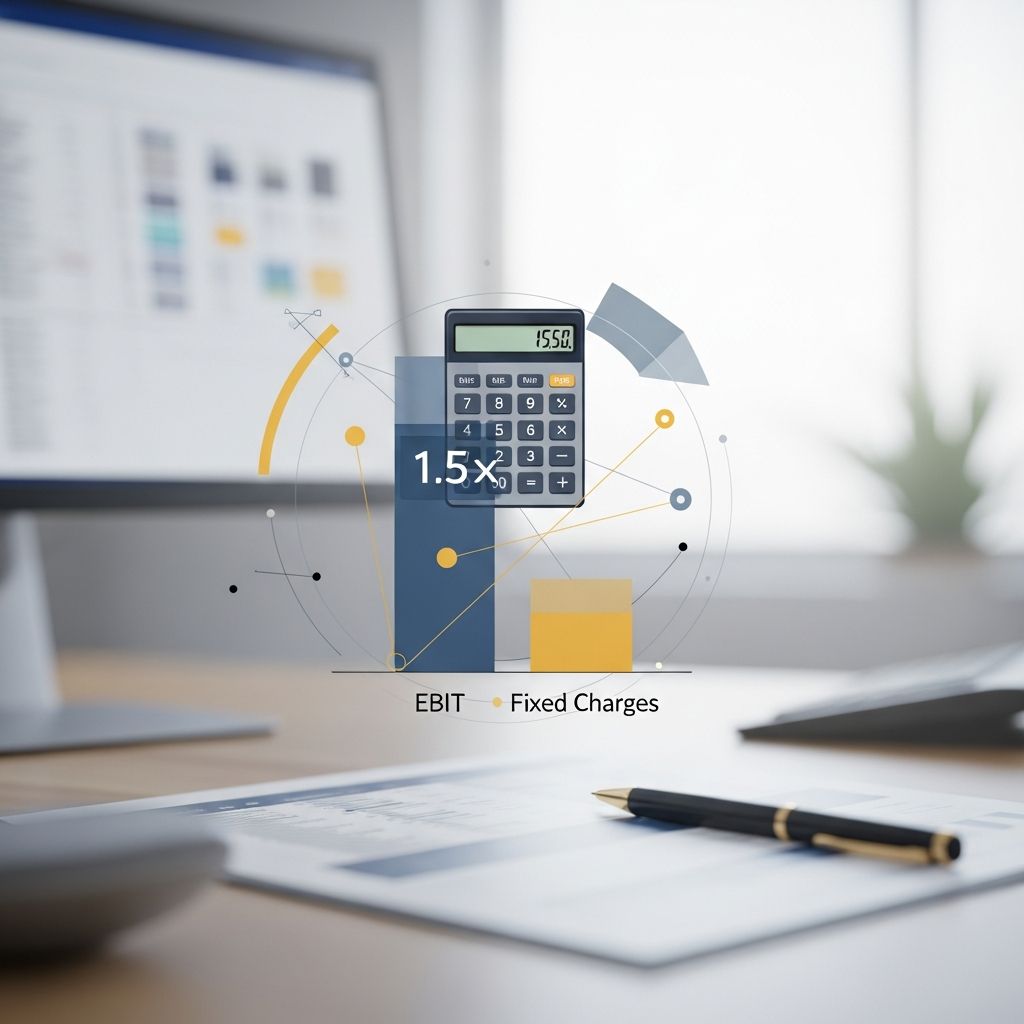
The fixed charge coverage ratio (FCCR) is a financial metric that measures a company’s capacity to pay its fixed expenses using its operating earnings. Fixed charges typically include debt principal repayments, interest expenses, lease payments, rent, and other recurring obligations that a company must meet regardless of its revenue levels or business performance.
This ratio serves as a critical indicator for lenders, creditors, and investors who need to assess whether a company generates sufficient cash flow to meet its contractual payment obligations. Unlike some other coverage ratios that focus exclusively on interest payments, the FCCR provides a more comprehensive view of a company’s financial obligations by incorporating all fixed charges that must be satisfied.
The fixed charge coverage ratio is particularly important in credit analysis because it helps financial institutions determine lending terms, interest rates, and the overall creditworthiness of a borrower. A company with a strong FCCR demonstrates financial stability and a lower risk of default, while a weak ratio may signal financial distress or operational challenges.
Understanding Fixed Charge Coverage Ratio
The FCCR operates on a straightforward principle: it compares a company’s available cash flow to the total fixed charges it must pay during a specific period. This ratio is similar to the times interest earned (TIE) ratio, which measures how many times a company can cover its interest obligations, but the FCCR is more conservative and inclusive because it accounts for all fixed costs, not just interest.
Fixed charges encompassed in this calculation include scheduled principal payments on long-term debt, interest expenses on all debt instruments, rental payments for leased properties or equipment, and any other contractual payment obligations. By including these diverse obligations, the FCCR provides stakeholders with a more accurate picture of a company’s total financial commitments.
Internally, companies use the FCCR to evaluate their fiscal health and make strategic decisions about taking on new fixed costs through capital investments or equipment leases. If a proposed project would reduce the FCCR to a critical level, management may decide against pursuing it to preserve the company’s financial stability.
For external users such as lenders and investors, the FCCR serves as an early warning system. A declining FCCR may indicate that the company is becoming increasingly leveraged or facing operational challenges that reduce profitability. This information helps creditors determine whether to adjust interest rates, impose stricter covenants, or restrict additional borrowing.
Fixed Charge Coverage Ratio Formula
The standard formula for calculating the fixed charge coverage ratio is:
FCCR = (EBIT + Fixed Charges Before Tax) / (Fixed Charges Before Tax + Interest)
Where:
- EBIT represents earnings before interest and taxes, also known as operating income. This figure is calculated by taking net income and adding back interest expense and tax expense.
- Fixed Charges Before Tax include all contractual obligations such as scheduled principal repayments on debt, lease payments, rent, and any other recurring expenses that must be paid regardless of business performance.
- Interest refers to the total interest expense on all debt obligations during the period.
The beauty of this formula lies in its flexibility. Because the FCCR is not restricted to a single cost category, it can be customized based on the specific fixed charges relevant to a particular company or industry. Some lenders may include additional items such as preferred stock dividends, unfunded maintenance capital expenditures, or cash taxes in the numerator and denominator, depending on the credit agreement and the nature of the business.
In more sophisticated analyses, particularly in private equity and corporate lending, analysts may use EBITDA (earnings before interest, taxes, depreciation, and amortization) or EBITDAR (which adds back rent and lease expenses) as the starting point for the numerator. They then make adjustments for capital expenditures, distributions, and other cash outflows to arrive at a more accurate representation of available cash flow.
Key Components Explained
Understanding each component of the FCCR formula is essential for accurate calculation and interpretation. The numerator, which combines EBIT and fixed charges before tax, represents the company’s earnings available to service its obligations. The denominator reflects the total amount of fixed charges the company must pay.
EBIT is found on the company’s income statement as operating income. To calculate it from net income, you add back both interest expense and income tax expense. This adjustment isolates the company’s operational profitability before financing and tax considerations.
Fixed charges before tax include the principal portion of debt payments that must be made in the current period, not just the interest portion. This distinction is crucial because many companies focus only on interest coverage, overlooking the significant burden of principal repayments. Additionally, lease obligations have become increasingly important since accounting standards now require companies to recognize operating leases on the balance sheet.
Interest in the denominator represents the total cost of borrowing across all debt instruments. In some calculations, this may include amortization of debt issuance costs or accretion of debt discounts, reflecting the true economic cost of maintaining the debt structure.
How to Interpret the Fixed Charge Coverage Ratio
The FCCR should always exceed 1.0x, indicating that a company generates enough earnings to cover its fixed obligations. However, the absolute value determines whether the company is in a healthy financial position:
FCCR Below 1.0x: A ratio below 1.0x signals financial distress. The company does not generate sufficient earnings to meet its fixed obligations and must rely on asset sales, additional borrowing, or drawing down cash reserves to pay its bills. This situation is unsustainable long-term and suggests the company may face bankruptcy or restructuring.
FCCR Between 1.0x and 2.0x: While technically adequate, a ratio in this range indicates tighter margins. The company covers its obligations, but has limited cushion for unexpected challenges or economic downturns. Lenders view this range as moderate risk and typically impose stricter covenants and higher interest rates.
FCCR Between 2.0x and 3.0x: This range represents a healthy financial position. The company generates earnings significantly above its fixed obligations, providing a comfortable buffer for adverse conditions. Lenders generally offer favorable terms to companies in this range.
FCCR Above 3.0x to 4.0x: Companies achieving these elevated ratios demonstrate strong financial health and operational efficiency. They have substantial capacity to take on additional obligations, pursue growth initiatives, or weather extended business challenges. These companies typically receive the most favorable credit terms.
It’s important to note that ideal FCCR levels vary by industry. Capital-intensive industries such as telecommunications or utilities typically operate with lower ratios due to their inherent fixed-cost structures, while less capital-intensive businesses may maintain higher ratios. Therefore, comparing a company’s FCCR to industry peers provides more meaningful insight than considering it in absolute terms.
Fixed Charge Coverage Ratio vs. Debt Service Coverage Ratio
The fixed charge coverage ratio is often compared to the debt service coverage ratio (DSCR), another important metric used in credit analysis. While these ratios serve similar purposes, they differ in scope and application.
The DSCR specifically measures a company’s ability to service its debt obligations (principal and interest) using net operating income. It is commonly used in commercial real estate lending and project finance.
The FCCR is broader in scope, encompassing not only debt service but also other essential fixed charges such as lease payments and rent. This comprehensiveness makes the FCCR more useful for analyzing companies with diverse fixed obligations beyond traditional debt.
Proponents of the FCCR argue that it provides a more complete picture of a company’s financial obligations because the DSCR may not adequately capture certain fixed commitments that companies legitimately require to operate. These include rent for physical premises, maintenance capital expenditures that are not debt-funded, and preferred stock dividends.
Fixed Charge Coverage Ratio in Practice
Lenders and analysts incorporate the FCCR into broader credit analysis frameworks alongside other metrics. The leverage ratio (total debt divided by EBITDA) provides context about the company’s overall debt burden, while the interest coverage ratio (EBITDA divided by interest) focuses specifically on the company’s ability to pay interest.
By examining multiple ratios together, lenders develop a comprehensive view of credit risk. For example, a company projected to achieve an FCCR of 3.0x to 4.0x is more likely to receive favorable debt terms than one with an FCCR of 1.0x to 2.0x. Lenders may stress-test the model across various scenarios, including economic downturns or industry-specific challenges, to evaluate how the FCCR performs under adverse conditions.
History provides powerful examples of the FCCR’s predictive value. In 2009, during the financial crisis, a major company’s FCCR fell to 1.02x, reflecting minimal margin for error. The company subsequently reported pre-tax losses for two consecutive years, causing the ratio to drop below 1.0x before ultimately filing for bankruptcy. This case demonstrates how declining or weak FCCRs can signal impending financial trouble.
Calculating Fixed Charge Coverage Ratio: Example
Consider a manufacturing company with the following annual figures:
- EBIT: $5,000,000
- Interest Expense: $800,000
- Scheduled Principal Payment: $600,000
- Annual Lease Payments: $400,000
Using the formula:
FCCR = ($5,000,000 + $1,000,000) / ($1,000,000 + $800,000) = $6,000,000 / $1,800,000 = 3.33x
This result indicates that the company generates $3.33 in earnings for every dollar of fixed charges it must pay. This is a healthy ratio suggesting the company has adequate capacity to meet its obligations.
Why Lenders Use the Fixed Charge Coverage Ratio
The FCCR helps lenders quantify risk and make informed lending decisions. A strong ratio reduces perceived default risk, allowing lenders to offer lower interest rates and more favorable terms. Conversely, a weak ratio increases perceived risk, prompting lenders to demand higher interest rates, additional fees, or stricter covenants as compensation for the elevated risk.
Beyond initial lending decisions, lenders monitor FCCR trends over time. A declining ratio may trigger covenant violations or require the company to take corrective action. This proactive monitoring helps lenders protect their investments and maintain portfolio quality.
Frequently Asked Questions
What is considered a good fixed charge coverage ratio?
Generally, a fixed charge coverage ratio between 2.0x and 3.0x is considered healthy, indicating the company comfortably covers its obligations with room for unexpected challenges. Ratios above 3.0x to 4.0x are excellent, while ratios below 1.5x may be considered risky depending on industry context.
How does the fixed charge coverage ratio differ from the times interest earned ratio?
The times interest earned (TIE) ratio measures only a company’s ability to pay interest expense, while the FCCR includes all fixed charges such as principal repayments, lease payments, and rent. This makes the FCCR more comprehensive and conservative.
Can the fixed charge coverage ratio be negative?
Yes, if a company reports negative EBIT (operating loss), the numerator becomes negative, resulting in a negative FCCR. This signals serious financial distress and indicates the company cannot meet its obligations from operating earnings.
Why do different lenders define FCCR differently?
Because there is no standardized definition, lenders and borrowers negotiate the specific components included in the calculation within credit agreements. Different companies and industries may have unique fixed charges that should be reflected in their particular FCCR calculation.
How frequently should companies monitor their fixed charge coverage ratio?
Companies should monitor their FCCR quarterly or annually depending on their business cycles and lender requirements. Some credit agreements require monthly monitoring to ensure compliance with debt covenants and to identify potential problems early.
References
- Fixed Charge Coverage Ratio (FCCR) — Corporate Finance Institute. 2024. https://corporatefinanceinstitute.com/resources/commercial-lending/fixed-charge-coverage-ratio/
- Fixed Charge Coverage Ratio – Study Finance — Study Finance. 2024. https://studyfinance.com/fixed-charge-coverage-ratio/
- The Fixed Charge Coverage Ratio (FCCR) in Credit Analysis — Breaking Into Wall Street. 2024. https://breakingintowallstreet.com/kb/financial-statement-analysis/fixed-charge-coverage-ratio-fccr/
- What Is a Fixed Charge Coverage Ratio? — SoFi Learn. 2024. https://www.sofi.com/learn/content/fixed-charge-coverage-ratio/
- Fixed Charge Coverage Ratio (FCCR) in Private Equity Transactions — A Simple Model. 2024. https://www.asimplemodel.com/insights/fixed-charge-coverage-ratio-fccr-in-private-equity-transactions
- Fixed-charge coverage ratio Definition — Nasdaq. 2024. https://www.nasdaq.com/glossary/f/fixed-charge-coverage-ratio
Similar Articles








Read full bio of medha deb