Fiscal Policy: Definition, Types, and Economic Impact
Understand how governments use taxation and spending to influence economic growth and stability.
Fiscal policy represents one of the most powerful tools available to governments for managing their national economies. It encompasses the decisions governments make regarding taxation, spending, and borrowing to influence macroeconomic conditions. Through fiscal policy, policymakers attempt to achieve multiple objectives simultaneously: controlling inflation, reducing unemployment, promoting sustainable economic growth, and maintaining overall economic stability. Understanding fiscal policy is essential for anyone interested in economics, investing, or public policy, as these government decisions directly affect economic performance and individual financial circumstances.
What Is Fiscal Policy?
Fiscal policy refers to the use of government revenue collection through taxes or tax cuts and government expenditure to influence a country’s economy. In essence, it describes how governments employ their financial tools to manage aggregate demand, control inflation, and influence employment levels. The development of fiscal policy as a deliberate economic management tool emerged during the Great Depression of the 1930s, when traditional laissez-faire approaches proved inadequate in addressing severe economic contraction.
The theoretical foundation for modern fiscal policy rests on the work of British economist John Maynard Keynes, whose groundbreaking theories suggested that government intervention through taxation and spending changes could significantly influence aggregate demand and overall economic activity. Keynesian economics fundamentally transformed how governments approach economic management, moving away from passive observation toward active policy intervention.
Key Objectives of Fiscal Policy
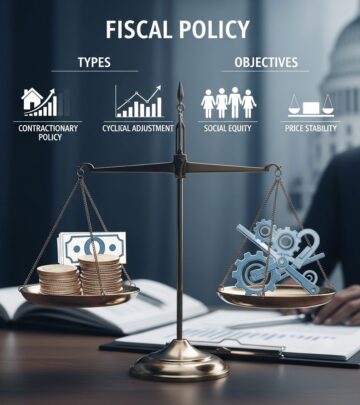
Modern fiscal policy operates with several interconnected objectives that policymakers balance simultaneously. These include:
– Controlling inflation to maintain price stability, with most economists considering 2% to 3% annual inflation as healthy- Promoting sustained GDP growth, typically targeting 2% to 3% annually- Maintaining employment levels near the natural unemployment rate of 4% to 5%- Stabilizing the economy throughout business cycles- Promoting equitable income distribution- Allocating resources efficiently across the economy
By adjusting taxation levels and government spending, fiscal authorities can directly influence aggregate demand, which in turn affects these macroeconomic variables. The combination of fiscal policy with monetary policy allows governments and central banks to coordinate efforts in achieving economic objectives.
Fiscal Policy vs. Monetary Policy
While fiscal policy and monetary policy work toward similar economic objectives, they operate through different mechanisms and are administered by different authorities. Fiscal policy deals specifically with taxation and government spending, typically managed by government finance ministries or treasury departments. Monetary policy, conversely, focuses on controlling the money supply and interest rates, functions primarily administered by a country’s central bank.
Both policy types influence economic performance substantially, but they achieve this through distinct channels. Fiscal policy directly affects consumer and business behavior through tax changes and spending decisions. Monetary policy influences economic activity through credit availability and borrowing costs. Together, these complementary tools enable policymakers to target inflation more effectively and work toward full employment.
The Three Stances of Fiscal Policy
Fiscal policy operates in three distinct forms, each suited to different economic conditions and designed to achieve specific objectives:
Expansionary Fiscal Policy
Expansionary fiscal policy is implemented when governments seek to stimulate economic activity during downturns or recessions. This approach involves government spending exceeding tax revenue by amounts greater than historical averages. Expansionary measures typically include:
– Increased government spending on infrastructure projects such as building schools, highways, and public facilities- Tax cuts that increase disposable income and consumer purchasing power- Enhanced transfer payments and social benefits- Government investment in research and development initiatives- Public employment programs designed to reduce unemployment
The rationale behind expansionary policy follows Keynesian theory: by increasing aggregate demand through higher government spending or lower taxes, the government can encourage businesses to invest and consumers to spend more, thereby pulling the economy out of recession. The resulting budget deficits are theoretically manageable because the expanded economy generates additional tax revenue during the subsequent expansion phase.
Contractionary Fiscal Policy
Contractionary fiscal policy serves the opposite purpose, designed to slow economic growth when inflation becomes excessive or unsustainable growth emerges. This stance involves raising tax rates while reducing government spending, resulting in lower government deficit spending than historical norms. Contractionary measures include:
– Increasing tax rates across individual and corporate income- Reducing government spending and public sector employment- Decreasing transfer payments and social benefits- Limiting government investment programs- Tightening fiscal budgets across agencies
By reducing the total income available in the economy, contractionary fiscal policy decreases aggregate demand and spending. This cooling effect helps address inflation pressures and prevents unsustainable economic expansion that could lead to subsequent recessions. However, contractionary policies carry risks, as excessive tightening can trigger unemployment increases and economic slowdown.
Neutral Fiscal Policy
Neutral fiscal policy represents a balanced approach where government spending approximately equals tax revenue over the business cycle. Rather than attempting to stimulate or contract the economy, neutral policy maintains stable conditions. A government budget balanced over the business cycle represents an effective neutral fiscal policy stance, neither accelerating nor decelerating economic activity systematically.
How Fiscal Policy Affects the Economy
Fiscal policy operates through multiple economic channels, producing complex effects throughout the economy. Changes in taxation levels and government spending composition directly influence:
Aggregate Demand and Economic Activity
Government spending directly increases aggregate demand when implemented. When the government builds infrastructure or funds public services, it purchases goods and services, directly adding to total demand. Tax cuts increase household disposable income, typically leading to increased consumer spending. Both mechanisms stimulate aggregate demand, encouraging businesses to expand production and hire additional workers.
Saving and Investment
Fiscal expansion affects private saving and investment decisions. When government spending increases, it may compete with private investment for available capital in credit markets. Higher government borrowing drives up interest rates, potentially discouraging private business investment—a phenomenon known as crowding out. Conversely, fiscal contraction reduces government borrowing, potentially freeing capital for private investment.
Income Distribution
The composition of fiscal policy significantly affects income distribution across different population segments. Progressive taxation and targeted transfer payments can reduce income inequality, while regressive tax structures may increase it. Government spending on education, healthcare, and social services disproportionately benefits lower-income populations, while tax cuts for high earners affect wealth distribution differently.
International Economic Effects
Fiscal expansion creates ripple effects in international markets. When a country experiences fiscal stimulus, foreign investors often increase capital flows into that country to purchase government bonds and invest in businesses. This increased demand for the country’s currency appreciates its exchange rate. While import costs decrease, export prices rise for foreign buyers, potentially reducing export competitiveness. These international transmission mechanisms complicate fiscal policy effects.
The Keynesian Perspective on Fiscal Policy
Keynesian economics provides the intellectual foundation for modern fiscal policy practice. Keynesians argue that increased government spending and decreased tax rates represent the most effective mechanisms for influencing aggregate demand and stimulating economic activity. According to Keynesian theory, expansionary fiscal policy should be aggressively deployed during recessions or periods of low economic activity, establishing frameworks for strong subsequent growth and full employment achievement.
Keynesians further contend that government should reduce spending and increase taxes after economic expansion occurs, using the resulting surpluses to pay down deficits accumulated during downturns. This counter-cyclical approach aims to stabilize economic fluctuations while maintaining long-term budget sustainability. The New Deal programs implemented during the Great Depression represented the practical application of these Keynesian principles.
Fiscal Policy Challenges and Considerations
Implementing fiscal policy effectively presents numerous challenges for policymakers. Recognition lags—the time required to identify economic problems—can delay policy responses. Implementation lags occur as legislation must be drafted, debated, and enacted before policy takes effect. Timing lags develop as fiscal measures take months or years to fully impact the economy. These delays can cause fiscal policy to become procyclical rather than counter-cyclical, potentially amplifying rather than moderating economic cycles.
Additionally, the distinction between automatic stabilizers and discretionary fiscal policy proves important. Automatic stabilizers—such as progressive taxation and unemployment benefits—adjust without legislative action. Discretionary fiscal policy requires deliberate government action through legislation, introducing political considerations that may prevent optimal economic management.
Real-World Applications of Fiscal Policy
Throughout economic history, governments have employed fiscal policy with varying degrees of success. During recessions, governments typically implement expansionary policies through infrastructure spending and tax cuts. During inflationary periods, they employ contractionary measures to cool demand. The 2008 financial crisis prompted massive fiscal stimulus packages globally. The COVID-19 pandemic triggered unprecedented fiscal support to maintain economic activity during lockdowns.
Different countries adopt varying fiscal policy philosophies based on their economic circumstances, political systems, and institutional structures. Some nations maintain more balanced budgets year-to-year, while others accept larger deficits during recessions while pursuing surpluses during expansions.
Frequently Asked Questions
What is the primary goal of fiscal policy?
The primary goal of fiscal policy is to stabilize the economy and achieve sustainable economic growth while managing inflation and maintaining employment near natural levels. Governments use taxation and spending to influence aggregate demand and macroeconomic conditions.
How does expansionary fiscal policy stimulate the economy?
Expansionary fiscal policy stimulates the economy by increasing government spending and reducing taxes, thereby increasing aggregate demand. Higher spending by government and consumers encourages business investment and hiring, pulling the economy out of recession.
What is the difference between fiscal and monetary policy?
Fiscal policy involves government taxation and spending decisions, while monetary policy involves central bank management of money supply and interest rates. Both influence economic performance but operate through different mechanisms and institutions.
Why might contractionary fiscal policy be necessary?
Contractionary fiscal policy becomes necessary when inflation rises to unsustainable levels or economic growth accelerates excessively. By reducing aggregate demand through higher taxes and lower spending, contractionary policy moderates inflation and prevents overheating.
What are the limitations of fiscal policy?
Fiscal policy limitations include recognition lags, implementation lags, timing lags before effects materialize, and political difficulties in implementing unpopular measures. Additionally, crowding out effects can reduce private investment when government borrowing increases.
References
- Fiscal policy — Wikipedia. Accessed 2025-11-29. https://en.wikipedia.org/wiki/Fiscal_policy
- Macroeconomic Indicators and Analysis — International Monetary Fund (IMF). 2024. https://www.imf.org/external/datamapper/
- Principles of Economics — U.S. Bureau of Economic Analysis. 2024. https://www.bea.gov/
Similar Articles








Read full bio of Sneha Tete