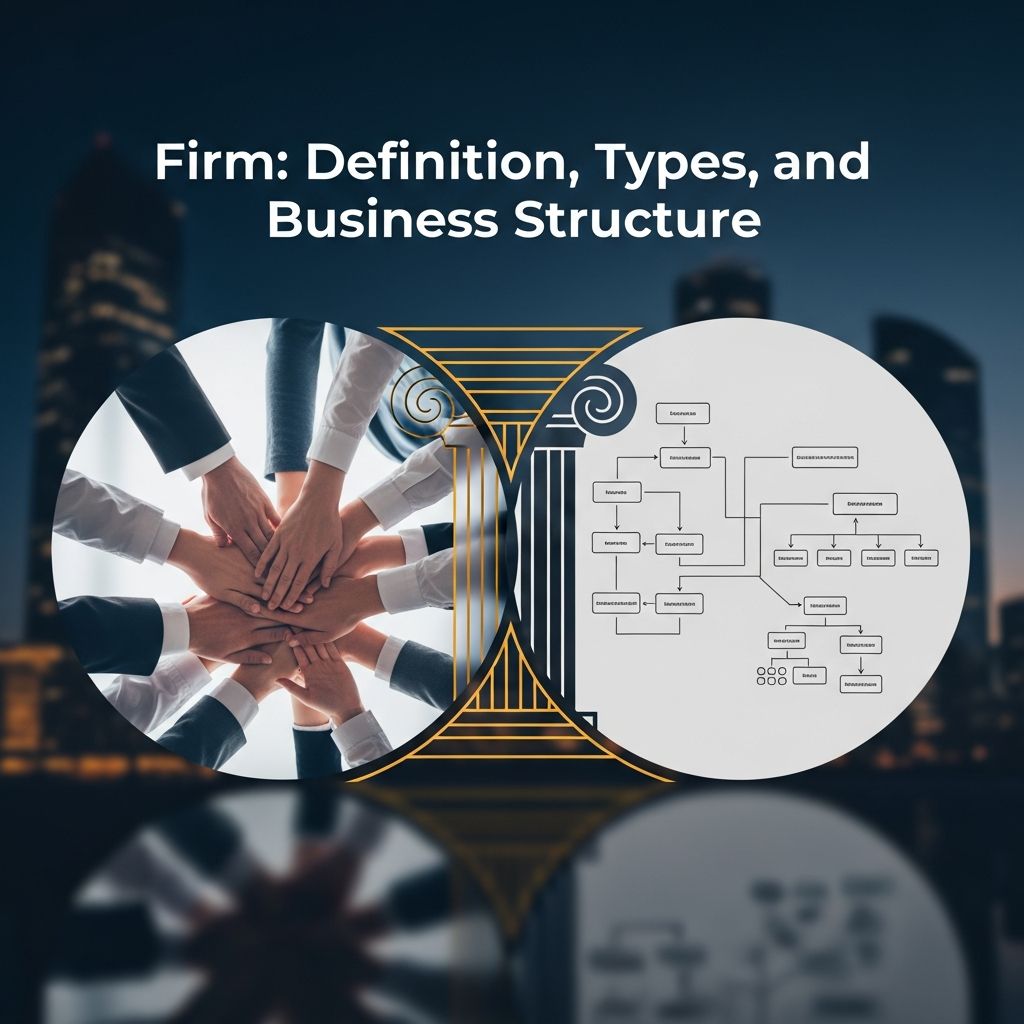
Firm: Definition, Types, and Business Structure
Understanding firms: Definition, organizational types, and business structures explained.
In the business world, the term “firm” is fundamental to understanding how commerce operates. A firm represents an economic unit that combines various factors of production—labor, capital, and materials—to produce and distribute goods or services to consumers. Whether a sole proprietorship, partnership, or corporation, firms are the backbone of the modern economy, driving innovation, employment, and economic growth.
What Is a Firm?
A firm is defined as a business organization established with the primary objective of generating profit through the production and sale of goods or services. At its core, a firm is an entity that brings together entrepreneurs, workers, and resources to create value in the marketplace. The term encompasses businesses of all sizes, from small family-owned enterprises to multinational corporations with thousands of employees.
Firms operate within a framework of economic principles where they aim to maximize efficiency and minimize costs while maximizing revenue. The firm’s success depends on its ability to adapt to market conditions, manage resources effectively, and satisfy customer demands. Every firm, regardless of its size or industry, functions as a decision-making unit that determines what to produce, how much to produce, and at what price to sell its offerings.
Key Characteristics of a Firm
Several defining characteristics distinguish a firm from other entities:
- Profit Motive: The primary objective is to generate profit by selling goods or services at prices higher than production costs.
- Organizational Structure: Firms have defined hierarchies, roles, and responsibilities that enable coordinated operations.
- Legal Entity: Depending on the structure, a firm may have independent legal status separate from its owners.
- Continuous Operations: Firms are designed to operate on an ongoing basis, not just for single transactions.
- Risk Assumption: Firms assume business risks and bear the consequences of market fluctuations and operational decisions.
- Resource Combination: Firms coordinate human resources, capital, technology, and raw materials to produce value.
Types of Firm Structures
Firms can be organized in various legal structures, each with distinct advantages, disadvantages, and tax implications. Understanding these structures is crucial for entrepreneurs deciding how to establish their businesses.
Sole Proprietorship
A sole proprietorship is the simplest and most common form of business organization. It involves a single individual who owns and operates the business. The owner has complete control over all business decisions, receives all profits, and bears all losses and liabilities personally. Sole proprietorships are easy to establish, require minimal regulatory compliance, and offer complete autonomy. However, they offer no personal liability protection, meaning the owner’s personal assets can be at risk if the business faces legal action or debt obligations.
Partnership
A partnership involves two or more individuals who combine resources and share ownership of the firm. Partnerships can take several forms, including general partnerships (where all partners share liability) and limited partnerships (where some partners have limited liability). Partnerships offer shared responsibility, combined expertise, and potential access to more capital than sole proprietorships. However, partners share liability, and disagreements between partners can create operational challenges. Partnership agreements are essential to clarify each partner’s rights, responsibilities, and profit-sharing arrangements.
Corporation
A corporation is a legal entity separate from its owners. It is created through government registration and exists independently of its shareholders. Corporations offer significant liability protection, as shareholders’ personal assets are generally protected from corporate debts and legal judgments. Corporations can raise capital by issuing stock, which makes them suitable for larger enterprises. However, corporations face more regulatory requirements, higher establishment costs, and potential double taxation on corporate profits and shareholder dividends.
Limited Liability Company (LLC)
An LLC combines characteristics of partnerships and corporations. It provides liability protection similar to corporations while maintaining the operational flexibility and tax advantages of partnerships. LLCs are increasingly popular among small to medium-sized businesses because they offer a middle ground between sole proprietorships and corporations. Members (owners) enjoy limited personal liability while the firm can be taxed as a partnership or corporation, depending on the owner’s election.
Cooperative
A cooperative is a firm owned and controlled by its members or users. Rather than pursuing maximum profit for external shareholders, cooperatives distribute profits among members based on their participation or patronage. Cooperatives are common in agriculture, consumer services, and credit unions. They emphasize member benefits, democratic decision-making, and community support.
Organizational Structure and Management
How a firm organizes itself internally significantly impacts its efficiency and success. Most firms operate with hierarchical structures that define reporting relationships, decision-making authority, and departmental responsibilities. Common organizational structures include:
- Functional Structure: Organized by business functions (marketing, finance, operations, human resources).
- Divisional Structure: Organized by product lines, geographic regions, or customer segments.
- Matrix Structure: Combines functional and divisional structures, allowing employees to report to multiple supervisors.
- Flat Structure: Minimizes hierarchical levels to encourage collaboration and faster decision-making.
- Network Structure: Relies on external partners and contractors for specialized functions.
Firm Size Classifications
Firms are often categorized by size, which influences their operational capacity, financial resources, and market reach:
| Classification | Employee Count | Annual Revenue | Characteristics |
|---|---|---|---|
| Micro-firm | 1-9 employees | Less than $1 million | Sole proprietorships and very small businesses with limited resources |
| Small Firm | 10-99 employees | $1-10 million | Growing businesses with basic organizational structure |
| Medium Firm | 100-999 employees | $10-100 million | Established businesses with more formal management and multiple departments |
| Large Firm | 1,000+ employees | Over $100 million | Complex organizations with extensive operations and global reach |
How Firms Create Value
Firms generate value through multiple mechanisms. The primary value creation process involves transforming inputs (labor, capital, materials) into outputs (products or services) that customers perceive as valuable. Firms create value by:
- Improving product quality and features that consumers desire.
- Reducing production costs through efficiency gains and innovation.
- Developing brand identity and customer loyalty.
- Adopting new technologies that enhance productivity.
- Expanding market reach and customer base.
- Providing exceptional customer service and support.
- Creating strategic partnerships and supply chain advantages.
The Role of Firms in the Economy
Firms are essential to economic systems worldwide. They drive employment by creating jobs for millions of workers. They contribute to government revenues through taxation, support infrastructure development, and foster innovation through research and development investments. Firms compete in markets, which promotes efficiency and consumer benefits through improved products and competitive pricing. Additionally, firms facilitate trade, both domestically and internationally, contributing to economic growth and global interconnectedness.
Challenges Faced by Firms
Operating a firm involves navigating numerous challenges. Market competition requires firms to continuously innovate and improve to maintain market share. Economic cycles and recessions can impact demand for products or services. Regulatory compliance demands resources and expertise. Human resource management challenges include recruiting talented employees and managing workplace dynamics. Technological disruption requires firms to adapt or risk obsolescence. Supply chain disruptions, changing consumer preferences, and global uncertainties add additional layers of complexity to firm operations.
Digital Transformation in Modern Firms
Contemporary firms increasingly embrace digital transformation to remain competitive. This involves adopting digital technologies across all business functions—from customer relationship management systems to artificial intelligence-powered analytics. Digital transformation enables firms to improve operational efficiency, enhance customer experiences, reach new markets through e-commerce, and make data-driven decisions. Firms that successfully navigate digital transformation gain significant competitive advantages, while those that lag behind risk losing market relevance.
Frequently Asked Questions
Q: What is the difference between a firm and a company?
A: While often used interchangeably, “firm” typically refers to a professional service organization (law firms, consulting firms), whereas “company” can apply to any business organization. However, in modern usage, the distinction is increasingly blurred.
Q: Can a firm operate as a non-profit?
A: Technically, traditional firms aim to generate profit. However, non-profit organizations operate similarly to firms in structure and operations but reinvest surpluses back into their mission rather than distributing profits to owners.
Q: What determines a firm’s size?
A: Firm size is typically determined by employee count and annual revenue. Different countries and industries may have varying definitions, but these two metrics are the most common benchmarks.
Q: How do firms decide what to produce?
A: Firms analyze market demand, competitive landscape, available resources, and profit potential. Market research, consumer surveys, and financial analysis guide production decisions to maximize profitability.
Q: What role does entrepreneurship play in firm creation?
A: Entrepreneurship is fundamental to firm creation. Entrepreneurs identify market opportunities, develop business ideas, secure resources, and establish firms to address customer needs and generate profits.
Q: How important is firm culture to success?
A: Firm culture significantly impacts employee satisfaction, retention, productivity, and overall performance. A positive organizational culture fosters innovation, collaboration, and commitment among team members.
References
- Small Business Administration (SBA) – Size Standards — U.S. Small Business Administration. 2025. https://www.sba.gov/document/support–table-size-standards
- Business Structures and Legal Forms — U.S. Internal Revenue Service (IRS). 2025. https://www.irs.gov/businesses/small-businesses-self-employed/business-structures
- Economics of the Firm — Massachusetts Institute of Technology (MIT) OpenCourseWare. 2024. https://ocw.mit.edu
- Organizational Behavior and Firm Performance — Society for Human Resource Management (SHRM). 2024. https://www.shrm.org/research
- Digital Transformation in Business: Strategy and Implementation — World Economic Forum. 2024. https://www.weforum.org/reports
Similar Articles








Read full bio of Sneha Tete