Loan Terms: An Essential Guide To Choosing The Right Term
Navigate loan duration decisions with confidence and financial clarity

When borrowing money, one of the most consequential decisions you’ll make involves selecting how long you want to repay that loan. This choice—known as the loan term—shapes your monthly budget, influences the total amount you’ll ultimately pay, and affects your financial flexibility for years to come. Yet many borrowers rush through this decision or simply accept whatever term a lender suggests without fully understanding the implications. Understanding how different loan terms work and evaluating them against your personal circumstances is essential for making a choice you’ll be satisfied with.
Understanding the Fundamentals of Loan Repayment Periods
A loan term represents the span of time you’ve agreed to repay borrowed funds, typically ranging from a few months to several decades depending on the type of borrowing. When you take out a personal loan, you might have options ranging from two to seven years. Mortgage terms commonly span 15 or 30 years, though other durations exist. Auto loans typically fall somewhere in the middle, often lasting three to six years. The term you select directly determines how your principal and interest get divided across your monthly payments.
The relationship between term length and your obligations isn’t simple arithmetic. A longer repayment timeline means each monthly payment spreads the principal across more months, resulting in smaller individual payments. Conversely, compressing repayment into a shorter timeframe requires larger monthly installments. However, the interest component complicates this picture significantly. The longer your money remains borrowed, the more interest accumulates, even if your monthly payment feels manageable.
The Payment-Versus-Cost Equation
The fundamental tension in loan term selection involves reconciling two competing priorities: keeping monthly payments affordable and minimizing total interest costs. These goals frequently pull in opposite directions. A borrower with $20,000 to repay at a 6% interest rate faces a crucial choice: spreading that repayment over 36 months results in monthly payments around $599 with approximately $1,220 in total interest. Extending the same loan to 60 months reduces the monthly obligation to roughly $386 but increases total interest paid to approximately $3,200.
This example illustrates why the decision warrants serious consideration. The difference between a three-year and five-year term on this moderate loan amount exceeds $1,980 in extra interest charges. For larger loan amounts, such as mortgages, the disparities become even more dramatic. Someone borrowing $300,000 at 6% would pay approximately $215,838 in interest over 30 years but only $109,638 over 15 years—a difference of more than $106,000.
Understanding these trade-offs requires moving beyond just comparing two or three options. Most lenders offer multiple term choices specifically because borrowers have different financial circumstances and priorities. The goal isn’t necessarily to find the objectively “best” term but rather to identify the arrangement that best aligns with your current situation and future aspirations.
Evaluating Your Current Financial Position
Before comparing specific term options, honestly assess your present financial reality. This assessment should examine three interconnected dimensions: your monthly income stability, your existing financial obligations, and your emergency savings cushion.
Your monthly income represents the foundation supporting all borrowing decisions. If your earnings fluctuate significantly—perhaps you work on commission or operate a seasonal business—you might need more flexibility than someone with stable, predictable paychecks. A lower, more stable monthly payment from a longer-term loan might provide the breathing room necessary to handle income variations without defaulting during slower months. Conversely, if you have reliable, substantial income, you might comfortably manage higher monthly payments associated with shorter terms.
Equally important is examining your existing financial obligations. Your new loan payment doesn’t exist in isolation; it’s one component of your monthly budget alongside rent or mortgage, utilities, insurance, food, transportation, childcare, student loan payments, and other commitments. Financial advisors often suggest that your total debt payments—including the new loan—shouldn’t exceed a certain percentage of your gross income, typically around 35-43%. If you’re already stretched across multiple obligations, a shorter term that requires higher payments might push you past sustainable limits.
The down payment or initial capital you can contribute also influences optimal term selection. A substantial down payment reduces the principal you need to borrow, which in turn reduces total interest regardless of term length. Someone able to put down 30% on a home purchase can afford shorter terms with higher payments because the overall loan amount remains manageable. Those with minimal savings for a down payment might need longer terms to make payments feasible, even though this increases total interest costs.
Matching Terms to Your Time Horizons
Beyond immediate affordability, consider how long you actually intend to keep the asset you’re financing and how your life circumstances might evolve. This temporal dimension significantly influences optimal term selection.
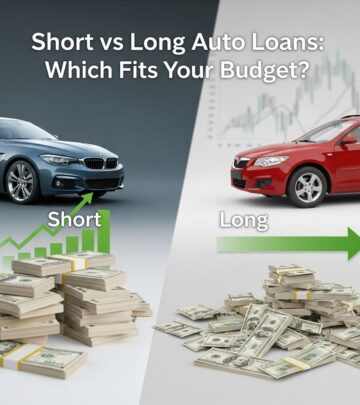
If you’re purchasing a vehicle you plan to drive for 10+ years, aligning your loan term with the vehicle’s expected useful lifespan makes sense. Taking a seven-year auto loan on a car you intend to keep for 12 years means you’ll own the vehicle outright during the final five years—ideally a period without loan payments. However, if you trade vehicles every three years, a longer auto loan term means you’ll still be paying for a vehicle after you’ve already replaced it with something newer.
Similarly, real estate decisions depend heavily on your residential time horizon. Someone who has firmly decided to remain in their home for 20+ years might comfortably choose a 30-year mortgage, knowing the entire repayment period will be completed before they expect to relocate. Someone uncertain about staying in the current home, perhaps expecting job relocation or lifestyle changes within five years, might prefer a 15-year term with higher payments, planning to sell and relocate before the loan term expires anyway.
Interest Rate Considerations and Market Timing
The interest rate attached to your loan interacts with term length in complex ways that deserve careful analysis. Shorter-term loans frequently carry lower interest rates than longer-term alternatives for the same borrower and lender. This rate advantage compounds the payment and cost benefits of choosing shorter terms. However, interest rate markets fluctuate based on broader economic conditions.
In periods when interest rates are unusually low and expected to rise in the future, locking in a longer-term loan at the current low rate protects you from future rate increases. Conversely, if rates are currently elevated but economic forecasts suggest decreases ahead, taking a shorter term might be preferable, allowing you to refinance at lower rates as they decline. However, this market-timing strategy requires confidence in economic predictions and acknowledgment that forecasts often prove wrong.
The interest rate differential between terms also varies. Sometimes the rate difference between a 15-year and 30-year mortgage is minimal—perhaps 0.25%—while other times it exceeds 1%. Comparing actual rates offered for each term option you’re considering, rather than relying on general assumptions, ensures you’re making decisions based on current market reality.
The Prepayment Flexibility Question
One often-overlooked feature can substantially change the term selection calculus: the ability to make additional payments without penalties. If a lender permits prepayment penalty-free, you can effectively create a hybrid approach. You might choose a longer-term loan for its lower monthly payment, protecting yourself against cash flow difficulties, while retaining the option to make extra payments whenever your budget allows.
This flexibility transforms the decision. Instead of committing to a specific monthly payment amount, you’re committing to a maximum payment while maintaining the option to pay more aggressively when circumstances permit. Someone selecting a 60-month term might still achieve 36-month payoff if they make extra payments during good financial months, capturing most of the interest savings of a shorter term while keeping their monthly baseline payment lower.
Not all lenders offer prepayment flexibility without penalty. Some charge fees if you pay off the loan early, which can eliminate the benefit of accelerated repayment. Always ask explicitly about prepayment penalties and policies before finalizing your loan selection.
Organizing Your Decision Process
| Decision Factor | Favors Shorter Terms | Favors Longer Terms |
|---|---|---|
| Monthly Budget | You have room for higher payments | You need lower payment flexibility |
| Total Interest Cost | You want to minimize interest paid | Monthly affordability matters more |
| Income Stability | Predictable, reliable income | Variable or uncertain income |
| Existing Obligations | Few competing financial commitments | Multiple existing debt payments |
| Time Horizon | You’ll keep the asset long-term | Uncertain ownership duration |
| Interest Rates | Rates expected to stay low | You want to lock in current rates |
| Down Payment | Substantial down payment possible | Limited down payment available |
Frequently Asked Questions About Loan Terms
Can I change my loan term after I’ve already borrowed?
Most loan agreements fix the term at origination and don’t allow changes without refinancing. Refinancing means applying for a new loan with different terms to pay off the original loan. While this offers flexibility, refinancing typically involves application fees, credit checks, and potential closing costs. It’s worth considering if your circumstances have significantly changed, but it’s not a cost-free option.
Do all loans come with multiple term options?
Many loan products offer several standard terms, allowing borrowers to choose among them. However, not all lenders provide identical options. Some specialize in specific term lengths. When shopping for loans, explicitly ask what terms are available rather than assuming standard options exist.
What happens if I can’t afford my monthly payment?
If you’re struggling with monthly payments, contact your lender immediately before missing a payment. Many lenders offer forbearance, deferment, or loan modification options that can provide temporary relief or restructure your repayment. Missing payments damages credit and creates legal consequences, so proactive communication is essential.
Should I always choose the shortest term possible?
Not necessarily. While shorter terms minimize interest costs, they only make sense if you can comfortably afford the higher monthly payments without compromising other financial goals or creating hardship. Stretching yourself financially to achieve a shorter term can backfire if unexpected expenses force missed payments.
Making Your Final Decision
Selecting a loan term involves weighing multiple factors that often point in different directions. There’s rarely a universally “correct” choice that applies to every borrower; rather, the optimal term depends on your specific financial circumstances, time horizons, and priorities.
Begin by honestly assessing your current financial situation and the monthly payment you can genuinely afford without jeopardizing other obligations or eliminating savings contributions. Then calculate the total interest costs for each term option available to you. Compare not just the monthly payment but the overall cost and the impact on your net worth over time. Consider how long you’ll actually have this loan and whether your plans might change. Finally, verify prepayment policies and compare actual interest rates offered for each term, as these real-world details often matter more than general principles.
The term you ultimately select should reflect a realistic appraisal of what you can manage today while supporting your longer-term financial health and goals. This balanced approach—considering both immediate affordability and eventual costs—leads to borrowing decisions that feel sustainable and supportive of your overall financial wellbeing.
References
- How to Choose the Right Loan Term: Short vs. Long-Term Borrowing — California Credit Union League. https://www.caccu.org/how-to-choose-the-right-loan-term-short-vs-long-term-borrowing/
- Determining the Right Loan Term for Your Fixed-Rate Mortgage — Woodsboro Bank. https://www.woodsborobank.com/blog/determining-the-right-loan-term-for-your-fixed-rate-mortgage/
- Understanding Loan Terms & Why They Matter for Borrowers — AF Bank. https://www.afbank.com/article/understanding-loan-terms-and-why-they-matter-for-borrowers
- Understand the Different Kinds of Loans Available — U.S. Consumer Finance Protection Bureau. https://www.consumerfinance.gov/owning-a-home/explore/understand-the-different-kinds-of-loans-available/
- How to Choose the Best Loan: Factors to Consider — Money Management International. https://www.moneymanagement.org/blog/how-to-compare-loan-terms
Similar Articles








Read full bio of medha deb