Financial Statements: Definition, Types, and Analysis
Understand financial statements: key documents for analyzing company performance.
Financial Statements: Definition and Overview
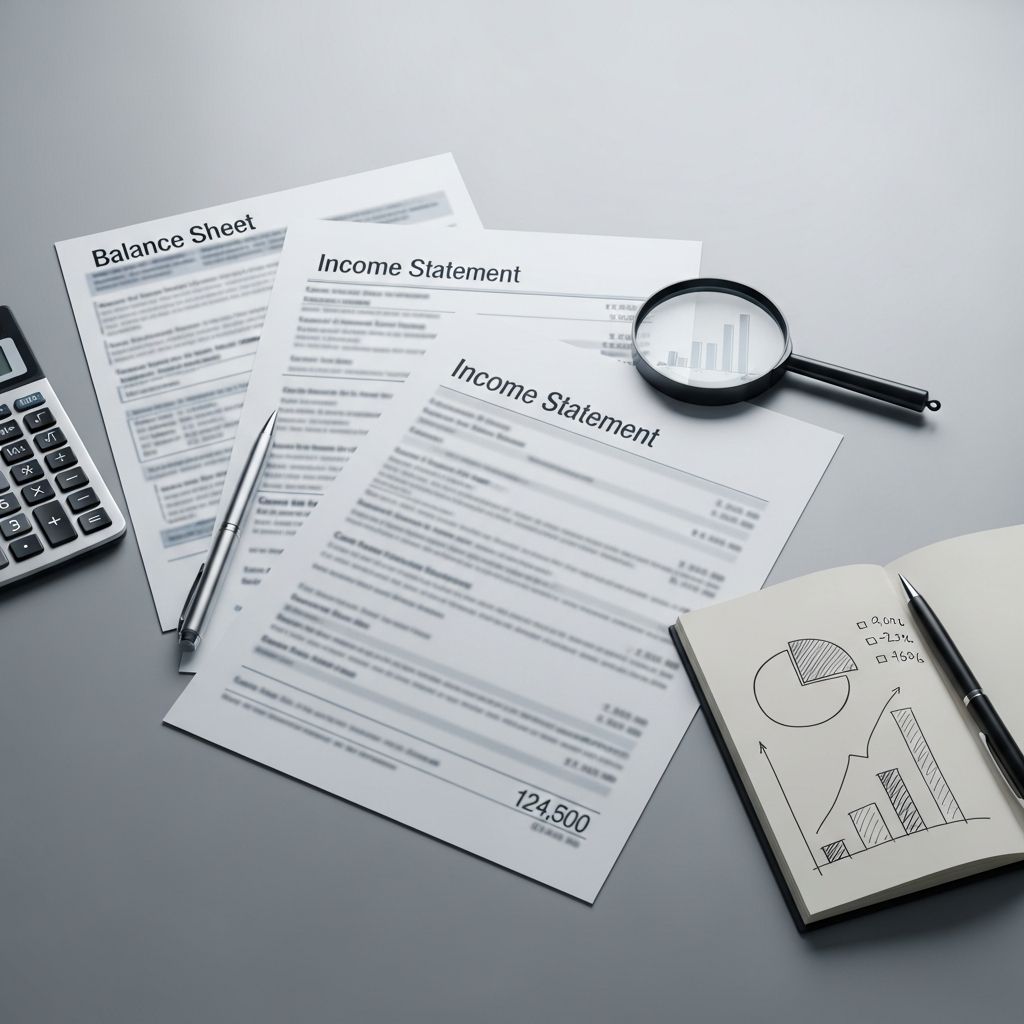
Financial statements are formal records that communicate the financial activities and performance of a business, organization, or individual. These documents provide a comprehensive view of an entity’s financial health, profitability, liquidity, and operational efficiency. Financial statements are essential tools for stakeholders including investors, creditors, management, regulators, and analysts who need to assess financial performance and make informed decisions.
The primary purpose of financial statements is to present financial information in a standardized format that allows for meaningful comparison across time periods and between different organizations. They are prepared according to Generally Accepted Accounting Principles (GAAP) in the United States or International Financial Reporting Standards (IFRS) in many other countries, ensuring consistency and transparency in financial reporting.
The Four Main Types of Financial Statements
Every complete set of financial statements typically comprises four primary documents, each serving a distinct purpose in presenting different aspects of an organization’s financial position and performance.
1. Balance Sheet (Statement of Financial Position)
The balance sheet presents a snapshot of a company’s financial position at a specific point in time, typically at the end of a fiscal quarter or year. It follows the fundamental accounting equation: Assets = Liabilities + Shareholders’ Equity.
Components of a Balance Sheet:
- Assets: Resources owned by the company with economic value, including current assets (cash, accounts receivable, inventory) and non-current assets (property, equipment, intangible assets)
- Liabilities: Obligations owed by the company, divided into current liabilities (due within one year) and long-term liabilities (due beyond one year)
- Shareholders’ Equity: The residual interest in assets after deducting liabilities, representing the owners’ stake in the company
The balance sheet is crucial for assessing a company’s financial stability, solvency, and ability to meet its obligations. Investors use it to evaluate capital structure and financial leverage.
2. Income Statement (Profit and Loss Statement)
The income statement measures a company’s financial performance over a specific period, typically a quarter or fiscal year. It shows whether a company is profitable by reporting revenues, expenses, and the resulting net income or loss.
Key Components:
- Revenue: Total income generated from selling products or providing services
- Cost of Goods Sold (COGS): Direct costs associated with producing goods sold by the company
- Gross Profit: Revenue minus COGS, indicating profitability before operating expenses
- Operating Expenses: Costs related to running the business, including salaries, rent, and utilities
- Operating Income: Profit from core business operations
- Net Income: Final profit after all expenses, taxes, and interest are deducted
The income statement reveals operational efficiency and profitability trends, making it essential for evaluating management performance and comparing companies within the same industry.
3. Cash Flow Statement
The cash flow statement tracks the movement of money in and out of a company during a specific period. Unlike the income statement, which uses accrual accounting, the cash flow statement focuses on actual cash transactions, providing insight into liquidity and operational sustainability.
Three Main Sections:
- Operating Activities: Cash generated or used in regular business operations, adjusted from net income for non-cash items and working capital changes
- Investing Activities: Cash used for or generated from investments in assets, including purchases and sales of equipment, property, and securities
- Financing Activities: Cash flows related to debt and equity transactions, including borrowing, repayment of loans, and dividend payments
The cash flow statement is vital for understanding whether a company can sustain operations, pay dividends, and invest in growth without relying on external financing.
4. Statement of Changes in Shareholders’ Equity
This statement reconciles opening and closing balances of shareholders’ equity, detailing changes during the reporting period. It includes the impact of net income, dividends paid, stock issuances, and other comprehensive income items.
This statement provides transparency on how management has utilized earnings and how ownership interest has changed, which is important for understanding the return on shareholders’ investments.
Why Financial Statements Matter
Financial statements serve multiple critical functions in the business ecosystem:
- Investment Decision-Making: Investors analyze financial statements to evaluate company performance, growth potential, and risk before making investment decisions
- Credit Assessment: Lenders review financial statements to determine creditworthiness and establish loan terms and interest rates
- Regulatory Compliance: Public companies must file audited financial statements with regulatory bodies like the Securities and Exchange Commission (SEC)
- Internal Management: Management uses financial statements to monitor performance, identify trends, and make strategic decisions
- Performance Benchmarking: Financial statements enable comparison with competitors and industry standards
- Stakeholder Accountability: They provide transparency to shareholders, employees, customers, and other stakeholders about company operations
Key Financial Ratios and Analysis
Financial statements form the foundation for calculating important financial ratios that provide deeper insights into company performance:
| Ratio Type | Examples | Purpose |
|---|---|---|
| Profitability Ratios | Gross Margin, Net Margin, ROE, ROA | Measures how effectively a company generates profit from operations |
| Liquidity Ratios | Current Ratio, Quick Ratio | Assesses ability to meet short-term obligations |
| Solvency Ratios | Debt-to-Equity, Interest Coverage | Evaluates long-term financial stability and debt levels |
| Efficiency Ratios | Asset Turnover, Inventory Turnover | Determines how effectively assets are utilized |
Standards and Frameworks for Financial Reporting
Financial statements must adhere to recognized accounting standards to ensure consistency and comparability. The two primary frameworks are:
- Generally Accepted Accounting Principles (GAAP): Used primarily in the United States, GAAP provides guidance on how financial transactions should be recorded and reported
- International Financial Reporting Standards (IFRS): Adopted by over 140 countries, IFRS aims to create globally comparable financial reporting
These standards ensure that financial information is prepared with integrity, transparency, and consistency, enabling meaningful comparison across organizations and time periods.
The Audit Process
For public companies and many larger organizations, financial statements must be audited by independent external auditors. The audit process involves:
- Reviewing accounting policies and internal controls
- Testing transactions and account balances
- Evaluating the reasonableness of significant estimates and judgments
- Issuing an auditor’s opinion on whether statements fairly represent financial position and performance
An unqualified or clean audit opinion provides assurance to stakeholders that financial statements are reliable and prepared in accordance with applicable standards.
Reading and Interpreting Financial Statements
Effective analysis of financial statements requires understanding how to extract meaningful information from these documents:
- Trend Analysis: Compare financial data across multiple periods to identify patterns, growth trends, and potential concerns
- Comparative Analysis: Evaluate a company’s performance against competitors and industry benchmarks
- Common Size Analysis: Express financial statement items as percentages of a base figure to identify structural changes and patterns
- Cash Flow Analysis: Examine the quality of earnings and the sustainability of operations and dividends
- Working Capital Analysis: Assess operational efficiency and liquidity through analysis of current assets and liabilities
Digital Transformation in Financial Reporting
The financial reporting landscape is evolving with technological advancements. Real-time reporting, data analytics, and improved accessibility are changing how stakeholders access and analyze financial information. Companies are increasingly adopting technologies that enhance transparency and reduce reporting timelines.
Frequently Asked Questions
Q: What is the primary purpose of financial statements?
A: Financial statements provide a comprehensive overview of a company’s financial position, performance, and cash flows, enabling stakeholders to make informed decisions about investments, lending, and business operations.
Q: How often must companies prepare financial statements?
A: Public companies must prepare quarterly and annual financial statements. Private companies typically prepare annual statements, though more frequent reporting may be required by lenders or investors.
Q: What is the difference between accrual accounting and cash accounting?
A: Accrual accounting records transactions when they occur regardless of cash flow, while cash accounting records transactions only when cash is exchanged. Financial statements use accrual accounting, while the cash flow statement specifically tracks cash movements.
Q: Why is the cash flow statement important if we have an income statement?
A: The cash flow statement reveals actual cash movements, which the income statement does not capture. A company can be profitable on paper but lack cash to pay obligations, making cash flow analysis critical.
Q: Can financial statements be manipulated?
A: While audits and regulations reduce the risk, accounting policies allow for some judgment. However, material misstatements or fraud are detected through audits and can result in serious legal consequences.
Q: How do I compare financial statements of companies in different countries?
A: Understand the accounting standards used (GAAP vs. IFRS), account for currency differences, and consider industry and economic conditions. Many global companies provide reconciliations to help with comparisons.
References
- Financial Accounting Standards Board (FASB) — United States Financial Accounting Standards Advisory Board. 2025. https://www.fasb.org
- International Financial Reporting Standards (IFRS) — IFRS Foundation. 2025. https://www.ifrs.org
- U.S. Securities and Exchange Commission (SEC) – Financial Reporting — U.S. Government. 2025. https://www.sec.gov/cgi-bin/browse-edgar
- Statement on Auditing Standards (SAS) — American Institute of CPAs (AICPA). 2024. https://www.aicpa.org
- Introduction to Financial Statement Analysis — CFA Institute. 2024. https://www.cfainstitute.org
- Public Company Accounting Oversight Board (PCAOB) Standards — U.S. Government. 2025. https://pcaobus.org
Similar Articles








Read full bio of medha deb