Financial Accounting vs. Managerial Accounting
Understand key differences between financial and managerial accounting for better business decisions.
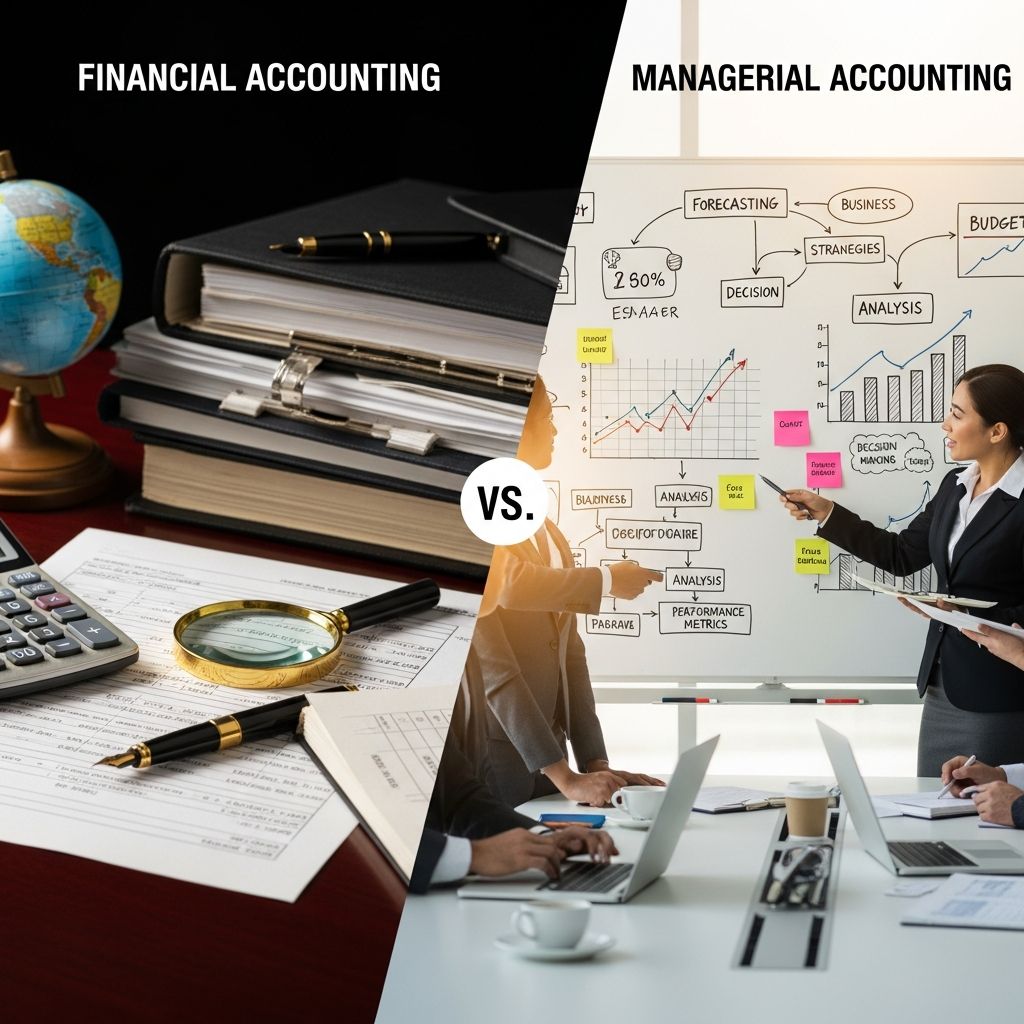
Financial Accounting vs. Managerial Accounting: Understanding the Key Differences
Accounting forms the foundation of sound financial management in any organization. Within the broader field of accounting, two distinct branches serve different purposes and audiences: financial accounting and managerial accounting. While both branches work with financial data and aim to improve business performance, they differ significantly in their focus, methodology, reporting requirements, and applications. Understanding these differences is essential for business professionals, managers, investors, and stakeholders who need to navigate the financial landscape effectively.
Financial accounting and managerial accounting are often confused or used interchangeably, yet they serve fundamentally different roles within an organization. Financial accounting reports externally on an organization’s transactions and financial health to stakeholders outside the company, such as investors, creditors, and regulators. Conversely, managerial accounting provides internal stakeholders—company managers and executives—with detailed financial information to support strategic decision-making and operational planning. This comprehensive guide explores the nuances of both accounting branches, highlighting their differences, similarities, and practical applications.
What Is Financial Accounting?
Financial accounting is the process of recording, classifying, and summarizing financial transactions to prepare standardized financial statements that present an organization’s financial position and performance to external parties. The primary objective of financial accounting is to provide a clear and transparent picture of a company’s financial health, allowing external stakeholders to assess the organization’s profitability, liquidity, and overall viability.
Financial accounting focuses on the overall value of a company’s assets and liabilities, generating comprehensive reports that document historical financial performance. These reports are typically prepared on a monthly, quarterly, or annual basis to meet regulatory requirements and the information needs of external stakeholders. The reports produced by financial accountants include balance sheets, income statements, cash flow statements, and statements of shareholders’ equity.
One of the defining characteristics of financial accounting is its adherence to strict accounting standards and regulations. In the United States, companies must comply with Generally Accepted Accounting Principles (GAAP), while internationally, organizations may follow International Financial Reporting Standards (IFRS). These standards ensure consistency, comparability, and reliability in financial reporting, giving external parties confidence in the accuracy and legitimacy of financial statements.
What Is Managerial Accounting?
Managerial accounting, also known as management accounting, encompasses identifying, analyzing, interpreting, and communicating financial data to help managers make informed decisions and achieve business goals. Unlike financial accounting, which focuses on external reporting, managerial accounting is exclusively designed for internal use by company managers and executives who need detailed, actionable information to guide strategic planning and operational decisions.
Managerial accountants help businesses achieve their objectives in numerous ways, including determining income, valuing inventory, identifying opportunities for improvement, ensuring efficient operations, forecasting trends, preparing financial and transactional data, analyzing product and service costs, optimizing finance allocation, isolating efficiency issues, and establishing functional, business, and corporate strategies. This broad range of responsibilities reflects the critical role managerial accountants play in organizational leadership and decision-making.
Managerial accounting focuses on analyzing the assets and liabilities to understand a company’s profit and productivity, looking beyond just the balance sheet totals. Managerial accountants examine intricate financial information alongside non-financial factors such as operational metrics, departmental performance, and market conditions. This comprehensive analytical approach enables managers to understand not just what happened financially, but why it happened and what implications it holds for future business performance.
Key Differences Between Financial and Managerial Accounting
While both financial and managerial accounting deal with financial information, they operate according to distinctly different principles and serve different purposes. Understanding these key differences is crucial for anyone involved in business finance or management.
Audience and Users
The primary difference between financial and managerial accounting lies in their intended audience. Financial accounting produces standardized financial statements designed for external stakeholders, including investors, creditors, lenders, financial institutions, regulators, the IRS, and the U.S. Securities and Exchange Commission. These external parties require reliable, consistent, and comparable financial information to make informed decisions about investing in, lending to, or regulating the organization.
Managerial accounting, conversely, focuses exclusively on providing information to internal stakeholders—company managers, department heads, executives, and senior employees. These internal users need detailed, customized information specific to their departments or functional areas to make operational and strategic decisions that drive business performance.
Focus and Time Orientation
Financial accounting focuses on historical performance, documenting and analyzing what has already happened in a business’s financial activities. Financial accountants examine historical equity, assets, revenue, liabilities, and expenses to create accurate records of past transactions. This backward-looking perspective allows external parties to assess the company’s past performance and make predictions about its future based on established trends.
Managerial accounting looks forward, examining financial information to make forecasts and projections about future performance. Managerial accountants analyze budgets, sales, expenses, cash flow, and non-financial factors to anticipate future scenarios and provide management with insights needed for proactive strategic planning. While managerial accounting certainly considers historical data, its primary orientation is toward the future and what it holds for the organization.
Reporting Standards and Compliance
Financial accounting operates under strict regulatory requirements and must comply with established accounting standards such as GAAP or IFRS. These standards encompass accounting conventions, rules, and principles that dictate how companies must record assets, liabilities, revenue, and net income. The rigid adherence to these standards ensures that financial statements are comparable across companies and time periods, enhancing their credibility and usefulness to external stakeholders.
Managerial accounting, by contrast, is not required by law and does not follow GAAP, IFRS, or other external reporting standards. Because managerial accounting is intended for internal consumption only, organizations have flexibility in how they structure and present information. Companies can develop internally created rules and processes tailored to their specific needs, allowing managerial accounting to be customized for different departments, product lines, or business units.
Reporting Frequency and Timing
Financial accounting produces reports according to a fixed schedule to meet regulatory requirements. Financial accountants typically prepare financial statements quarterly or annually, depending on the company’s size, industry, and regulatory obligations. These periodic reports provide consistent, predictable information to external stakeholders at established intervals.
Managerial accounting operates on a more flexible and frequent reporting schedule. Managerial accountants may prepare reports monthly, weekly, daily, or even in real-time, depending on management’s information needs and decision-making timelines. This frequent reporting enables managers to monitor operational performance continuously, identify issues quickly, and adjust strategies promptly when business conditions change.
Systems and Process Focus
Financial accounting primarily focuses on the outcome of generating profit without necessarily examining the overall system or processes that produce that outcome. Financial statements provide aggregate results but may not reveal operational inefficiencies or bottlenecks that affect profitability.
Managerial accounting focuses on identifying and resolving operational bottlenecks—operations working at maximum capacity that cannot accept additional work. By analyzing system performance and identifying constraints, managerial accountants help organizations eliminate inefficiencies, increase capacity, and enhance profitability.
Valuation Approach
Financial accounting focuses on the overall value of a company’s assets and liabilities as reported on the balance sheet, providing an aggregate view of the company’s financial position. Managerial accounting analyzes assets and liabilities more granularly to understand how specific resources contribute to a company’s profit and productivity, providing insights into resource allocation effectiveness.
Similarities Between Financial and Managerial Accounting
Despite their significant differences, financial and managerial accounting share important commonalities that reflect their shared foundation in accounting principles and financial analysis.
Both branches quantify the results of business activity and transactions, converting operational events into financial metrics. Both deal with expenses, assets, liabilities, and cash flows, examining how these financial elements affect organizational performance. Financial statements and reports prepared by both types of accountants often rely on the same underlying database of financial transactions, ensuring consistency in data sources and reducing the likelihood of conflicting information.
Additionally, both financial and managerial accounting involve determining and measuring costs, analyzing how business resources are consumed in generating revenue. Both branches recognize that accurate financial information is essential for business success, and both employ rigorous analytical methods to ensure the reliability of their findings.
Comparison Table: Financial Accounting vs. Managerial Accounting
| Aspect | Financial Accounting | Managerial Accounting |
|---|---|---|
| Primary Audience | External stakeholders (investors, creditors, regulators, IRS) | Internal stakeholders (managers, executives, department heads) |
| Purpose | Provide standardized financial statements assessing financial health | Support internal decision-making and strategic planning |
| Time Orientation | Historical (past performance) | Prospective (future planning) |
| Reporting Standards | Must comply with GAAP or IFRS | No mandatory standards; flexible and customizable |
| Reporting Frequency | Quarterly or annually | Monthly, weekly, daily, or real-time |
| Focus | Overall company performance and profitability outcomes | Operational efficiency and specific business decisions |
| Data Presentation | Standardized formats for comparability | Customized formats for specific information needs |
| Mandatory Requirement | Required by law for public companies and many organizations | Not legally required; optional for internal use |
Overlaps Between Financial and Managerial Accounting
Although financial and managerial accounting serve different purposes and audiences, they overlap in several important ways. Both branches quantify the results of business activity and transactions, documenting the financial impact of organizational operations. Both deal with expenses, assets, liabilities, and cash flows, analyzing how these elements affect the company’s financial position and performance.
Both accounting branches often prepare reports using the same underlying financial database, ensuring consistency and accuracy. Financial accountants and managerial accountants both focus on determining and measuring costs, understanding how the organization consumes resources in pursuit of its objectives. This shared foundation ensures that the financial information generated by both branches is consistent and reliable, preventing conflicting signals about the company’s financial condition.
Is Managerial Accounting More Difficult Than Financial Accounting?
Managerial accounting is generally considered easier than financial accounting in some respects, primarily because it involves budgeting and forecasting rather than complex external reporting requirements. Managerial accounting is designed for internal use only and does not require compliance with rigid accounting standards, offering greater flexibility in how information is presented and analyzed.
However, this perception can be misleading. While managerial accounting may appear simpler due to fewer regulatory constraints, it actually requires significant expertise and training. Managerial accountants must deeply understand the factors influencing business success or failure, possess strong analytical skills, and be able to translate complex operational data into actionable insights for management. The flexibility of managerial accounting demands greater judgment and critical thinking than simply following established accounting rules.
Financial accounting, meanwhile, requires strict adherence to complex accounting standards and must prepare reports for both internal and external users, including investors, lenders, regulators, and creditors. Financial accountants must navigate intricate regulatory requirements and ensure complete accuracy and compliance with established standards.
Ultimately, both accounting branches present distinct challenges and require different skill sets. The difficulty is not inherently greater in one branch but rather different in nature.
Salary Differences
The career paths of financial accountants and managerial accountants differ not only in their work responsibilities but also in their compensation. According to recent data, financial accountants earn an average salary of approximately $69,324, while managerial accountants earn an average base salary of approximately $56,507. However, these figures vary significantly based on several factors, including geographic location, years of experience, professional certifications, educational background, and industry sector.
Interestingly, financial accountants typically command higher salaries despite managerial accountants often holding more strategic positions within organizations. This salary differential may reflect the regulatory requirements and external reporting responsibilities that financial accountants carry, as well as the specialized knowledge required to maintain compliance with complex accounting standards.
Can a Business Rely Only on Financial Accounting?
While technically a business can function using only financial accounting, doing so would mean missing important internal insights crucial for operational excellence and strategic planning. Financial accounting, with its backward-looking perspective and focus on historical performance, does not provide the forward-looking insights needed for day-to-day decision-making and future planning. Financial statements, while valuable for external reporting and historical analysis, do not typically contain the granular, real-time operational data that managers need to optimize performance, identify inefficiencies, or capitalize on emerging opportunities.
Additionally, financial accounting’s aggregate view of company performance may obscure departmental or operational-level issues that significantly impact profitability. A company relying solely on financial accounting might fail to identify bottlenecks, inefficient processes, or cost overruns until they have already substantially affected bottom-line performance.
Smart organizations recognize the complementary value of both accounting branches. Financial accounting ensures external credibility and compliance, while managerial accounting drives internal optimization and strategic decision-making.
The Bottom Line
Financial accounting and managerial accounting represent two essential but distinct approaches to analyzing and reporting financial information. Financial accounting aims to provide standardized financial statements that accurately measure company performance and assess financial health for external stakeholders. Managerial accounting, conversely, aims to provide financial information and strategic insights that enable managers to make decisions aligned with business strategies and drive operational excellence.
Though significant differences exist between these two accounting branches, the most successful organizations leverage both. Financial accounting ensures the organization maintains compliance with regulatory requirements and provides credible information to external stakeholders. Managerial accounting ensures that internal management has the detailed insights and forward-looking analysis needed to make strategic decisions, optimize operations, and drive profitable growth.
Understanding the unique strengths, purposes, and applications of each accounting branch enables business leaders, finance professionals, and stakeholders to use financial information more effectively. By recognizing that financial accounting and managerial accounting serve complementary functions, organizations can develop comprehensive financial management strategies that ensure both external credibility and internal operational excellence.
Frequently Asked Questions
Q: What is the primary difference between financial accounting and managerial accounting?
A: The primary difference is audience and purpose. Financial accounting produces standardized reports for external stakeholders like investors and regulators, while managerial accounting provides internal information to help managers make strategic decisions.
Q: Do both accounting types use the same financial data?
A: Yes, both financial and managerial accounting typically draw from the same underlying database of financial transactions, but they analyze and present this data differently based on their specific purposes and audiences.
Q: Is managerial accounting required by law?
A: No. Managerial accounting is only used internally and does not have to follow GAAP, IFRS, or other external reporting standards. However, financial accounting is legally required for public companies and many organizations.
Q: How frequently are reports prepared in each accounting type?
A: Financial accounting reports are typically prepared quarterly or annually to meet regulatory requirements. Managerial accounting reports can be prepared monthly, weekly, daily, or in real-time, depending on management’s decision-making needs.
Q: Which accounting type focuses on future performance?
A: Managerial accounting focuses on the future through budgeting, forecasting, and trend analysis, while financial accounting focuses on historical performance.
Q: Can a company survive using only financial accounting?
A: Technically yes, but not optimally. Relying solely on financial accounting would mean missing important internal insights needed for operational optimization, cost management, and strategic decision-making.
References
- Financial Accounting vs. Managerial Accounting: What’s the Difference? — BAU Blog. 2024. https://bau.edu/blog/financial-accounting-vs-managerial-accounting/
- Key Insights on Financial vs. Managerial Accounting — Our Lady of the Lake University. 2024. https://www.ollusa.edu/blog/financial-accounting-vs-managerial-accounting.html
- Managerial Accounting vs Financial Accounting — TGG Accounting. 2024. https://tgg-accounting.com/managerial-accounting-vs-financial-accounting/
Similar Articles








Read full bio of Sneha Tete