FICO Vs VantageScore Vs Experian Scores: Key Differences 2025
Unravel the key differences between FICO, VantageScore, and Experian credit scores to better manage your financial profile effectively.
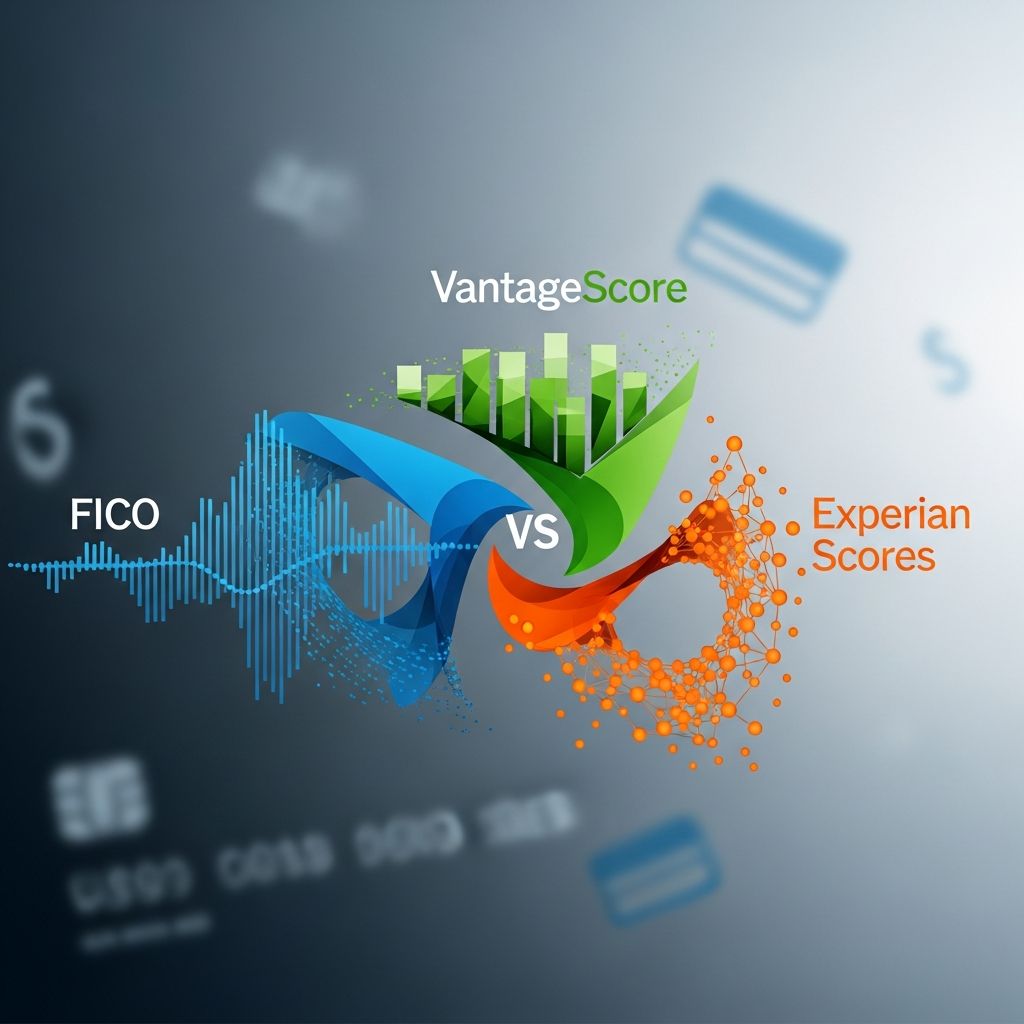
Understanding credit scores is essential for anyone navigating loans, credit cards, or mortgages, as these numerical representations predict borrowing reliability. FICO and VantageScore represent the primary scoring systems, while Experian serves as a key provider rather than a unique model. This article delves into their origins, methodologies, ranges, and practical implications to empower better financial choices.
Foundations of Major Credit Scoring Systems
Credit scoring models emerged to standardize risk assessment for lenders. FICO, created by the Fair Isaac Corporation in the mid-20th century, has long dominated lending decisions, with its FICO Score 8 version prevalent today. In contrast, VantageScore launched in 2006 through collaboration among Experian, Equifax, and TransUnion, aiming for broader accessibility, especially VantageScore 3.0 and 4.0.
Experian, one of the three major U.S. credit bureaus, does not develop its own proprietary score but delivers both FICO and VantageScore based on its credit report data. This means an “Experian score” typically refers to one of these models pulled from Experian’s records, which may differ slightly from scores at other bureaus due to varying lender reporting.
Core Components Driving Score Calculations
Both models analyze credit report data but emphasize factors differently. FICO relies on five key elements: payment history (35%), amounts owed or credit utilization (30%), length of credit history (15%), credit mix (10%), and new credit (10%). Payment history and utilization dominate, reflecting repayment reliability and debt management.
VantageScore employs six categories without fixed percentages but with influence levels: payment history (extremely influential at around 40%), credit utilization or balances (highly influential at 20-21%), age and type of credit (highly influential at 21%), amounts owed (moderately influential at 11%), recent credit behavior, and available credit (less influential). This structure highlights historical depth and account variety more prominently.
- Payment History: Tracks on-time payments; FICO at 35%, VantageScore at 40%.
- Credit Utilization: Ratio of balances to limits; both penalize high usage, but newer VantageScore versions scrutinize trends over time.
- Length and Mix: VantageScore values longer histories and diverse accounts more.
Score Ranges and Category Definitions
Both systems span 300-850, but category thresholds vary, affecting perceptions of credit health. FICO defines ranges as: Super Prime/Excellent (800-850), Prime/Good (740-799), Near Prime/Fair (700-739), Subprime (620-699), and Deep Subprime/Poor (300-619). VantageScore categorizes as Excellent (781-850), Good (661-780), Fair (601-660), Poor (500-600), and Very Poor (300-499).
| Category | FICO Range | VantageScore Range |
|---|---|---|
| Excellent | 800-850 | 781-850 |
| Good | 740-799 | 661-780 |
| Fair | 700-739 | 601-660 |
| Poor | 620-699 | 500-600 |
| Very Poor | 300-619 | 300-499 |
These differences mean a 670 FICO might be “Good,” while the same in VantageScore is borderline “Fair,” influencing lender approvals.
Thresholds for Generating a Score
Accessibility sets them apart for newcomers. FICO demands at least one account open six months and activity reported in the last six months. VantageScore requires just one month of history and one account updated in two years, aiding those with thin files.
For rate shopping, FICO groups inquiries over 45 days for auto, student, or mortgage loans; VantageScore uses 14 days across more types, including cards, reducing short-term score dips.
Nuances in Handling Negative Marks
Late payments impact both, but VantageScore differentiates by account type, hitting certain lines harder. Newer VantageScore (4.0) incorporates trended data—payment patterns over 24 months—and penalizes chronic high utilization more than FICO, which treats delinquencies uniformly.
Experian’s Distinct Role in Scoring
As a bureau, Experian compiles data from lenders and offers FICO Score 8, FICO 9, VantageScore 3.0, and 4.0 via services like CreditWorks. Scores vary by bureau due to incomplete tri-bureau reporting; a free Experian VantageScore is common, but lenders often use FICO.
Tri-bureau VantageScore unifies across bureaus, unlike FICO’s bureau-tailored versions, promoting consistency.
Practical Impacts on Lending and Monitoring
Lenders predominantly favor FICO (90% of decisions), but VantageScore gains traction for its inclusivity, scoring 33-40 million more people. Check scores via bureau sites, annualcreditreport.com, or apps; discrepancies arise from model or data variances.
- Monitor multiple models for a full picture.
- Improve universally: pay on time, keep utilization under 30%, avoid new inquiries.
Strategies to Boost Your Scores Across Models
Target shared factors: Maintain 35+ months average age, diversify accounts responsibly. Dispute errors promptly. For VantageScore, consistent full payments help trended data; for FICO, stabilize utilization.
Tools like secured cards build history faster for thin files, benefiting VantageScore users initially.
Frequently Asked Questions
Which score do lenders use more?
FICO powers most decisions, but VantageScore is rising.
Why do my scores differ by bureau?
Not all lenders report everywhere, causing data gaps.
Can I get a score with no credit history?
VantageScore yes, minimally; FICO no.
How often should I check scores?
Monthly via free services, weekly if active.
Does paying rent boost scores?
Increasingly, via services reporting to bureaus.
References
- Differentiating FICO, VantageScore, and Experian — Chase. 2024-05. https://www.chase.com/personal/credit-cards/education/credit-score/differentiating-fico-vantagescore-experian
- VantageScore® vs. FICO®: How Credit Score Models Differ — Self Inc. 2024. https://www.self.inc/blog/fico-vs-vantagescore
- Are FICO® Scores and VantageScore® Different? — Equifax. 2024. https://www.equifax.com/personal/education/credit/score/articles/-/learn/difference-between-fico-scores-vantagescore/
- What Is a VantageScore? How It Works vs. FICO — NerdWallet. 2024. https://www.nerdwallet.com/finance/learn/vantagescore-fico-score-the-difference
- The Difference Between VantageScore Credit Scores and FICO Scores — Experian. 2024. https://www.experian.com/blogs/ask-experian/the-difference-between-vantage-scores-and-fico-scores/
Similar Articles








Read full bio of Sneha Tete