Fibonacci Retracement: Technical Analysis for Trading
Master Fibonacci retracement levels to identify support and resistance in trading.
Understanding Fibonacci Retracement in Technical Analysis
Fibonacci retracement is a method of technical analysis used to determine support and resistance levels in financial markets. This tool helps traders identify where prices might pause or reverse after significant moves. The technique is named after the Fibonacci sequence, a mathematical pattern where each number is the sum of the two preceding numbers: 1, 1, 2, 3, 5, 8, 13, 21, 34, 55, 89, 144, and so on. The ratios derived from this sequence have been observed in nature and markets, making them valuable for predicting potential price retracements.
When prices move significantly in one direction, they often retrace a portion of that move before continuing in the original direction. Fibonacci retracement levels help traders pinpoint these potential reversal zones, allowing them to make more informed trading decisions. The tool plots horizontal lines at specific percentage levels that represent mathematical relationships within the Fibonacci sequence.
The Mathematics Behind Fibonacci Retracement
The Fibonacci sequence forms the foundation of this technical analysis tool. The mathematical relationships within the sequence create ratios that appear frequently in various markets. The most commonly used Fibonacci retracement levels are derived from dividing one number in the sequence by another.
The key retracement levels used by traders are:
- 23.6% — The shallowest retracement level
- 38.2% — A moderate retracement level
- 50% — The midpoint, though not a true Fibonacci ratio
- 61.8% — The deepest common retracement level, also known as the golden ratio
The 61.8% level is particularly significant because it corresponds to the golden ratio (0.618), which appears throughout nature and has been studied by mathematicians for centuries. This level is frequently used by financial analysts and is considered one of the most important support and resistance levels.
How to Apply Fibonacci Retracement
Creating a Fibonacci retracement on a price chart involves a straightforward process. First, traders identify two extreme points on a chart—typically a significant high and a significant low during an uptrend or downtrend. The vertical distance between these two points is then divided by the Fibonacci ratios mentioned above.
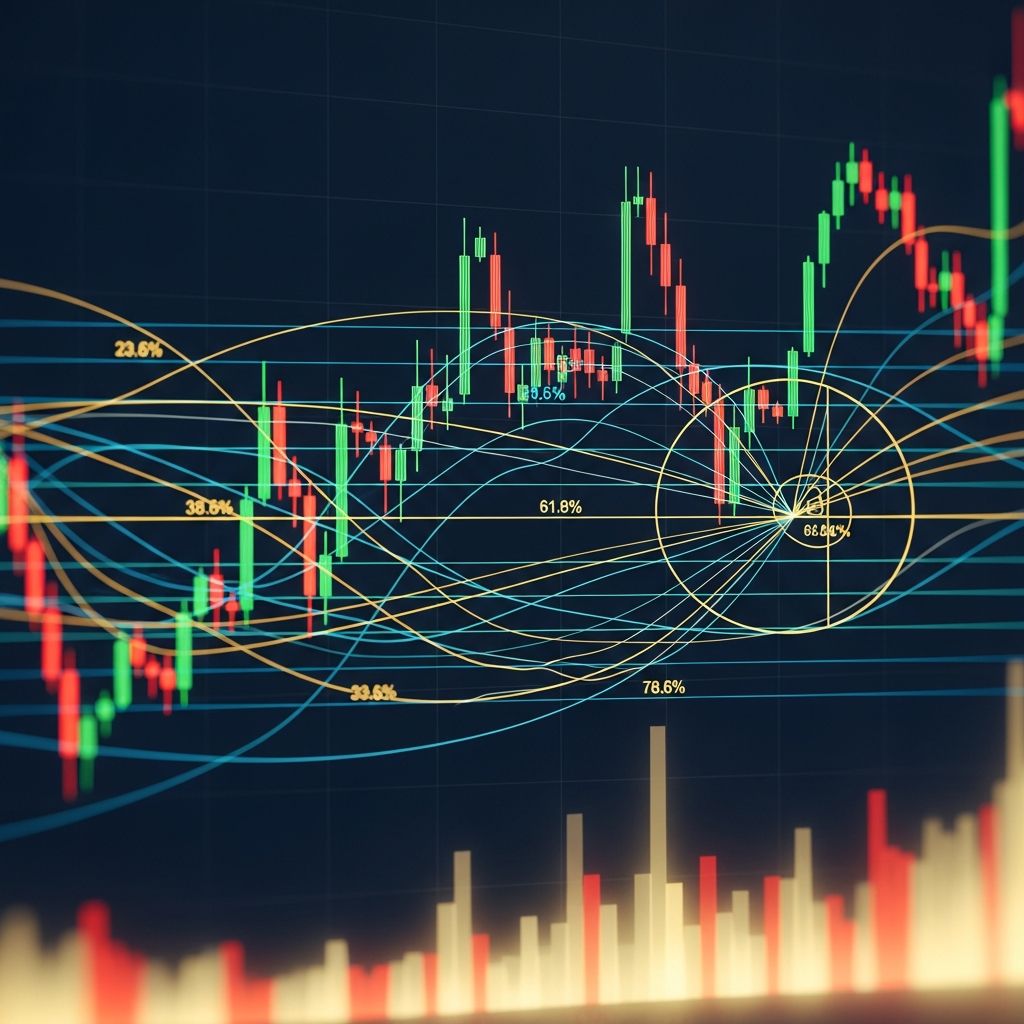
Once these calculations are made, horizontal lines are drawn at each percentage level across the price chart. These lines represent potential support and resistance areas where price action may pause or reverse. The 0% level represents the starting point of the retracement, while the 100% level represents a complete reversal to the original price before the move began.
Traders use these levels to:
- Identify strategic entry points for new positions
- Determine appropriate stop-loss levels
- Set price targets for potential exits
- Confirm support and resistance areas in combination with other technical indicators
Key Characteristics of Fibonacci Retracement Levels
Unlike other technical analysis tools, Fibonacci retracement levels possess unique characteristics that make them valuable for traders. One significant advantage is that these levels are static prices. Once plotted on a chart, they remain at fixed price points, allowing traders and investors to quickly identify and react when price levels are tested.
The static nature of these levels creates what analysts call inflection points. At these inflection points, traders expect some form of price action—either a break through the level or a rejection that causes prices to bounce. This predictability makes Fibonacci retracement a popular tool among both technical traders and institutional investors.
Additionally, because Fibonacci retracement levels are easy to identify and calculate, they provide quick visual references for market participants. In today’s fast-paced trading environment, the ability to rapidly recognize potential trading opportunities at these key levels can make a significant difference in execution quality.
Common Applications in Trading
Technical traders employ Fibonacci retracement in numerous ways to enhance their trading strategies. One primary application is identifying support and resistance values for currency pairs and other financial instruments. When a significant price movement occurs, new support and resistance levels often form at Fibonacci retracement lines.
Traders also use Fibonacci retracement in conjunction with other technical analysis methods. The tool appears as a component in several advanced trading strategies, including Tirone levels, Gartley patterns, and the Elliott Wave principle. By combining Fibonacci retracement with these other methodologies, traders can develop more robust trading systems with improved accuracy.
The retracement concept helps traders understand market psychology and price behavior. Many market participants watch the same Fibonacci levels, creating a self-fulfilling prophecy where prices do tend to pause or reverse at these key areas simply because traders expect them to.
Advantages of Using Fibonacci Retracement
Fibonacci retracement offers several advantages for technical traders and investors. First, it provides a systematic approach to identifying support and resistance levels based on mathematical principles rather than arbitrary price points. This mathematical foundation appeals to traders seeking an objective analysis method.
Second, the tool is relatively simple to apply. Traders don’t need advanced mathematical skills or complex calculations to plot Fibonacci retracement levels on a chart. Most trading platforms include built-in Fibonacci retracement tools that automatically draw the levels once traders select the high and low points.
Third, the universal recognition of these levels across the trading community creates what analysts call a “confluence zone.” When multiple traders watch the same price levels, the likelihood of significant price action increases at those points.
Finally, Fibonacci retracement works across all timeframes and financial instruments, from stocks and commodities to currencies and cryptocurrencies. This versatility makes it a valuable tool for traders operating in diverse markets.
Criticisms and Limitations
Despite its popularity, Fibonacci retracement has attracted considerable criticism from academic researchers and statisticians. Extensive backtests examining thousands of stocks have shown that retracement values of 38%, 50%, and 62% were no more likely to occur than any other possible retracement values. This finding suggests that the predictive power of Fibonacci retracement may be overstated.
The appearance of retracements at Fibonacci levels can potentially be ascribed to price volatility rather than any special mathematical property. According to Burton Malkiel, a Princeton economist who authored the influential work “A Random Walk Down Wall Street,” random price movements can create patterns that appear meaningful but lack true predictive value.
Additionally, Arthur Merrill’s analysis in “Filtered Waves” concluded that there is no reliably standard retracement pattern, further questioning the reliability of this tool as a standalone indicator. Critics argue that traders may experience confirmation bias, seeing Fibonacci levels work when they align with other technical factors while ignoring failures.
Another limitation is that Fibonacci retracement only works in trending markets where significant price movements have already occurred. In sideways or choppy markets, this tool provides limited utility. Additionally, traders must correctly identify the starting and ending points of a trend, which can be subjective and lead to different retracement levels depending on the interpretation.
Combining Fibonacci Retracement with Other Indicators
To overcome some limitations, experienced traders typically combine Fibonacci retracement with other technical analysis tools. When Fibonacci levels align with moving averages, trend lines, or other support and resistance indicators, the confluence of signals becomes stronger.
Volume analysis can also validate Fibonacci retracement levels. Price bounces off Fibonacci levels accompanied by increasing volume suggest stronger support or resistance than bounces occurring on low volume.
The Relative Strength Index (RSI), Moving Average Convergence Divergence (MACD), and other momentum indicators can confirm whether prices are likely to reverse or continue breaking through Fibonacci levels. By using multiple confirmation tools, traders can improve the reliability of their trading decisions.
Practical Tips for Using Fibonacci Retracement
Select Clear Trend Moves: Choose obvious high and low points rather than trying to trade smaller, less significant price movements. Clearer trends produce more reliable Fibonacci levels.
Use Multiple Timeframes: Check Fibonacci levels across different timeframes to identify areas where multiple levels align. These confluence zones tend to be stronger support and resistance areas.
Combine with Price Action: Watch how price reacts when it reaches Fibonacci levels. Rejection candlestick patterns or volume changes provide confirmation signals.
Set Realistic Targets: Don’t expect every trade to hit target levels. Use Fibonacci levels as guides for approximate targets, not absolute price points.
Manage Risk Appropriately: Place stop-loss orders beyond Fibonacci levels to account for market volatility and false breaks.
Frequently Asked Questions (FAQs)
Q: What is the most important Fibonacci retracement level?
A: The 61.8% level, known as the golden ratio, is generally considered the most important Fibonacci retracement level. This level corresponds to the mathematical golden ratio (0.618) and is frequently used by financial analysts as a key support or resistance area.
Q: Can Fibonacci retracement work on all financial instruments?
A: Yes, Fibonacci retracement can be applied to stocks, commodities, currencies, cryptocurrencies, and other financial instruments. The tool works across all timeframes, from minute charts to monthly charts, making it versatile for different trading styles.
Q: How do I determine the correct high and low points for Fibonacci retracement?
A: Select the most recent significant high and low points that define a clear trend move. For uptrends, measure from the lowest low to the highest high. For downtrends, measure from the highest high to the lowest low. The more obvious the trend, the more reliable the Fibonacci levels.
Q: Is Fibonacci retracement a reliable indicator on its own?
A: While popular among traders, Fibonacci retracement has been criticized by researchers for not being consistently reliable as a standalone indicator. Research shows that retracements at Fibonacci levels are not statistically more likely than other retracement levels. Most successful traders combine it with other technical analysis tools.
Q: What percentage retracement most commonly occurs in markets?
A: The most commonly cited retracement percentages are 23.6%, 38.2%, 50%, and 61.8%. However, backtests have shown that none of these levels are statistically more common than any other retracement percentage, suggesting that market behavior may be more random than Fibonacci theory suggests.
Q: How does Fibonacci retracement differ from support and resistance trend lines?
A: Fibonacci retracement levels are fixed horizontal lines based on mathematical ratios and do not change. Traditional trend lines are subjective lines drawn by traders and can be adjusted based on interpretation. Fibonacci levels provide more objective, predetermined price points that traders across the market can reference.
References
- Fibonacci retracement — Wikipedia. Accessed November 2025. https://en.wikipedia.org/wiki/Fibonacci_retracement
- What Is A Fibonacci Retracement? — Fidelity Investments Learning Center. Accessed November 2025. https://www.fidelity.com/learning-center/trading-investing/technical-analysis/technical-indicator-guide/fibonacci-retracement
Similar Articles








Read full bio of Sneha Tete