Federal Funds Rate History: 1980 to Present
Comprehensive guide to Federal Reserve rate changes from 1980 through today's economy.

Understanding the Federal Funds Rate and Its Historical Significance
The federal funds rate stands as one of the most influential tools in the American economic landscape, serving as the interest rate at which commercial banks lend reserve balances to each other overnight. This critical benchmark has shaped economic policy for decades, directly affecting everything from mortgage rates to employment levels. The Federal Reserve’s Open Market Committee (FOMC) uses the federal funds rate as its primary mechanism for implementing monetary policy, adjusting it to promote maximum employment and stable prices. From dramatic rate spikes in the early 1980s to unprecedented lows during financial crises, the history of this rate tells the story of America’s economic evolution and the Fed’s ongoing battle against inflation and recession.
The 1980s: Fighting Inflation at Any Cost
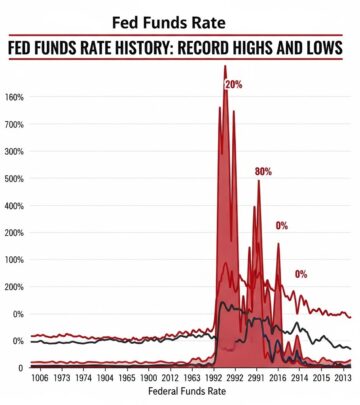
The decade of the 1980s represents one of the most turbulent periods in Federal Reserve history. The fed funds rate began January 1980 at a target level of 14 percent, reflecting the severe inflation crisis gripping the nation. By December 5, 1980, Federal Reserve officials had executed an aggressive move, hiking the target range by 2 percentage points to 19-20 percent—the highest level in the Federal Reserve’s entire history. This unprecedented rate represented a deliberate strategy to combat soaring inflation that had spiraled out of control.
The Fed’s approach, though painful in the short term, was rooted in economic theory. As counterintuitive as it might seem for an institution dedicated to maintaining economic productivity, the Federal Reserve essentially manufactured a recession to bring prices back down. This strategy, sometimes called "Volcker’s Shock" after Fed Chairman Paul Volcker, prioritized long-term price stability over short-term economic growth.
The early 1980s witnessed significant volatility in rate adjustments. Rates fell sharply to a target range of 13-14 percent on November 2, 1981, then rebounded dramatically to 15 percent in the first four months of 1982, before dropping to 11.5-12 percent on July 20, 1982. Throughout this entire decade, the effective fed funds rate averaged 9.97 percent. For context, interest rates have not exceeded 10 percent since November 1984, demonstrating how exceptional this period truly was. The average interest rate in the United States from 1971 through 2025 stands at 5.41 percent, highlighting the dramatic deviation during this era.
The Late 1980s and 1990s: Stabilization and Gradual Normalization
Following the aggressive rate hikes of the early 1980s, the Federal Reserve gradually normalized monetary policy. Interest rates declined steadily through the mid-1980s as inflation began to subside. This period marked a transition toward more stable economic conditions, with the Fed taking a measured approach to rate adjustments. The late 1980s and 1990s were characterized by relative economic stability, though the Fed remained vigilant in monitoring inflationary pressures and adjusting rates accordingly to maintain economic equilibrium.
The 2000s: Crisis Management and Rate Cutting
The new millennium brought fresh challenges to the Federal Reserve’s policy toolkit. In response to the September 11, 2001 terrorist attacks, the Fed implemented emergency rate cuts totaling 150 basis points over just four months. On September 17, 2001, the Fed cut rates by 50 basis points to 3 percent in an emergency meeting. Additional cuts followed in October (50 basis points to 2.5 percent), November (50 basis points to 2 percent), and December 2001 (25 basis points to 1.75 percent). By June 24-25, 2003, the fed funds rate had been reduced to 1 percent.
This extended period of low rates was designed to stimulate economic activity following both the terrorist attacks and the dot-com bubble burst. However, historically low rates during this period helped fuel the housing bubble that would eventually contribute to the 2008 financial crisis. From November 2004 through June 2006, the Fed executed a steady hiking cycle, raising rates from 2 percent to 5.25 percent in quarter-point increments. The last full cycle of rate increases occurred between June 2004 and June 2006 as rates steadily rose from 1.00 percent to 5.25 percent, where the target rate remained for over a year.
The Financial Crisis and Great Recession: Unprecedented Lows
The collapse of Lehman Brothers in September 2008 triggered the worst financial crisis since the Great Depression. In response, the Federal Reserve began lowering rates in September 2007 and continued an aggressive easing cycle through December 2008, as the target rate fell from 5.25 percent to a range of 0.00–0.25 percent. This represented the first time in Federal Reserve history that rates approached zero.
Most remarkably, between December 2008 and December 2015, the target rate remained at 0.00–0.25 percent, the lowest rate in the Federal Reserve’s history, as a reaction to the 2008 financial crisis and the Great Recession. One reason the Fed established a range rather than a specific rate was because a rate of exactly 0 percent could have had problematic implications for money market funds, whose fees could potentially outpace yields in such an environment. On March 15, 2020, the target range for the Federal Funds Rate dropped again to 0.00–0.25 percent, a full percentage point decline occurring less than two weeks after being lowered to 1.00–1.25 percent.
The Recovery and Rate Normalization (2015-2019)
As the economy gradually recovered from the Great Recession, the Federal Reserve began incrementally raising rates. In December 2015, the Fed raised rates from 0.25–0.50 percent, marking the first increase in nearly a decade. The Fed continued this gradual normalization process, raising rates in subsequent years. By December 2016, the target range had risen to 0.50–0.75 percent, with March 2017 seeing an increase to 0.75–1.00 percent and June 2017 reaching 1.00–1.25 percent.
Throughout 2018, the Fed continued its hiking cycle with four 25-basis-point increases: March 20-21 to 1.5-1.75 percent, June 12-13 to 1.75-2 percent, September 25-26 to 2-2.25 percent, and December 18-19 to 2.25-2.5 percent. This normalization reflected the Fed’s confidence in the economic recovery and its desire to return rates to more historical levels. However, by October 2019, the target range had declined to 1.50–1.75 percent as the Fed responded to emerging economic uncertainties.
The COVID-19 Pandemic and Aggressive Inflation Fighting (2020-2023)
The COVID-19 pandemic in March 2020 prompted the Fed to slash rates dramatically. On March 3, 2020, the target range was lowered to 1.00–1.25 percent, and just twelve days later, on March 15, 2020, it was slashed to 0.00–0.25 percent—the lowest level since the 2008 financial crisis. The Fed maintained these ultra-low rates through 2021 while the pandemic raged and governments enacted lockdowns.
However, by 2021-2022, massive fiscal stimulus combined with pandemic-related supply chain disruptions triggered the most severe inflation spike in four decades. In light of this crisis, the Federal Reserve responded with aggressive rate hikes—the most forceful in 40 years. In the latter half of 2022, the FOMC executed extraordinary measures, hiking the federal funds rate by 75 basis points on four consecutive occasions, and in its final meeting of 2022, added another 50 basis points.
The rate increases during this period occurred at a blistering pace. On November 1-2, 2022, the Fed raised rates by 75 basis points to 3.75-4 percent, followed by a 50 basis point increase on December 13-14, 2022 to 4.25-4.5 percent. Then came 25 basis point increases: January 31-February 1, 2023 to 4.5-4.75 percent, March 21-22, 2023 to 4.75-5 percent, May 2-3, 2023 to 5-5.25 percent, and July 25-26, 2023 to 5.25-5.5 percent. The FFR peaked around 5.5 percent in mid-2023 and remained at that level through much of late 2023.
Current Rate Environment and Recent Adjustments
After reaching its peak, the Federal Reserve began cautiously reducing rates in response to moderating inflation and concerns about economic slowdown. The current era is marked by a transition from aggressive inflation-fighting back toward more accommodative policy. On December 17-18, 2024, the Fed cut rates by 25 basis points to 4.25-4.5 percent. This was followed by additional cuts: on September 16-17, 2025, another 25 basis point reduction brought rates to 4-4.25 percent, and most recently on October 28-29, 2025, a final 25 basis point cut lowered the target range to 3.75-4 percent.
The Federal Reserve’s key borrowing benchmark currently stands at a target range of 3.75-4 percent, representing a measured approach to monetary policy as the economy navigates competing pressures of maintaining price stability while supporting employment. This level remains well above the near-zero rates of 2020-2021 but significantly below the peaks reached in 2023.
How Federal Reserve Rate Decisions Impact the Economy
The Federal Reserve’s decisions regarding the federal funds rate significantly impact the broader economy in multiple ways. When the Fed raises rates, borrowing becomes more expensive for consumers and businesses. This affects mortgage rates, auto loans, credit card rates, and business lending costs. Higher borrowing costs typically slow consumer spending and business investment, which can reduce inflation but also risks slowing economic growth and employment.
Conversely, when the Fed lowers rates, borrowing becomes cheaper, encouraging spending and investment. This can stimulate economic growth and employment but may also fuel inflation if the economy is already running at full capacity. The Fed must balance these competing objectives—maintaining maximum employment while keeping inflation stable—in setting its policy rate.
Key Factors Influencing Federal Funds Rate Decisions
Several economic indicators guide the Fed’s interest rate decisions. Inflation rates, employment levels, GDP growth, and financial market conditions all play crucial roles in determining rate policy. The Fed also considers forward-looking economic projections and risks to its dual mandate. During inflationary periods, the Fed typically raises rates to cool demand. During recessions or financial crises, it cuts rates to stimulate economic activity. Geopolitical events, supply chain disruptions, and sudden shocks to the financial system can also prompt rapid policy adjustments.
Frequently Asked Questions About the Federal Funds Rate
Q: What exactly is the federal funds rate?
A: The federal funds rate is the interest rate at which commercial banks lend reserve balances to each other overnight. It is not a rate directly available to consumers but rather influences all consumer interest rates including mortgages, auto loans, and savings accounts.
Q: How does the Federal Reserve actually control the federal funds rate?
A: The FOMC sets a target range for the federal funds rate. Since the 2008 financial crisis, the Fed has primarily adjusted the interest rate paid on reserve balances to keep the actual federal funds rate within its target range. The Fed also conducts open market operations, buying and selling securities to influence the money supply and thus the federal funds rate.
Q: What was the highest federal funds rate in history?
A: The highest federal funds rate ever was 19-20 percent, set in December 1980 as the Fed fought double-digit inflation. This remains a historical peak and demonstrates the extraordinary measures taken to control inflation during that era.
Q: What was the lowest federal funds rate in history?
A: The lowest federal funds rate was 0.00–0.25 percent, first achieved in December 2008 following the financial crisis and maintained through December 2015. This ultra-low rate was repeated again in March 2020 during the COVID-19 pandemic.
Q: How do Federal Reserve rate changes affect my mortgage?
A: The federal funds rate directly influences mortgage rates. When the Fed raises its target rate, mortgage rates typically increase, making home loans more expensive. When the Fed lowers rates, mortgage rates generally decline as well, making borrowing cheaper for homebuyers.
Q: Why did the Fed raise rates so aggressively in 2022-2023?
A: The Fed raised rates dramatically during this period in response to the highest inflation in four decades, triggered by massive fiscal stimulus, pandemic-related supply chain disruptions, and strong demand for goods and services. The aggressive hikes were designed to reduce inflation by cooling economic activity.
Q: What does a target range mean for the federal funds rate?
A: Rather than setting a single specific rate, the Fed now sets a target range with a lower and upper bound. The actual federal funds rate typically falls somewhere within this range based on market conditions. This approach began during the 2008 financial crisis when rates approached zero.
Q: Has the Fed always set explicit federal funds rate targets?
A: No. Beginning in 1967, the FOMC’s memoranda referred to specific federal funds rate levels, but explicit targeting didn’t become standard practice until the early 1970s. Prior to that, the Fed monitored the rate as an indicator of money market conditions rather than actively targeting it.
References
- Federal Funds Rate History: 1980 Through The Present — Bankrate. 2025. https://www.bankrate.com/banking/federal-reserve/history-of-federal-funds-rate/
- Federal funds rate — Wikipedia. 2025. https://en.wikipedia.org/wiki/Federal_funds_rate
- Federal Funds Rate — Federal Reserve History. Board of Governors of the Federal Reserve System. https://www.federalreservehistory.org/essays/fed-funds-rate
- United States Fed Funds Interest Rate — Trading Economics. 2025. https://tradingeconomics.com/united-states/interest-rate
- The Federal Reserve Explained — Board of Governors of the Federal Reserve System. https://www.federalreserve.gov/aboutthefed/fedexplained/accessible-version.htm
Similar Articles








Read full bio of medha deb