Federal Funds Rate Explained: How It Affects Your Money In 2025
Discover how the federal funds rate shapes borrowing costs, savings yields, and the broader U.S. economy through Federal Reserve decisions.

The
federal funds rate
is the interest rate at which banks and credit unions lend reserve balances to each other overnight on an uncollateralized basis. Set as a target range by the Federal Open Market Committee (FOMC), it serves as a cornerstone of U.S. monetary policy, influencing broader economic activity, employment, and inflation control.Core Mechanics of the Federal Funds Rate
Depository institutions must maintain reserve balances at Federal Reserve Banks to meet regulatory requirements and handle daily transactions. Banks with excess reserves lend to those needing more, typically overnight, at rates that cluster around the FOMC’s target range. The
effective federal funds rate (EFFR)
is a volume-weighted median of these transactions, published daily by the New York Fed.The FOMC, comprising Federal Reserve Board members and regional bank presidents, meets about eight times yearly to set the target range based on economic data. Adjustments occur via tools like interest on reserve balances (IORB), which pays banks for holding funds at the Fed, setting a floor; overnight reverse repurchase agreements for non-banks; and the discount rate, creating a ceiling.
Role in Monetary Policy Objectives
The Federal Reserve pursues a dual mandate: maximum sustainable employment and stable prices, targeting 2% inflation. When inflation rises above this, the FOMC raises the federal funds rate to increase borrowing costs, curbing spending and demand to ease price pressures.
Conversely, during recessions or high unemployment, rate cuts lower borrowing costs, encouraging consumer and business spending to boost growth. Open market operations—buying securities to inject money or selling to withdraw it—help align the effective rate with the target.
Everyday Impacts on Consumers and Businesses
- Savings Accounts and CDs: Higher federal funds rates often lead to better yields on savings products as banks compete for deposits.
- Loans and Mortgages: Adjustable-rate products like credit cards and home equity lines track changes closely, while fixed-rate mortgages are indirectly affected via bond yields.
- Auto Loans and Personal Credit: Prime rates, typically 3% above the federal funds rate, determine consumer lending benchmarks.
For instance, a federal funds target of 4.00%-4.25% correlates with prime rates around 7.00%-7.25%, influencing monthly payments across millions of accounts.
Distinctions from Related Benchmarks
| Rate Type | Description | Typical Spread to Fed Funds | Direct Impact |
|---|---|---|---|
| Federal Funds Rate | Bank-to-bank overnight lending | N/A | Monetary policy benchmark |
| Prime Rate | Bank lending to top customers | +3% | Consumer loans, credit cards |
| Discount Rate | Fed loans to banks | Higher ceiling | Emergency borrowing |
| LIBOR (phased out) | Interbank estimates | Varies | Global derivatives |
The prime rate, set by major banks, directly ties to consumer products, diverging from the interbank federal funds focus.
Historical Evolution and Key Cycles
Introduced in the early 20th century amid banking reforms, the federal funds rate gained prominence post-1951 Treasury-Fed Accord, enabling independent policy. Notable periods include:
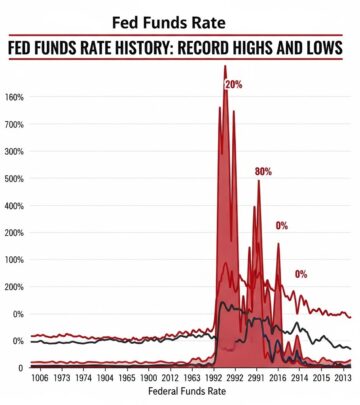
- 1980s Inflation Fight: Paul Volcker’s hikes to nearly 20% tamed double-digit inflation but triggered recession.
- 2008 Financial Crisis: Slashed to 0%-0.25%, with quantitative easing for stimulus.
- 2022-2023 Tightening: Rapid hikes from near-zero to over 5% combated post-pandemic inflation.
These shifts demonstrate the rate’s power in navigating booms, busts, and external shocks like oil crises or pandemics.
Current Landscape and Forward Guidance
As of late 2025, the target range hovers at 4.00%-4.25%, reflecting balanced risks after prior hikes. FOMC statements and dot plots signal expectations, with markets trading futures on anticipated moves via CME FedWatch tools. Investors monitor inflation gauges like PCE and unemployment data for clues on pauses or cuts.
Strategies for Navigating Rate Changes
Consumers can adapt by:
- Locking in fixed rates on long-term debt during hikes.
- Shifting to high-yield savings when rates rise.
- Refinancing mortgages if cuts loom.
- Diversifying into rate-sensitive assets like bonds or TIPS.
Businesses adjust by timing expansions, managing debt, or hedging via interest rate swaps.
Global Ripples and Interconnections
U.S. policy reverberates worldwide: higher rates strengthen the dollar, pressuring emerging markets’ dollar-denominated debt, while easing spurs global liquidity. Central banks like the ECB or BOJ often mirror moves to stabilize currencies.
Frequently Asked Questions
What happens when the Fed raises the federal funds rate?
It increases short-term borrowing costs, slowing economic activity to control inflation.
How does the federal funds rate differ from the prime rate?
Fed funds is interbank; prime is for prime borrowers, usually 3% higher.
Who decides the federal funds rate?
The FOMC sets the target range eight times a year or as needed.
Does the federal funds rate affect my mortgage?
Indirectly via Treasury yields for fixed rates; directly for ARMs.
Can individuals access the federal funds market?
No, it’s exclusively for depository institutions.
Broader Economic Indicators Tracked by the Fed
Beyond the rate, the Fed eyes GDP growth, CPI/PCE inflation, core rates excluding food/energy, JOLTS job openings, and ISM manufacturing indices. These inform dot plots projecting future rates over 2-3 years.
In summary, the federal funds rate is more than a number—it’s a lever for economic stability, rippling through personal finances to global markets. Staying informed via Fed releases empowers better decisions amid flux.
References
- What Is the Federal Funds Rate? — Experian. 2025-10 (approx.). https://www.experian.com/blogs/ask-experian/what-is-federal-funds-rate/
- Federal funds rate — Wikipedia (citing Fed sources). Accessed 2026. https://en.wikipedia.org/wiki/Federal_funds_rate
- Federal Funds Rate – Overview, Types, Impact on Interest Rates — Corporate Finance Institute. Recent update. https://corporatefinanceinstitute.com/resources/economics/federal-funds-rate/
- Effective Federal Funds Rate — Federal Reserve Bank of New York. Daily publication. https://www.newyorkfed.org/markets/reference-rates/effr
- What Is the Federal Funds Rate? — NerdWallet. Recent. https://www.nerdwallet.com/banking/news/what-is-the-fed-rate
Similar Articles








Read full bio of medha deb