Federal Funds Rate: Current Rates and What They Mean
Understanding the Fed's interest rate, how it affects your finances, and current rate targets.
Fed Funds Rate
The federal funds rate is one of the most important interest rates in the U.S. economy, yet many people don’t fully understand what it means or how it affects their daily financial lives. This rate serves as a benchmark for virtually all other interest rates in the financial system, from mortgage rates to credit card rates to savings account yields. Understanding the federal funds rate is essential for anyone making financial decisions, whether you’re considering a home purchase, looking for the best savings account, or simply trying to understand economic news.
What It Means
The federal funds rate is the interest rate at which banks and other depository institutions lend money to each other, usually on an overnight basis. This might sound like an obscure banking detail, but it’s actually the foundation of the entire U.S. financial system. Banks are required by law to maintain certain reserve balances at the Federal Reserve. These reserves ensure that banks have sufficient liquidity to handle unexpected withdrawals and meet regulatory requirements. On any given day, some banks have excess reserves they don’t need, while others find themselves short of the required amount.
When a bank needs additional reserves to meet its requirements, it borrows from banks that have excess funds. The interest rate charged on these overnight loans is the federal funds rate. While this might seem like an internal banking matter, it has profound implications for consumers and the broader economy. Banks don’t simply charge one fixed rate; instead, they negotiate rates between themselves. The weighted average of all these overnight transactions is known as the effective federal funds rate.
The Federal Reserve doesn’t directly set the federal funds rate in the traditional sense of dictating an exact number. Rather, the Federal Open Market Committee (FOMC) sets a target range for the rate and uses various tools to influence the market toward that target. The current target range for the federal funds rate is 3.75-4.00 percent, representing a significant decrease from the recent peak of 5.25-5.5 percent reached in mid-2023.
How It’s Used
The federal funds rate serves multiple critical functions in managing the U.S. economy. The Federal Reserve uses this rate as its primary tool to control the supply of money available in the economy, which in turn influences inflation, employment, and economic growth. Understanding how this mechanism works is essential to grasping modern monetary policy.
When the Federal Reserve wants to slow down the economy and reduce inflation, it raises the federal funds rate. A higher fed funds rate makes it more expensive for banks to borrow from each other, which discourages lending. Banks respond by charging higher interest rates to consumers and businesses for loans, credit cards, and mortgages. This increased cost of borrowing reduces the demand for credit and loans, which decreases the amount of money circulating in the economy. With less money available for spending, inflation pressures typically ease. Raising rates also makes savings more attractive, as people earn higher yields on savings accounts, CDs, and money market accounts, further reducing spending.
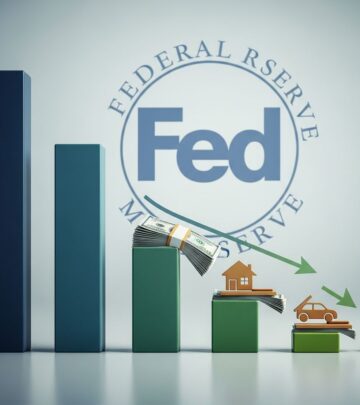
Conversely, when the economy is struggling or inflation is too low, the Federal Reserve lowers the federal funds rate to stimulate borrowing and spending. A lower fed funds rate reduces the cost of overnight borrowing between banks, which encourages more lending. Banks pass these lower costs to consumers through reduced interest rates on loans and mortgages, making borrowing cheaper. This encourages businesses to invest in expansion and consumers to make purchases like homes and cars, increasing economic activity and employment. The trade-off is that increased spending can eventually lead to higher inflation if the economy becomes overheated.
Impact on Consumers
Although the federal funds rate is technically only the rate banks charge each other for overnight lending, it ripples throughout the entire economy and directly affects your finances. Mortgage rates, auto loan rates, credit card rates, and savings account yields are all influenced by movements in the federal funds rate.
When mortgage rates were at their lowest during the pandemic, the federal funds rate was near zero. As the Fed raised rates aggressively starting in 2022 to combat soaring inflation—the fastest pace since the 1980s—mortgage rates climbed sharply. Homebuyers found that borrowing $300,000 cost significantly more than it had just months earlier. Similarly, credit card rates rose for consumers carrying balances, making debt more expensive to maintain.
The relationship between the federal funds rate and savings account rates is looser but still significant.[10] Banks are less motivated to offer competitive savings rates when the fed funds rate is low because they can borrow inexpensively. When the Fed raises rates, banks gain more incentive to offer higher savings rates to attract deposits. However, banks typically pass along rate increases to consumers more quickly than they reduce rates, meaning savers often benefit more slowly from Fed rate increases than borrowers suffer from them.
Current Rate Information
As of the most recent action, the Federal Reserve has adjusted the federal funds rate to a target range of 3.75-4.00 percent. This represents a series of reductions from the recent high of 5.25-5.5 percent, which represented the highest level since 2001 and was achieved after an aggressive hiking campaign to combat post-pandemic inflation.
The Fed began cutting rates in September 2024 and has continued to adjust the target range downward through late 2025. These cuts reflect the Federal Reserve’s assessment that inflation has moderated sufficiently and that economic conditions warrant a more accommodative monetary policy stance. However, rates remain elevated compared to the historical average, reflecting the Fed’s cautious approach to ensuring that inflation remains under control.
Historical Context and Rate Movements
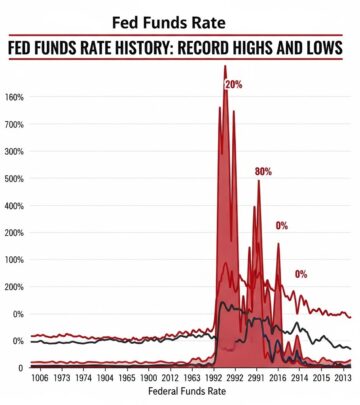
Understanding where rates are today requires examining where they’ve been. The federal funds rate has varied dramatically over the past four decades, reflecting different economic conditions and policy priorities.
In the early 1980s, the Federal Reserve implemented extraordinarily high interest rates to combat the severe inflation that had plagued the economy during the 1970s. Rates reached as high as 15 percent in the first four months of 1982, the highest level in the entire post-World War II era. During the entire 1980-1990 period, the effective federal funds rate averaged 9.97 percent. Interest rates didn’t fall below 10 percent until November 1984, and they have never approached those levels again since that time.
The subsequent decades saw more moderate rate movements as the Fed pursued more balanced policies. Rates declined through the late 1980s and 1990s but were gradually increased starting in 1999. The Fed raised rates steadily through 2000 before cutting them sharply in 2001 in response to the recession and terrorist attacks of that year. Rates fell to near-zero levels during the 2008-2009 financial crisis and remained exceptionally low for nearly a decade during the recovery period.
The Fed began a gradual rate-hiking cycle in late 2015, raising rates in increments of 25 basis points (0.25 percentage points) throughout 2017 and 2018. This cycle was interrupted by rate cuts in 2019, but rates were raised again in 2022 and 2023 at a much faster pace to combat inflation. This recent hiking campaign has been the most aggressive since the early 1980s, with multiple increases of 50 and 75 basis points occurring within a short timeframe.
How the Fed Controls Rates
The Federal Reserve employs several tools to influence the federal funds rate toward its target range. The primary method is Interest on Reserve Balances (IORB), which is the interest rate the Fed pays to banks for holding reserves at the Federal Reserve. Because this offers a risk-free way to earn interest, banks are unlikely to lend to each other at rates below the IORB, effectively setting a floor for the federal funds rate.
Additionally, the Fed uses an Overnight Reverse Repurchase Agreement Facility to set rates for financial institutions that don’t qualify for IORB payments. This mechanism allows these institutions to earn interest on their funds and helps ensure a floor for the federal funds rate across the entire financial system.
Finally, the Federal Reserve maintains a discount rate—the interest rate at which the Fed loans funds to eligible institutions through its discount window. By adjusting this rate, the Fed sets an effective ceiling on the federal funds rate, since banks or other institutions are unlikely to lend to each other at rates higher than they can borrow from the Fed directly.
Frequently Asked Questions
Q: How does the federal funds rate differ from other interest rates?
A: The federal funds rate is the interest rate for overnight lending between banks. Other rates, like mortgage rates or credit card rates, are influenced by the federal funds rate but are typically higher because they involve more risk and longer time periods. However, all these rates tend to move in the same direction as the federal funds rate.
Q: How often does the Federal Reserve change the federal funds rate?
A: The Federal Open Market Committee meets approximately eight times per year to consider adjusting the federal funds rate. The committee may also hold additional meetings and implement changes outside its regular schedule if economic conditions warrant urgent action.
Q: Why don’t savings account rates fall when the Fed cuts rates?
A: Banks adjust savings rates more slowly than the fed funds rate changes, particularly when rates are falling. When the Fed raises rates, banks eagerly offer higher savings rates to attract deposits. When the Fed cuts rates, banks are slower to reduce savings rates since depositors will be unhappy about lower yields, and they can access cheaper funding through other means.[10]
Q: What was the highest federal funds rate ever?
A: The federal funds rate reached 15 percent in 1982 during the Fed’s effort to combat severe inflation. This remains the highest rate in the post-World War II era.
Q: How does the federal funds rate affect mortgage rates?
A: While the federal funds rate doesn’t directly determine mortgage rates, mortgage rates track closely with the Fed’s actions. When the Fed raises the federal funds rate, mortgage rates typically increase as well, making home loans more expensive. When the Fed cuts rates, mortgage rates generally decline, making borrowing cheaper for home purchases.
Q: Is the federal funds rate the same as the discount rate?
A: No, these are different rates. The federal funds rate is what banks charge each other for overnight lending. The discount rate is the interest rate at which the Federal Reserve itself lends to banks through the discount window. The discount rate is typically set higher than the federal funds rate to discourage heavy reliance on this borrowing mechanism.
References
- Federal Funds Rate History: 1980 Through The Present — Bankrate. 2025. https://www.bankrate.com/banking/federal-reserve/history-of-federal-funds-rate/
- What is the Federal Funds Rate? How the Fed Controls Interest Rates — Bankrate. 2025. https://www.bankrate.com/banking/federal-reserve/what-is-the-federal-funds-rate/
- Federal Funds Rate — Board of Governors of the Federal Reserve System. 2025. https://www.federalreserve.gov/
- Federal Funds Rate | Federal Reserve Fed Fund Rates — Bankrate. 2025. https://www.bankrate.com/rates/interest-rates/federal-funds-rate/
- 6 Key Ways the Federal Reserve Impacts Your Money — Bankrate. 2025. https://www.bankrate.com/banking/federal-reserve/how-federal-reserve-impacts-your-money/
- How the Federal Reserve Affects Mortgages — Bankrate. 2025. https://www.bankrate.com/mortgages/federal-reserve-and-mortgage-rates/
- How the Federal Reserve Impacts Savings Account Interest Rates — Bankrate. 2025. https://www.bankrate.com/banking/federal-reserve/federal-reserve-impact-on-savings-accounts/
Similar Articles








Read full bio of Sneha Tete