Fed Funds Rate History: Record Highs and Lows
Explore the Federal Reserve's interest rate history from record highs to historic lows.
Understanding the Federal Funds Rate and Its Historical Significance
The federal funds rate represents one of the most critical tools in the Federal Reserve’s monetary policy arsenal. This overnight lending rate between commercial banks has shaped the American economy for decades, influencing everything from mortgage rates to employment levels. Understanding the historical trajectory of this rate provides valuable insights into how the Federal Reserve has responded to various economic challenges and opportunities throughout modern history.
The federal funds rate is the interest rate at which commercial banks lend reserve balances to each other overnight. While this might seem like an obscure banking detail, the Federal Reserve uses this rate as its primary mechanism for implementing monetary policy. By adjusting the target range for the federal funds rate, the Fed influences broader economic conditions, including inflation, employment, and overall economic growth.
The Record-Breaking 1980s: Fighting Inflation at Any Cost
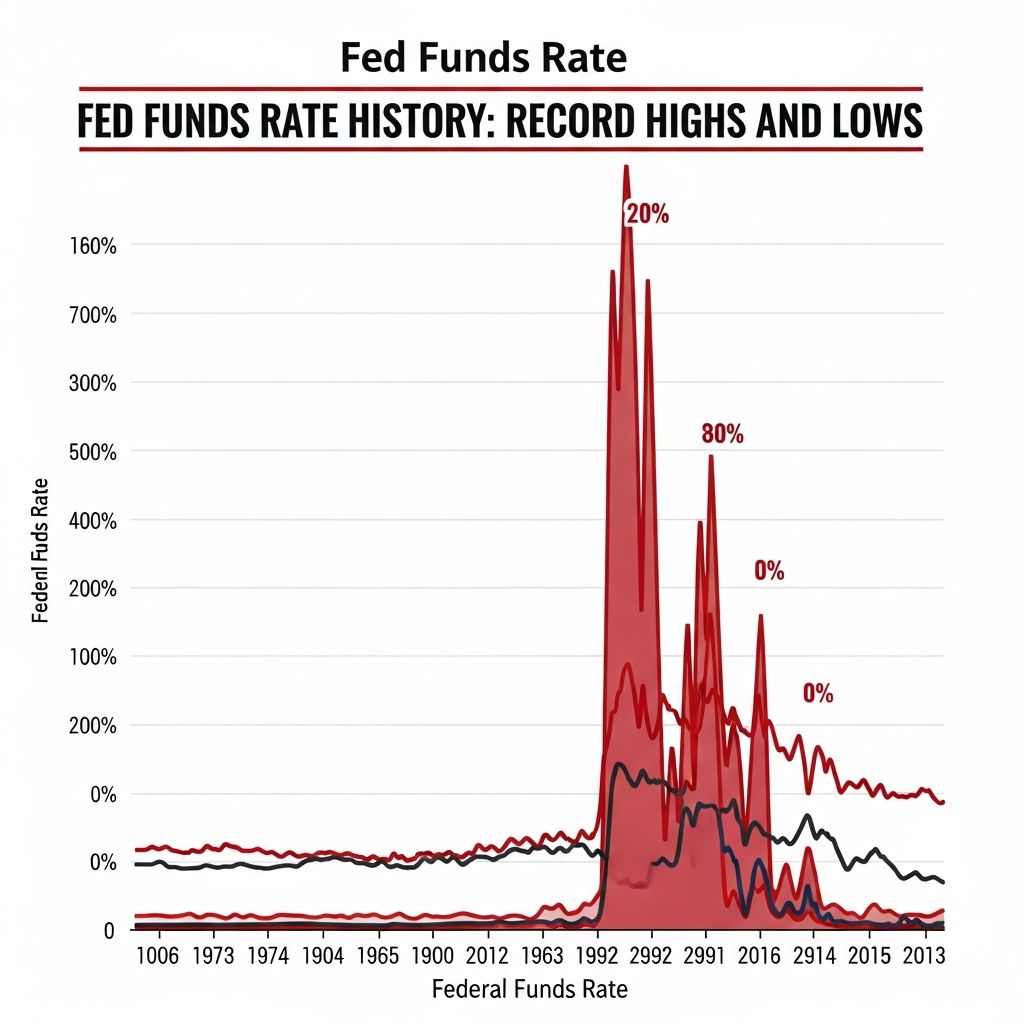
The 1980s witnessed the most dramatic period in federal funds rate history, with rates reaching levels never before seen and never replicated since. When the decade began, inflation had spiraled out of control, reaching an astounding 14.6 percent in 1980—the highest level on record at that time. To combat this persistent inflation crisis, the Federal Reserve under Chairman Paul Volcker made the controversial decision to dramatically raise interest rates.
The federal funds rate began January 1980 at a target level of 14 percent. By December 5, 1980, Fed officials had orchestrated one of the most aggressive rate hikes in history, pushing the target range to 19-20 percent—the highest level ever recorded in Federal Reserve history. This unprecedented move reflected the Fed’s determination to break the back of inflation, even though the strategy would inevitably trigger a severe recession.
The period from 1981 to 1990 showcased the Fed’s commitment to historically hawkish monetary policy. Rates fluctuated significantly during this decade as the Fed navigated between fighting inflation and supporting economic growth. The effective federal funds rate averaged 9.97 percent throughout the entire 1980s, a level that has never been approached in any subsequent decade. By November 1984, interest rates finally fell below 10 percent for the first time since the crisis began, marking an important turning point in monetary policy.
This aggressive rate-hiking campaign worked, though at considerable cost. The manufactured recession successfully brought inflation under control, setting the stage for the economic expansion that would characterize much of the 1990s. The lesson was clear: the Federal Reserve possessed the will and capability to make painful short-term decisions to achieve long-term economic stability.
The 1990s and 2000s: Gradual Adjustments and Crisis Response
After the turbulent 1980s, the 1990s and early 2000s saw a more measured approach to monetary policy. The Fed engaged in periodic adjustments to interest rates based on economic conditions, inflation pressures, and employment trends. This period demonstrated the Fed’s increasing sophistication in fine-tuning monetary policy rather than implementing dramatic swings.
Between June 2004 and June 2006, the Federal Reserve conducted the last full cycle of rate increases during what economists now view as the pre-crisis period. During this two-year span, rates rose steadily from 1.00 percent to 5.25 percent through seventeen consecutive quarter-point increases. The target rate remained at 5.25 percent for over a year before the Fed began its next major policy shift in September 2007, just as warning signs of financial trouble began appearing in the housing market.
The 2008 Financial Crisis: From 5.25% to Near-Zero
The financial crisis of 2007-2008 and the accompanying Great Recession represented the second most dramatic period in federal funds rate history. Beginning in September 2007, the Federal Reserve initiated a sharp reversal from its rate-hiking cycle. The Fed cut rates from 5.25 percent down to a range of 0.00-0.25 percent by December 2008, representing a massive 525 basis point reduction in less than eighteen months.
Under Chairman Ben Bernanke’s leadership, the Fed implemented what was arguably the most aggressive economic rescue effort in its history. This near-zero rate environment persisted for an extended period—seven full years—as the economy struggled with the aftermath of the financial crisis. Between December 2008 and December 2015, the target rate remained fixed at its effective lower bound of 0.00-0.25 percent.
One significant innovation during this period was the Fed’s decision to use a range rather than a specific rate target. According to monetary policy experts, this approach helped prevent potential problems that could have emerged in money market funds, where management fees might have exceeded yields if rates had hit exactly zero percent.
The Gradual Recovery: 2015 to 2019
Beginning in December 2015, the Federal Reserve cautiously began raising interest rates again as the economy showed signs of genuine recovery. After leaving rates at their historic lows for seven years, the Fed raised rates by 25 basis points in December 2015, marking the beginning of a new tightening cycle.
The subsequent rate hikes proceeded very gradually. In 2016, the Fed raised rates just once. In 2017, it increased rates three times. During 2018, the Fed accelerated the pace somewhat, raising rates four times, ultimately reaching a target range of 2.25-2.5 percent by December 2018. This measured approach reflected the Fed’s desire to support continued economic growth while gradually normalizing interest rates from their crisis-era lows.
However, facing tepid inflation and moderating growth in 2019, the Fed reversed course. The committee voted to reduce interest rates three times during that year, returning the target range to 1.5-1.75 percent. These cuts represented what Fed officials called “insurance” moves, designed to protect the economy from potential slowdown rather than responding to an immediate crisis.
The COVID-19 Pandemic and the 2022 Inflation Surge
The COVID-19 pandemic triggered another emergency response from the Federal Reserve. On March 3, 2020, the FOMC cut the target range by 50 basis points. Twelve days later, on March 15, 2020, the Fed implemented an additional 100 basis point cut, returning the federal funds rate to its effective lower bound of 0-0.25 percent—the same level reached during the 2008 financial crisis.
This rapid move to near-zero rates reflected the severe economic uncertainty created by the pandemic lockdowns. The Fed maintained this accommodative stance throughout 2020 and most of 2021 as the economy struggled with the immediate impacts of COVID-19.
However, inflation began rising sharply in 2021 and accelerated further into 2022, creating a significant challenge for policymakers. By late 2022, the Federal Reserve faced pressure to raise rates aggressively to combat what had become the highest inflation in forty years. The response was dramatic: in the latter half of 2022, the FOMC raised the federal funds rate by 75 basis points on four consecutive occasions, demonstrating a commitment to aggressive tightening.
In its final 2022 meeting, the Fed raised rates an additional 50 basis points, bringing the federal funds rate to approximately 4.4 percent. During this period, Fed communications suggested that rate cuts would not occur until 2024 at the earliest, signaling the committee’s determination to maintain restrictive policy until inflation showed clear signs of moving back toward the Fed’s 2 percent target.
Frequently Asked Questions About Federal Funds Rate History
Q: What was the highest federal funds rate ever recorded?
A: The federal funds rate reached an all-time high of 20 percent in March 1980, when Federal Reserve Chairman Paul Volcker implemented dramatic rate increases to combat the era’s record inflation of 14.6 percent. This remains the highest rate in Federal Reserve history.
Q: What was the lowest federal funds rate ever?
A: The federal funds rate reached its historic low of 0.00-0.25 percent in December 2008 during the financial crisis and again in March 2020 during the COVID-19 pandemic. This near-zero range represented the Fed’s most accommodative monetary policy stance.
Q: How long did interest rates remain at near-zero levels?
A: Following the 2008 financial crisis, the federal funds rate remained at 0.00-0.25 percent for seven full years, from December 2008 through December 2015. This extended period reflected the severity of the Great Recession and the subsequent slow recovery.
Q: Why does the Federal Reserve use a range rather than a specific rate?
A: Starting during the 2008 financial crisis, the Fed began using a range (such as 0.00-0.25 percent) rather than a specific target rate. This approach helps prevent potential complications in money market funds, where management fees could exceed yields if the rate hit exactly zero percent.
Q: How often does the Federal Reserve meet to discuss interest rates?
A: The Federal Reserve’s policy committee, known as the Federal Open Market Committee (FOMC), typically meets eight times per year to review economic conditions and make decisions regarding the target range for the federal funds rate.
Q: What economic indicators influence Federal Reserve rate decisions?
A: The Fed considers numerous economic indicators when setting interest rates, including inflation rates, unemployment levels, economic growth, wage growth, and asset prices. The Fed maintains a dual mandate to pursue maximum employment and stable prices.
Key Takeaways on Federal Funds Rate History
The history of the federal funds rate tells the story of the Federal Reserve’s evolving approach to monetary policy. From the dramatic rate hikes of 1980 that combated double-digit inflation to the near-zero rates deployed during financial crises, the Fed has demonstrated its flexibility in responding to economic challenges.
The federal funds rate remains the primary mechanism through which the Federal Reserve influences the broader economy. Understanding its historical patterns helps investors, policymakers, and citizens comprehend how monetary policy shapes economic outcomes. The trajectory from the record highs of 1980 through the historic lows of 2008 and 2020 illustrates both the challenges facing policymakers and the Fed’s determination to maintain economic stability in times of crisis.
References
- Federal Funds Rate History: 1980 Through The Present — Bankrate. 2024. https://www.bankrate.com/banking/federal-reserve/history-of-federal-funds-rate/
- Federal Funds Rate — Federal Reserve Bank of Chicago. 2024. https://www.chicagofed.org/research/dual-mandate/the-federal-funds-rate
- Federal Funds Rate — Federal Reserve History, Federal Reserve. https://www.federalreservehistory.org/essays/fed-funds-rate
- United States Fed Funds Interest Rate — Trading Economics. 2025. https://tradingeconomics.com/united-states/interest-rate
- Federal Funds Effective Rate (FEDFUNDS) — Federal Reserve Economic Data (FRED), Federal Reserve Bank of St. Louis. https://fred.stlouisfed.org/series/FEDFUNDS
- Effective Federal Funds Rate — Federal Reserve Bank of New York. 2024. https://www.newyorkfed.org/markets/reference-rates/effr
Similar Articles








Read full bio of Sneha Tete