FDIC vs SIPC Protection Explained
Discover the key differences between FDIC and SIPC insurance to safeguard your bank deposits and investment accounts effectively.
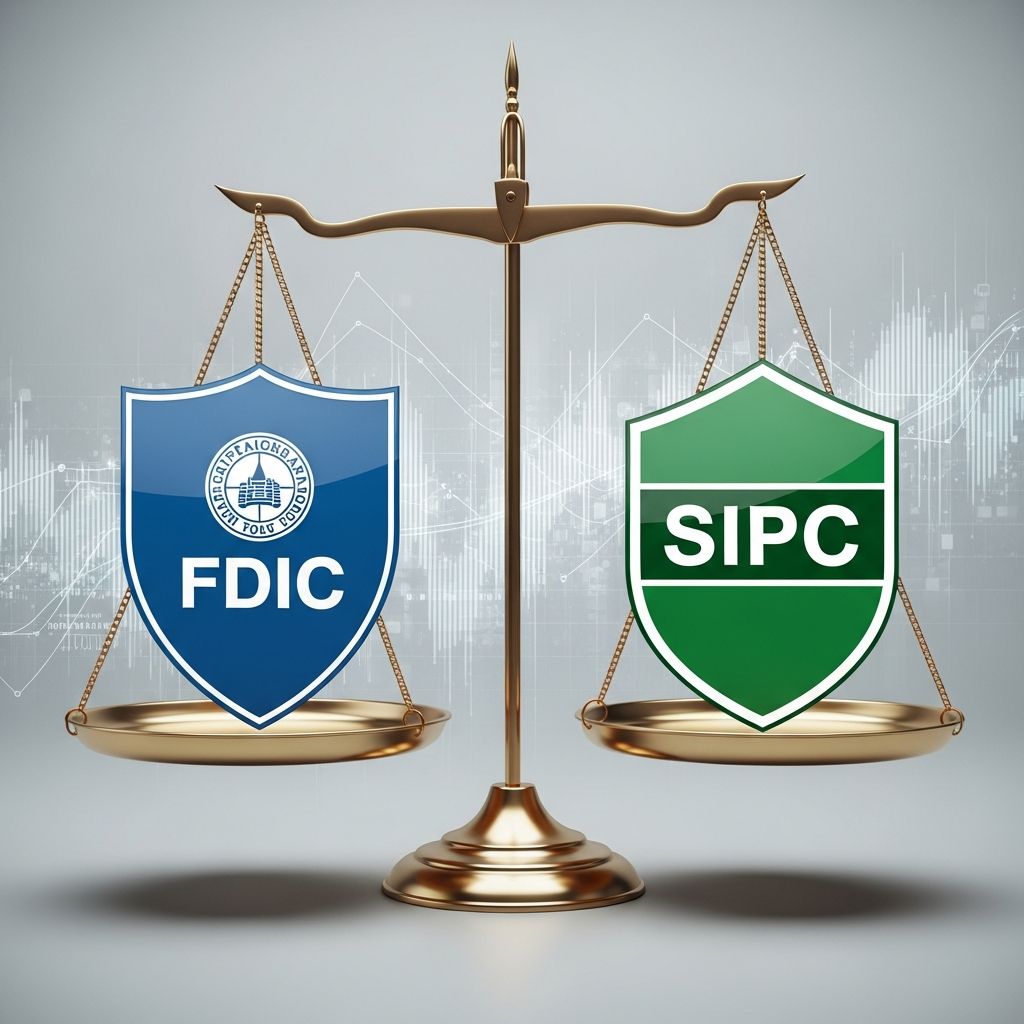
Financial protections like FDIC and SIPC insurance provide essential safeguards for your money, but they apply to different types of accounts and institutions. FDIC insurance secures deposits in banks, while SIPC coverage protects securities in brokerage accounts during firm failures.
Understanding FDIC Deposit Insurance
The
Federal Deposit Insurance Corporation (FDIC)
is a government-backed agency that insures deposits at participating banks and savings associations. Established in 1933 after widespread bank failures, it prevents depositors from losing money if their bank collapses.FDIC coverage applies automatically to eligible accounts at over 4,000 insured institutions. It reimburses depositors directly if the bank fails, ensuring quick access to funds up to the insured limit.
Core Coverage Details for FDIC
- Protected Accounts: Checking accounts, savings accounts, money market deposit accounts (MMDAs), and certificates of deposit (CDs).
- Exclusions: Investments like stocks, bonds, mutual funds, annuities, or safe deposit box contents are not covered.
- Insurance Limit: Up to
$250,000 per depositor, per insured bank, per ownership category
. This means coverage resets for different account types or banks.
For instance, a single account holder’s checking and savings at one bank combine toward the $250,000 limit, but opening accounts at multiple banks multiplies protection.
Ownership Categories and How They Impact Coverage
FDIC categorizes accounts by ownership to expand protection. Here’s a breakdown:
| Category | Description | Insurance Limit |
|---|---|---|
| Single Accounts | Individual accounts in one person’s name | $250,000 total per bank |
| Joint Accounts | Shared by two or more people | $250,000 per co-owner per bank |
| Retirement Accounts | IRAs, 401(k)s (self-directed) | $250,000 per owner per bank |
| Trust Accounts | Revocable/irrevocable trusts | $250,000 per beneficiary (revocable); simplified rules for irrevocable post-2024 |
| Business Accounts | Corporate or partnership accounts | $250,000 per entity per bank |
Trust coverage, updated in April 2024, insures up to $250,000 per beneficiary for revocable trusts, simplifying prior complex rules for irrevocable ones.
Exploring SIPC Securities Protection
The
Securities Investor Protection Corporation (SIPC)
, a nonprofit created by Congress in 1970, protects customers of member brokerage firms. Unlike FDIC, SIPC does not guarantee investment performance but restores missing securities and cash if the broker-dealer fails.Nearly all U.S. brokerages are SIPC members. Coverage activates during bankruptcy, working with trustees to transfer accounts or liquidate assets for reimbursement.
Key Elements of SIPC Coverage
- Covered Assets: Stocks, bonds, mutual funds, Treasury securities, corporate bonds, and uninvested cash in brokerage accounts.
- Not Covered: Market losses, commodities, futures contracts, investment contracts not registered with the SEC, or fixed annuities.
- Maximum Protection: Up to
$500,000 per customer per capacity
, including a $250,000 sub-limit for cash claims.
“Separate capacity” refers to distinct account types, like individual vs. joint, allowing multiple $500,000 protections per brokerage.
Critical Differences Between FDIC and SIPC
While both offer peace of mind against institutional failure, FDIC and SIPC differ fundamentally in scope and application.
| Aspect | FDIC Insurance | SIPC Protection |
|---|---|---|
| Institution Type | Banks & thrifts | Brokerage firms |
| What’s Protected | Deposits (cash equivalents) | Securities & cash |
| Coverage Amount | $250K/depositor/bank/category | $500K/customer/capacity ($250K cash) |
| Triggers Protection | Bank insolvency | Brokerage bankruptcy |
| Market Risk Protection | No | No |
FDIC payouts come from a government-managed fund; SIPC uses member assessments and a trust fund. Neither protects against poor investment choices or economic downturns.
Hybrid Accounts: Where FDIC Meets SIPC
Modern brokerages often blend protections via cash sweep programs. Uninvested cash “sweeps” into FDIC-insured partner banks, shifting from SIPC to FDIC coverage.
- Sweep Benefits: FDIC’s $250,000 per bank limit applies across partner institutions, potentially insuring millions.
- Free Credit Balances: Non-swept cash stays under SIPC up to $250,000.
- Interest Earnings: Swept funds may earn variable rates, though often below money market yields.
Verify your brokerage’s program—coverage details vary by provider.
Strategies to Maximize Your Financial Protections
To optimize safeguards:
- Spread Deposits: Use multiple FDIC-insured banks for deposits exceeding $250,000.
- Diversify Brokerages: Separate accounts across SIPC firms for additional $500,000 coverage each.
- Leverage Ownership Categories: Structure accounts as joint, trust, or retirement to multiply FDIC limits.
- Opt for Sweep Programs: Ensure excess brokerage cash sweeps to FDIC banks.
- Monitor Limits: Use FDIC’s Electronic Deposit Insurance Estimator (EDIE) tool for precise calculations.
For businesses, allocate operating cash to FDIC accounts and investments to SIPC-protected brokerages.
Frequently Asked Questions (FAQs)
Does FDIC cover online banks?
Yes, as long as the bank is FDIC-insured—check the FDIC website or account disclosures.
Is my 401(k) FDIC-insured?
Only the cash portion in FDIC-insured accounts; plan investments typically fall under SIPC or ERISA protections.
What if I exceed SIPC limits?
Excess SIPC coverage (up to $50M) may be available from private insurers; inquire with your brokerage.
Does SIPC protect crypto or forex?
No, these are typically excluded unless held as registered securities.
How do I confirm FDIC/SIPC membership?
Use FDIC’s BankFind or SIPC’s broker directory.
Recent Developments in Coverage Rules
As of 2024, FDIC simplified trust account insurance, aligning irrevocable trusts with revocable ones at $250,000 per beneficiary. SIPC continues advocating for expansions, but core limits remain stable amid economic shifts.
Stay informed, as protections evolve with regulations. Regularly review account structures to align with your risk tolerance and goals.
References
- FDIC vs. SIPC: Where Is It Better to Hold Cash? — LendingClub. 2023. https://www.lendingclub.com/resource-center/personal-savings/fdic-vs-sipc-where-is-it-better-to-hold-cash
- Understanding SIPC vs. FDIC Insurance — Thrivent. 2024-05-15. https://www.thrivent.com/insights/investing/fdic-vs-sipc-whats-the-difference
- SIPC vs. FDIC Insurance: What’s the Difference? — Experian. 2024-04-01. https://www.experian.com/blogs/ask-experian/sipc-vs-fdic-insurance/
- FDIC vs. SIPC Insurance: Key Differences Explained — Ramp. 2024. https://www.ramp.com/blog/fdic-vs-sipc
- Guide to the Differences Between FDIC vs SIPC — SoFi. 2023-11-20. https://www.sofi.com/learn/content/sipc-vs-fdic/
- How Bank Deposit Accounts are Protected: SIPC vs FDIC Insurance — Arc. 2024. https://www.joinarc.com/learning-center/how-bank-deposits-are-protected-fdic-sipc-insurance
Similar Articles








Read full bio of Sneha Tete