FDIC Rate Caps: 2025 Guide For Savers And Banks
Understand FDIC national rate caps: their purpose, calculation flaws, and impact on banks and savers in today's high-rate environment.
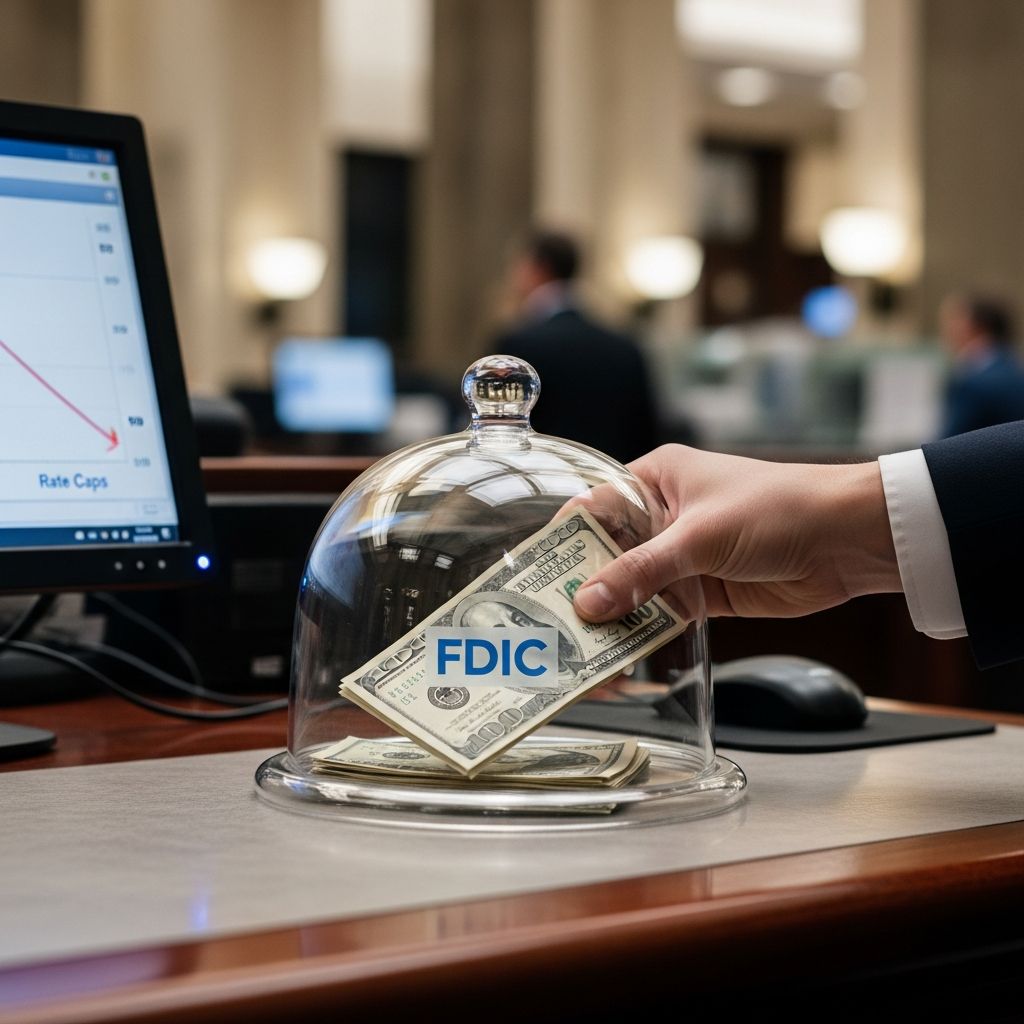
FDIC rate caps play a critical role in regulating deposit rates offered by banks, particularly for money market accounts (MMAs) and certificates of deposit (CDs). These caps are designed to protect the banking system by limiting the rates that less-than-well-capitalized institutions can offer, preventing them from attracting deposits aggressively during financial distress. Understanding these caps is essential for both banks managing compliance and savers seeking the best returns on FDIC-insured products.
What Are FDIC National Rates and Rate Caps?
The FDIC publishes Weekly National Rates and Rate Caps every Thursday, reflecting data collected from banks as of the previous Tuesday. These rates represent the simple average of rates paid by all insured U.S. banks and thrifts on specified maturity deposits, including money market accounts and CDs in denominations over $100,000.
The national rate is calculated as the average yield across thousands of institutions. The rate cap, however, is the higher of: (1) the national rate plus 75 basis points (0.75%), or (2) 120% of the current yield on similar maturity U.S. Treasury securities. For example, as of July 2025, the national rate cap for money market accounts under $100,000 stood at 5.08%, unchanged for several months amid stable high-interest conditions.
| Month | National Rate Cap (MM <100k) |
|---|---|
| Jul 2025 | 5.08000% |
| Jun 2025 | 5.08000% |
| May 2025 | 5.08000% |
| Apr 2025 | 5.08000% |
| Mar 2025 | 5.08000% |
This table illustrates the stability of rate caps in mid-2025, despite Federal Reserve rate hikes pushing short-term rates up significantly.
Why Do FDIC Rate Caps Exist?
Established under FDIC Financial Institution Letter (FIL) 25-2009, rate caps restrict banks that are not well-capitalized from offering rates significantly above national averages. The primary goal is to curb risky behavior: troubled banks might otherwise lure deposits with high rates to fund operations, increasing FDIC’s potential liability if the bank fails.
Well-capitalized banks face no such restrictions and can offer competitive rates to attract deposits. However, if a bank’s capital category drops—triggering Prompt Corrective Action (PCA)—it must adhere to these caps. This mechanism promotes financial stability by discouraging over-reliance on hot money deposits during vulnerability.
- Well-capitalized banks: No rate restrictions.
- Adequately capitalized: Cannot offer rates above the national rate.
- Less than adequately capitalized: Cannot accept deposits using rates above national rate or rate caps.
How Are National Rates Calculated?
The FDIC aggregates ‘board rates’—standard advertised rates—from over 5,500 banks and 90,000 branches nationwide. For MMAs, it focuses on accounts over $100,000, while CDs are segmented by maturity (e.g., 3-month, 1-year).
However, this methodology has notable flaws. Large banks (just 55 charters) control over 50% of branches, often in urban areas, skewing averages downward. These institutions maintain low rates on MMAs and CDs due to massive transaction account platforms, suppressing national rates.
Additionally, banks frequently offer ‘special rates’ higher than board rates to compete locally, which the FDIC ignores. This disconnect means national rates often lag true market yields. For instance, while the 1-year national rate might be 0.40%, local community banks pay far more to retain deposits.
Flaws in the FDIC National Rates Methodology
The calculation’s reliance on board rates from branch-heavy mega-banks creates systemic bias. Community banks in rural or competitive markets must offer higher rates to compete, yet these are underrepresented.
In a rising rate environment—short-term rates up 175 basis points since Fed hikes began—the gap between Fed Funds Target Rate and FDIC national rates has ballooned from 5bps to 160bps. A 1-year national rate of 0.40% sets a rate cap at 1.15%, far below what many community banks pay organically.
Regulators classify deposits 75bps above national rates as ‘high rate,’ reclassifying them from core to volatile in liquidity models. This ‘liquidity trap’ hampers even healthy banks’ funding, especially with loan demand rising and investment portfolios depleted.
Impact on Banks Under Prompt Corrective Action (PCA)
PCA activates when a bank’s capital falls below thresholds, imposing escalating restrictions. Rate caps are central: undercapitalized banks cannot solicit or renew deposits above caps, even from existing customers.
This creates rollover risk. If local rates exceed caps (common today), maturing CDs cannot be renewed competitively, forcing runoff. Banks reliant on wholesale funding face acute stress, potentially needing collateral swaps or alternative liquidity.
Recent examples highlight dangers: even core relationship deposits get tagged ‘high rate’ or brokered under scrutiny, complicating liquidity modeling.
Recent Regulatory Changes: Reciprocal Deposits
The 2018 Economic Growth, Regulatory Relief, and Consumer Protection Act brought relief. Reciprocal deposits—exchanged via networks like CDARS/ICS—are no longer brokered for well-capitalized banks with ‘outstanding’ or ‘good’ exams, up to the lesser of 20% of liabilities or $5 billion.
This aids community banks serving municipalities with large, collateralized deposits, boosting liquidity without brokered classifications. However, if capital slips, caps apply to new reciprocal inflows.
Current Rate Environment and Rate Caps
As of July 2025, money market national rate caps hover at 5.08%, reflecting sustained high rates post-Fed hikes. Vanguard notes average bank savings yields at 0.39% as of December 2025, underscoring the spread.
Savers benefit: FDIC-insured MMAs at Huntington offer higher yields than savings, with liquidity and check-writing. FDIC covers $250,000 per depositor per bank per ownership category.
What This Means for Savers
Rate caps rarely bind top-tier banks, so competitive MMAs and CDs abound. Shop online banks or credit unions for yields beating national averages—often 4-5% APY in 2025-2026.
- Compare rates weekly via FDIC reports.
- Opt for promotional/special rates.
- Understand FDIC limits: $250k per category.
BNY Pershing sweep products yield up to 3.63% on money funds, with FDIC sweeps at lower 0.75% but multi-bank diversification up to $2.5M coverage.
Bank Best Practices for Compliance and Liquidity
Banks should:
- Model PCA scenarios with high-rate deposit outflows.
- Set liquidity tolerances accounting for rate competition.
- Leverage reciprocal deposits within limits.
- Update contingency plans for regulatory shifts.
Frequently Asked Questions (FAQs)
What is the current FDIC national rate cap for money market accounts?
As of July 2025, it’s 5.08% for MMAs under $100k, calculated as national rate +75bps or 120% Treasury yield.
Do rate caps apply to well-capitalized banks?
No, only banks under PCA face restrictions.
Why are national rates lower than market rates?
Skewed by large banks’ low board rates; specials ignored.
Are reciprocal deposits still brokered?
No, for qualifying well-capitalized banks up to specified limits post-2018 Act.
How much FDIC insurance per account?
$250,000 per depositor, per bank, per ownership category.
Conclusion
FDIC rate caps safeguard stability but reveal flaws in a dynamic market. Banks must navigate carefully, while savers can pursue high yields from compliant institutions. Monitor weekly updates for opportunities.
References
- Deposit Diaries: National Rate Caps and “Hidden” Liquidity Risk — Taylor Advisor. 2023. https://www.tayloradvisor.com/deposit-diaries-national-rate-caps-and-hidden-liquidity-risk/
- National Rate Cap: Money Market <100M (MMNRC) — Federal Reserve Bank of St. Louis (FRED). 2025-07-21. https://fred.stlouisfed.org/series/MMNRC
- Rates | BNY Pershing — BNY. 2026. https://www.bny.com/pershing/us/en/rates.html
- High Interest Rate Money Market Accounts — Huntington Bank. 2025. https://www.huntington.com/Personal/savings-cds-overview/relationship-money-market-account
- National Rates and Rate Caps – Previous Rates — FDIC.gov. 2025. https://www.fdic.gov/national-rates-and-rate-caps/national-rates-and-rate-caps-previous-rates
- Vanguard Cash Plus Account — Vanguard. 2025-12-15. https://investor.vanguard.com/accounts-plans/vanguard-cash-plus-account
- Understanding Deposit Insurance — FDIC.gov. 2025. https://www.fdic.gov/resources/deposit-insurance/understanding-deposit-insurance
Similar Articles








Read full bio of Sneha Tete