FDIC Protection for IRAs Explained
Discover if your IRA qualifies for FDIC insurance, understand coverage limits, and learn strategies to safeguard your retirement savings from bank failures.
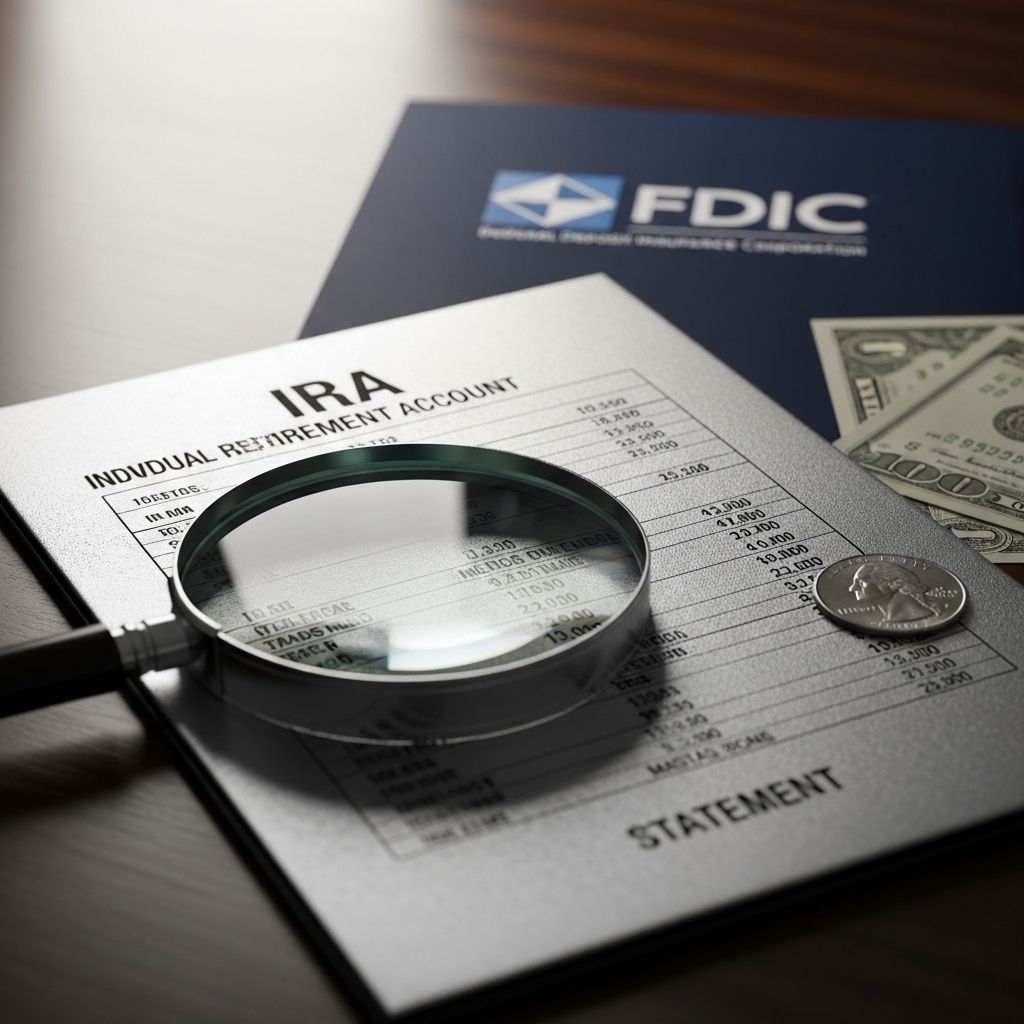
Individual Retirement Accounts (IRAs) serve as vital tools for building long-term financial security, but their safety hinges on the type of institution and assets held within them. FDIC insurance applies specifically to deposit-based IRAs at insured banks, offering up to $250,000 coverage per owner against bank failures, while investment-focused IRAs lack this protection.
Understanding the Basics of FDIC Insurance
The Federal Deposit Insurance Corporation (FDIC) acts as a government-backed safeguard for depositors at participating financial institutions. Established to maintain stability in the banking system, it reimburses account holders if an insured bank fails, covering principal and accrued interest up to defined limits. This protection activates automatically for eligible accounts, typically restoring funds within days of a failure declaration.
Only deposits like checking, savings, and certificates of deposit (CDs) qualify; non-deposit products such as stocks, bonds, mutual funds, annuities, or cryptocurrencies do not receive coverage, even when offered by FDIC-insured banks.
When Does FDIC Coverage Apply to Retirement Accounts?
FDIC insurance extends to certain self-directed retirement plans, including traditional and Roth IRAs, where participants control investment choices. These accounts aggregate across all similar holdings at one institution, capping total protection at $250,000 per owner, irrespective of beneficiary numbers.
For instance, multiple IRA CDs or savings at the same bank combine toward the limit. Self-directed status means the account owner selects deposit placements, distinguishing it from employer-managed plans without such flexibility.
- Eligible IRA Types: Traditional IRAs, Roth IRAs, and self-directed portions of 401(k)s or 457 plans held in deposits.
- Ineligible Plans: 403(b) plans and non-deposit investments within any retirement vehicle.
- Key Requirement: Funds must reside in deposit accounts at FDIC-member banks.
Core Coverage Limits and Rules
The standard limit stands at $250,000 per depositor, per insured bank, per ownership category. This structure allows strategic account setups to amplify protection.
| Ownership Category | Coverage Amount | Notes |
|---|---|---|
| Single Accounts | $250,000 | Individual ownership without co-owners or beneficiaries. |
| Joint Accounts | $250,000 per co-owner | Assumes equal shares; up to $500,000 for spouses. |
| Certain Retirement Accounts (e.g., IRAs) | $250,000 per owner | Aggregates all qualifying accounts at one bank; beneficiaries do not increase limit. |
| Revocable Trust Accounts | $250,000 per beneficiary (up to $1,250,000 per owner) | Applies if IRA converts to trust upon death. |
| Employee Benefit Plans | $250,000 per participant | Non-contingent interests only. |
Bank failures remain infrequent due to regulatory oversight, yet understanding these boundaries ensures full safeguarding of retirement nest eggs.
Navigating Balances Exceeding $250,000
Excess funds beyond the cap risk loss in a failure scenario. A $300,000 IRA deposit, for example, secures only $250,000, leaving $50,000 exposed.
Strategies to mitigate this include:
- Distributing assets across multiple FDIC-insured banks for multiplied coverage.
- Utilizing joint ownership where applicable to double limits.
- Exploring trust structures for beneficiary-enhanced protection in revocable setups.
- Opting for bank sweep programs that spread funds over partner institutions, potentially reaching higher totals like $1.25 million.
Beneficiary designations demand care; inheriting an IRA without proper titling can merge balances, breaching limits. Maintaining separate accounts post-inheritance preserves individual coverages.
Differences Between FDIC and Other Protections
FDIC distinctly shields bank deposits from institutional insolvency, excluding market fluctuations, theft, or fraud. Securities Investor Protection Corporation (SIPC) covers brokerage accounts up to $500,000 (including $250,000 cash) against broker-dealer failures, but not investment losses.
IRAs at brokerages holding stocks or funds rely on SIPC, not FDIC. Bank-offered investment products fall outside FDIC scope, underscoring the need to verify account composition.
Practical Steps to Verify and Maximize IRA Protection
Account holders should confirm FDIC membership via bank disclosures or the FDIC’s BankFind tool. Review statements to ensure funds remain in insured deposits, avoiding non-qualifying products.
- Assess current IRA balance against the $250,000 threshold per bank.
- Identify ownership category and aggregation rules.
- Split large balances across institutions if nearing limits.
- Consult advisors for complex beneficiary or trust scenarios.
- Monitor for plan changes affecting self-directed status.
Regular audits prevent inadvertent overexposure, aligning protection with retirement objectives.
Real-World Examples of Coverage in Action
Consider an individual with $200,000 in a single IRA deposit and $100,000 in a joint IRA at Bank A. The single account covers fully, while the joint provides $50,000 per owner, securing the full personal share.
Another case: Two IRA CDs totaling $400,000 at one bank insure only $250,000 combined. Transferring $150,000 to Bank B achieves full protection.
For trusts, a revocable IRA with five beneficiaries could insure $1,250,000 ($250,000 each), vital for estate planning.
Frequently Asked Questions
Are all IRAs automatically FDIC-insured?
No, only deposit accounts at FDIC-insured banks qualify. Investment IRAs at brokerages do not.
Does naming beneficiaries increase my IRA’s FDIC limit?
Not for standard IRAs; all accounts aggregate to $250,000 per owner per bank. Revocable trusts may expand via beneficiaries.
What happens if my bank fails?
FDIC reimburses eligible deposits plus interest promptly, often within days.
Can I get more than $250,000 coverage for my IRA?
Yes, by using multiple banks or qualifying ownership categories.
Are CDs in an IRA FDIC-insured?
Yes, as deposit products, up to the ownership limits.
Planning for Comprehensive Retirement Security
Beyond FDIC, diversification across asset classes and institutions fortifies portfolios against varied risks. While bank deposits offer principal protection, balancing with growth-oriented investments suits long-term goals. Staying informed on regulatory updates ensures adaptive strategies.
Proactive management, including periodic reviews and professional guidance, optimizes both safety and growth in IRA holdings.
References
- Are IRAs FDIC-Insured? — Experian. 2023. https://www.experian.com/blogs/ask-experian/are-iras-fdic-insured/
- Retirement Accounts and the FDIC — Synchrony Bank. 2023. https://www.synchrony.com/blog/bank/retirement-accounts-fdic-insured
- FDIC Insurance Coverage — CapFed. 2024. https://www.capfed.com/about-capfed/news/fdic-insurance-coverage
- Certain Retirement Accounts — FDIC.gov. 2024-03-01. https://www.fdic.gov/financial-institution-employees-guide-deposit-insurance/certain-retirement-accounts
- What Is FDIC Insurance and How Does It Work? — Vanguard. 2024. https://investor.vanguard.com/investor-resources-education/article/how-does-fdic-insurance-work
- Understanding Deposit Insurance — FDIC.gov. 2024. https://www.fdic.gov/resources/deposit-insurance/understanding-deposit-insurance
- Understanding FDIC and SIPC Insurance — Schwab Moneywise. 2023. https://www.schwabmoneywise.com/essentials/understanding-fdic-and-sipc-insurance
Similar Articles








Read full bio of Sneha Tete