Famous Economists and Their Contributions to Economics
Discover how influential economists shaped modern economic theory and practice.
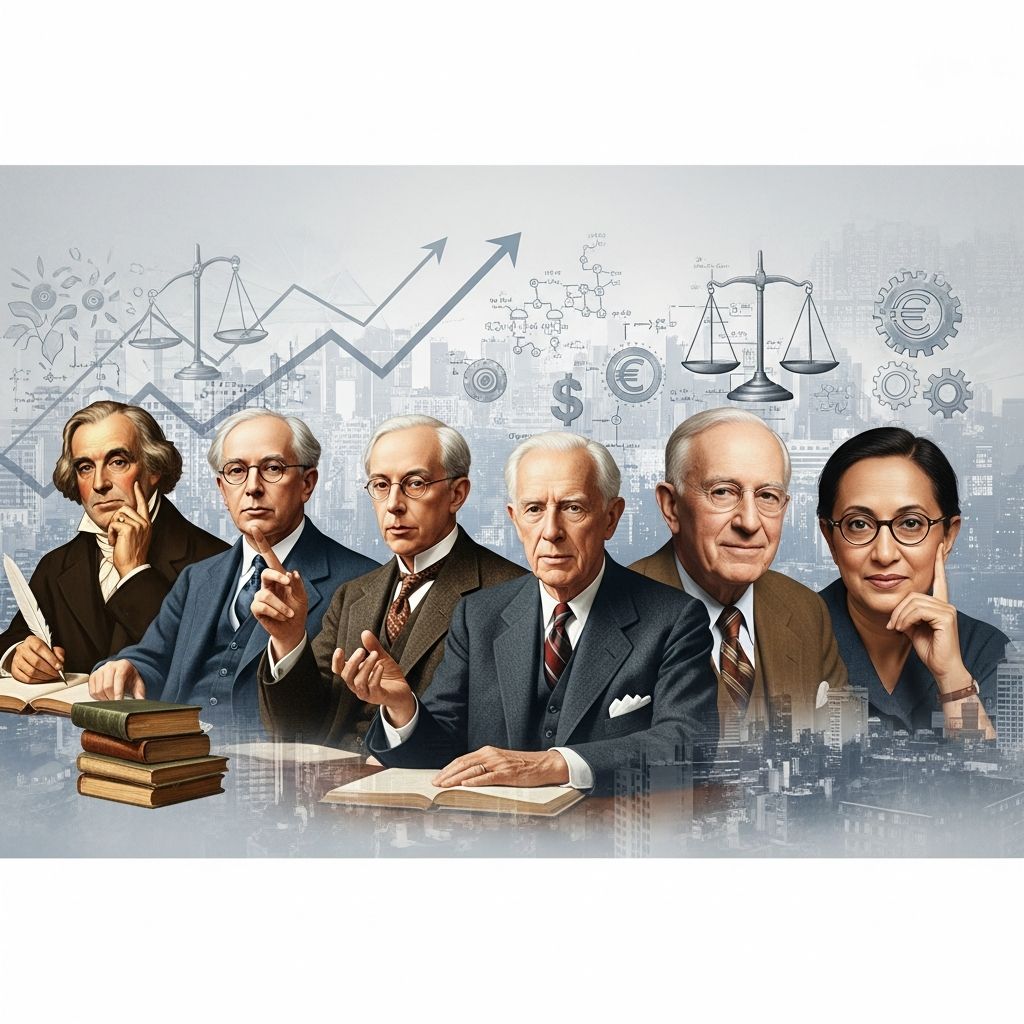
Economics as a discipline has been shaped by brilliant minds over centuries, each contributing unique perspectives on how markets function, wealth is created, and prosperity is achieved. Understanding the work of famous economists provides invaluable insights into the theories that guide modern monetary policy, investment strategies, and government fiscal decisions. These economists have fundamentally altered our understanding of supply and demand, inflation, unemployment, and international trade.
Adam Smith: The Father of Modern Economics
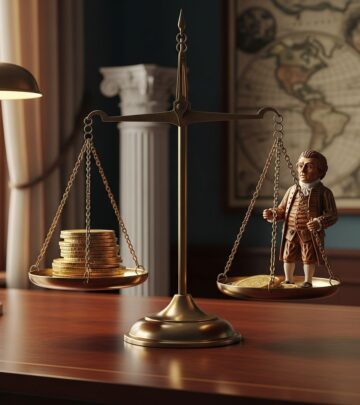
Adam Smith stands as one of the most influential figures in economic history. Born in Scotland in 1723, Smith revolutionized economic thought with his groundbreaking work The Wealth of Nations, published in 1776. This seminal text introduced the concept of the “invisible hand,” a metaphor describing how individual self-interest and competition naturally lead to economic efficiency and growth.
Smith’s most enduring contribution was demonstrating that markets could self-regulate through competition rather than requiring heavy government intervention. He argued that when individuals pursue their own economic interests, they inadvertently promote the general welfare of society. This principle became the foundation for capitalist economics and remains central to modern free-market theory.
- The Division of Labor: Smith emphasized how specialization and the division of labor increase productivity and economic output
- Free Trade: He advocated for minimal tariffs and trade restrictions, believing that free commerce benefits all nations
- Labor Theory of Value: Smith proposed that the value of goods is determined by the labor required to produce them
David Ricardo: Trade and Comparative Advantage
David Ricardo, an English economist and stockbroker, built upon Smith’s foundation by developing the theory of comparative advantage. Ricardo’s work in the early 19th century provided crucial insights into international trade that remain relevant today.
Ricardo demonstrated that even if one nation is more efficient at producing all goods, trade can still benefit both countries if each specializes in producing what it does best relative to other goods. This principle, known as comparative advantage, contradicted the prevailing mercantilist belief that one nation’s gain necessarily meant another nation’s loss.
- Comparative Advantage: Nations should specialize in producing goods where they have the lowest opportunity cost
- International Trade Benefits: Free trade increases overall efficiency and consumer welfare globally
- Rent and Wages: Ricardo analyzed how wealth distribution affects different economic classes
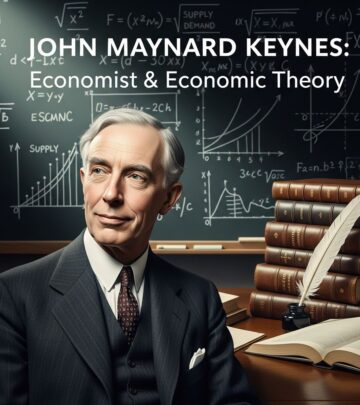
John Maynard Keynes: Revolution in Economic Thought
John Maynard Keynes fundamentally transformed economics in the 20th century, particularly through his revolutionary explanation of why economies fail to self-correct during recessions and depressions. Published in 1936, his masterwork The General Theory of Employment, Interest and Money challenged classical economic orthodoxy and provided the intellectual foundation for modern macroeconomic policy.
Keynes argued that economies could remain stuck in equilibrium at less than full employment. He introduced the concept of aggregate demand and demonstrated that government intervention through fiscal policy could stimulate economic growth and reduce unemployment. This thinking justified expansionary government spending during recessions and periods of high unemployment.
- Aggregate Demand: Total spending in an economy determines overall economic output and employment levels
- The Multiplier Effect: Government spending generates additional economic activity as recipients spend their income
- Animal Spirits: Keynes introduced the concept that investor psychology and confidence drive investment decisions
- Fiscal Policy: Government can influence economic cycles through taxation and spending decisions
Milton Friedman: Monetarism and Free Markets
Milton Friedman emerged as one of the most influential economists of the late 20th century, championing free-market economics and the quantity theory of money. Friedman’s work provided a powerful intellectual counterweight to Keynesian economics, particularly during the stagflation of the 1970s.
Friedman’s monetarism emphasizes the role of the money supply in determining inflation and economic output. He argued that inflation is fundamentally a monetary phenomenon caused by excessive growth in the money supply relative to economic growth. His famous statement, “Inflation is always and everywhere a monetary phenomenon,” became a cornerstone of modern central banking practice.
- Quantity Theory of Money: The money supply directly influences the price level and inflation rates
- Natural Rate of Unemployment: Friedman identified a level of unemployment below which inflation accelerates
- Permanent Income Hypothesis: Consumer spending reflects permanent rather than temporary income changes
- Capitalism and Freedom: Friedman advocated for minimal government intervention and maximum individual economic liberty
Karl Marx: Revolutionary Economic Analysis
Karl Marx provided a radical critique of capitalism that influenced not only economics but political movements worldwide. Though his predictions about capitalism’s collapse proved incorrect, Marx’s analytical framework for understanding class relationships and economic systems remains influential in academic circles.
Marx argued that capitalism creates inherent contradictions through the exploitation of labor and the concentration of wealth. His labor theory of value and concept of surplus value provided a foundation for understanding worker exploitation. While most modern economists reject Marx’s conclusions about capitalism’s inevitable collapse, his analytical methods continue to inform heterodox economic schools of thought.
Alfred Marshall: The Foundations of Microeconomics
Alfred Marshall synthesized classical and neoclassical economic thought, creating a framework that dominates microeconomics to this day. His 1890 work Principles of Economics introduced supply and demand curves, the concept of elasticity, and marginal analysis—tools that remain central to economic analysis.
Marshall demonstrated how prices adjust through the interaction of supply and demand, establishing the equilibrium price concept that underlies all modern market analysis. His mathematical approach to economics helped professionalize the discipline and provided economists with powerful analytical tools.
- Supply and Demand: Market prices result from the interaction between consumer demand and producer supply
- Elasticity: The responsiveness of quantity demanded or supplied to price changes determines market dynamics
- Consumer Surplus: Consumers often benefit from purchases by paying less than their willingness to pay
Joseph Schumpeter: Innovation and Creative Destruction
Joseph Schumpeter introduced the concept of “creative destruction,” explaining how capitalism progresses through cycles of innovation and disruption. He argued that entrepreneurs and technological innovation drive economic growth more than marginal adjustments in existing systems.
Schumpeter’s framework helps explain why mature industries decline as new technologies and businesses emerge. His work provides valuable insights for understanding technological revolutions, from industrialization to digital transformation. The concept of creative destruction remains essential for understanding modern economic dynamics and business cycles.
Comparison Table of Major Economic Schools
| Economist | Primary Contribution | Key Theory | Time Period |
|---|---|---|---|
| Adam Smith | Foundation of capitalism | Invisible Hand | 1776 |
| David Ricardo | International trade | Comparative Advantage | 1810s-1820s |
| John Maynard Keynes | Macroeconomic policy | Aggregate Demand | 1936 |
| Milton Friedman | Monetary economics | Monetarism | 1950s-1970s |
| Joseph Schumpeter | Innovation economics | Creative Destruction | 1910s-1940s |
Modern Economic Thought
Contemporary economists continue building on these foundational ideas while developing new frameworks to address current challenges. Behavioral economics, pioneered by scholars like Daniel Kahneman and Richard Thaler, challenges the assumption of rational economic actors by incorporating psychological insights into economic analysis.
Environmental economics addresses market failures related to pollution and resource depletion, while development economics focuses on explaining and reducing poverty in low-income nations. These emerging fields demonstrate that economic theory continues to evolve as economists confront new challenges and incorporate new methodologies.
The Relevance of Classic Economic Thought Today
Understanding classical and modern economic theories remains essential for investors, policymakers, and informed citizens. The 2008 financial crisis revived interest in Keynesian economics, while recent inflation concerns have elevated the prominence of monetarist theory. Schumpeter’s framework has proven invaluable for understanding technology sector disruptions and venture capital dynamics.
The debates initiated by these economists continue to shape policy discussions. Whether central banks should intervene aggressively during downturns, how regulation should be balanced against market freedom, and what causes inflation remain contested issues with roots in the theoretical frameworks established by the economists discussed above.
Frequently Asked Questions
Q: What makes someone a famous economist?
A: Famous economists typically introduce groundbreaking theories that transform how we understand economic phenomena, create frameworks still used centuries later, and influence policy decisions that affect millions of people. Their work often serves as the foundation for entire schools of economic thought.
Q: Are classical economics and capitalism the same thing?
A: While related, they are not identical. Classical economics refers to economic theories developed by Smith, Ricardo, and others that emphasize market efficiency. Capitalism is an economic system based on private ownership and market mechanisms. Classical economic theory provides intellectual support for capitalism but describes a broader analytical framework.
Q: Why do Keynesian and monetarist economists disagree?
A: Keynesians emphasize aggregate demand and government spending as tools to combat recessions, while monetarists stress the importance of controlling the money supply. These differences stem from different beliefs about how markets self-correct and the effectiveness of policy tools in addressing economic problems.
Q: How do economists’ theories impact investment decisions?
A: Understanding economic theories helps investors anticipate how central banks will respond to economic conditions, how inflation will develop, and how different sectors will perform under various economic scenarios. Theories about business cycles, interest rates, and market behavior inform investment strategy.
Q: Can economic theories ever be definitively proven correct or wrong?
A: Economic theories are difficult to prove conclusively because economies are complex systems with many variables. Instead, economists evaluate theories based on how well they explain historical events, their internal logical consistency, and their predictive accuracy. No theory perfectly explains all economic phenomena.
Q: Which economist’s ideas are most relevant today?
A: This depends on current economic conditions. During recessions, Keynes becomes highly relevant. During inflationary periods, Friedman’s monetarism gains prominence. Schumpeter’s creative destruction framework proves especially valuable for understanding technology-driven economic change. Most economists today draw on insights from multiple theoretical traditions.
References
- The Wealth of Nations — Adam Smith. 1776. Project Gutenberg. https://www.gutenberg.org/ebooks/3825
- On the Principles of Political Economy and Taxation — David Ricardo. 1817. The Library of Economics and Liberty. https://www.econlib.org/library/Ricardo/ricP.html
- The General Theory of Employment, Interest and Money — John Maynard Keynes. 1936. Project Gutenberg. https://www.gutenberg.org/files/30135/30135-pdf.pdf
- Capitalism and Freedom — Milton Friedman. 1962. The University of Chicago Press. https://press.uchicago.edu/ucp/books/book/chicago/C/bo3684152.html
- The Theory of Economic Development — Joseph Schumpeter. 1911. Harvard University Press. https://www.hup.harvard.edu/
- Principles of Economics — Alfred Marshall. 1890. The Library of Economics and Liberty. https://www.econlib.org/library/Marshall/marP.html
Similar Articles








Read full bio of Sneha Tete