Falling Rates: Smart Moves for Your Savings
Interest rates are dropping in 2026—discover proven strategies to protect and grow your cash amid economic shifts.

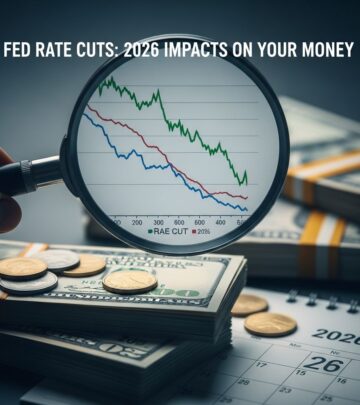
Interest rates are on a downward trajectory in 2026, with the Federal Reserve expected to lower its benchmark from the current 3.50%-3.75% range toward 3% by year-end, driven by cooling inflation and labor market trends. This shift impacts savers directly, reducing returns on traditional accounts and prompting a reevaluation of cash placement strategies. While borrowing costs ease, preserving yield on idle cash becomes critical for financial security.
Understanding the 2026 Rate Decline Forecast
The Federal Reserve’s recent 25-basis-point cut at its final 2025 meeting marks the culmination of 175 basis points in reductions since September 2024, reflecting a response to moderated inflation nearing the 2% target. Projections from Fed members indicate a median federal funds rate of 2.9% for 2026 and 2027, with ranges spanning 2.4% to 4.9%. iShares anticipates a further drop to around 3%, contingent on economic data like inflation and employment, though uncertainty looms with Fed Chair Jay Powell’s term ending in May 2026.
Market futures and analysts like Morningstar align with this outlook, forecasting rates around 2.75% in 2026, averaging to 2.7% ±0.2% when combining expert views. These declines stem from slowed consumer spending, a cooling job market, and declining CPI from 2.7% in December to 2.4% in January. For savers, this means yields on savings products will compress, but opportunities arise in locking in current rates before they vanish.
Current Yields and Why Action Is Needed Now
As of early 2026, high-yield savings accounts and money market funds offer competitive rates, though they trail the peaks seen during the 2022-2023 tightening cycle when the fed funds rate hit 5.33%. With rates projected to stabilize near 2.5%-2.9% by late 2026, today’s options—still above historical lows—provide a window to secure better returns.
| Product Type | Current Average Yield (Early 2026) | Projected 2026 Yield |
|---|---|---|
| High-Yield Savings | ~4.5%-5% | ~2.5%-3% |
| Money Market Accounts | ~4.2%-4.8% | ~2.3%-2.8% |
| 1-Year CD | ~4.0%-4.5% | Locked at current |
This table illustrates the urgency: variable-rate products will adjust downward with Fed moves, while fixed options like CDs can preserve higher yields.
Top Strategies to Safeguard Your Cash
To counter falling rates, diversify across yield-preserving vehicles. Prioritize liquidity needs, risk tolerance, and time horizons when allocating funds.
- Lock in CDs for Guaranteed Returns: Certificates of deposit offer fixed rates for terms from 3 months to 5 years. Current 1-year CDs yield around 4%, shielding against declines. Shop online banks for the best rates, as they often exceed brick-and-mortar options.
- High-Yield Savings for Flexibility: These FDIC-insured accounts provide easy access with yields above traditional savings. Rates are variable but remain elevated in early 2026—ideal for emergency funds.
- Money Market Funds for Stability: Offering check-writing and debit card features, these funds invest in short-term securities, yielding slightly less than CDs but with daily liquidity.
Building a Bond Ladder for Steady Income
As rates fall, bond prices rise inversely, making fixed-income investments attractive. A bond ladder—staggered maturities of Treasury or corporate bonds—delivers predictable income and reinvestment opportunities.
- Select bonds with maturities matching your goals (e.g., 1-5 years).
- Focus on U.S. Treasuries for safety, currently yielding 3.75%-4% on shorter terms.
- Reinvest maturing bonds at prevailing rates to maintain yield.
This approach mitigates reinvestment risk in a declining rate environment, providing a hedge as savings yields drop.
Broader Economic Impacts on Your Finances
Falling rates ripple through markets: mortgage rates, hovering near 6% for 30-year fixed loans, could dip to 5.5%-6.4% by late 2026, boosting affordability and refinancing. Stock markets may see increased risk appetite as safe yields compress, while real estate supply rises with more sellers emerging from low-rate locks.
For cash holders, the key is balance: maintain 3-6 months’ expenses in liquid accounts, park medium-term funds in CDs or ladders, and consider equities for long-term growth.
Comparing Cash Options: Pros and Cons
| Option | Pros | Cons | Best For |
|---|---|---|---|
| HYSA | High liquidity, FDIC insurance, competitive yields | Variable rates fall with Fed | Emergency funds |
| CDs | Fixed rates, guaranteed principal | Penalties for early withdrawal | Known short-term needs |
| Bond Ladder | Rising prices in falling rates, income stream | Interest rate risk on longer terms | Income-focused investors |
| Money Market | Check access, stable NAV | Lower yields than CDs | Daily spending needs |
Risks and Considerations in a Low-Rate World
Inflation risk persists if rates fall too slowly, eroding real returns. A potential new Fed chair introduces policy uncertainty. Diversification across maturities and issuers minimizes these. Always verify FDIC coverage up to $250,000 per account.
Frequently Asked Questions
Will rates keep falling through 2026?
Yes, consensus points to 2.5%-2.9% by year-end, though data-dependent.
Should I move cash from savings to CDs now?
If you won’t need funds soon, yes—lock in 4%+ yields before they drop.
Are bonds better than savings in declining rates?
For medium-term holds, yes, due to price appreciation and locked yields.
How do Fed cuts affect my existing savings?
Variable accounts will see yields decline gradually; fixed products remain unchanged.
What’s the safest place for cash?
FDIC-insured HYSA or CDs for principal protection with yield.
Steps to Optimize Your Cash Today
1. Assess your cash pile and liquidity needs.
2. Compare rates via bank aggregators.
3. Ladder CDs or bonds for 1-3 years.
4. Monitor Fed announcements quarterly.
5. Rebalance as rates evolve.
Proactive management ensures your savings keep pace despite the downturn.
References
- Fed Outlook 2026: Rate Forecasts and Fixed Income Strategies — iShares. 2026. https://www.ishares.com/us/insights/fed-outlook-2026-interest-rate-forecast
- How Far Will Interest Rates Drop in 2026 and 2027? — Wealthtender. 2026. https://wealthtender.com/insights/how-far-will-interest-rates-drop-in-2026-and-2027/
- Will Mortgage Rates Drop Further in 2026? What Experts Predict — MidFlorida. 2026. https://www.midflorida.com/resources/insights-and-blogs/insights/mortgage/will-mortgage-rates-drop-further-in-2026-what-experts-predict
- What’s the mortgage interest rate forecast for March 2026? — CBS News. 2026-02-25. https://www.cbsnews.com/news/mortgage-interest-rate-forecast-for-march-2026/
- Will Interest Rates Go Down in April? | Predictions 2026 — The Mortgage Reports. 2026. https://themortgagereports.com/32667/mortgage-rates-forecast-fha-va-usda-conventional
Similar Articles








Read full bio of medha deb