Factors Shaping Your Credit Score
Discover the key elements influencing your credit score and practical steps to improve it for better financial opportunities.
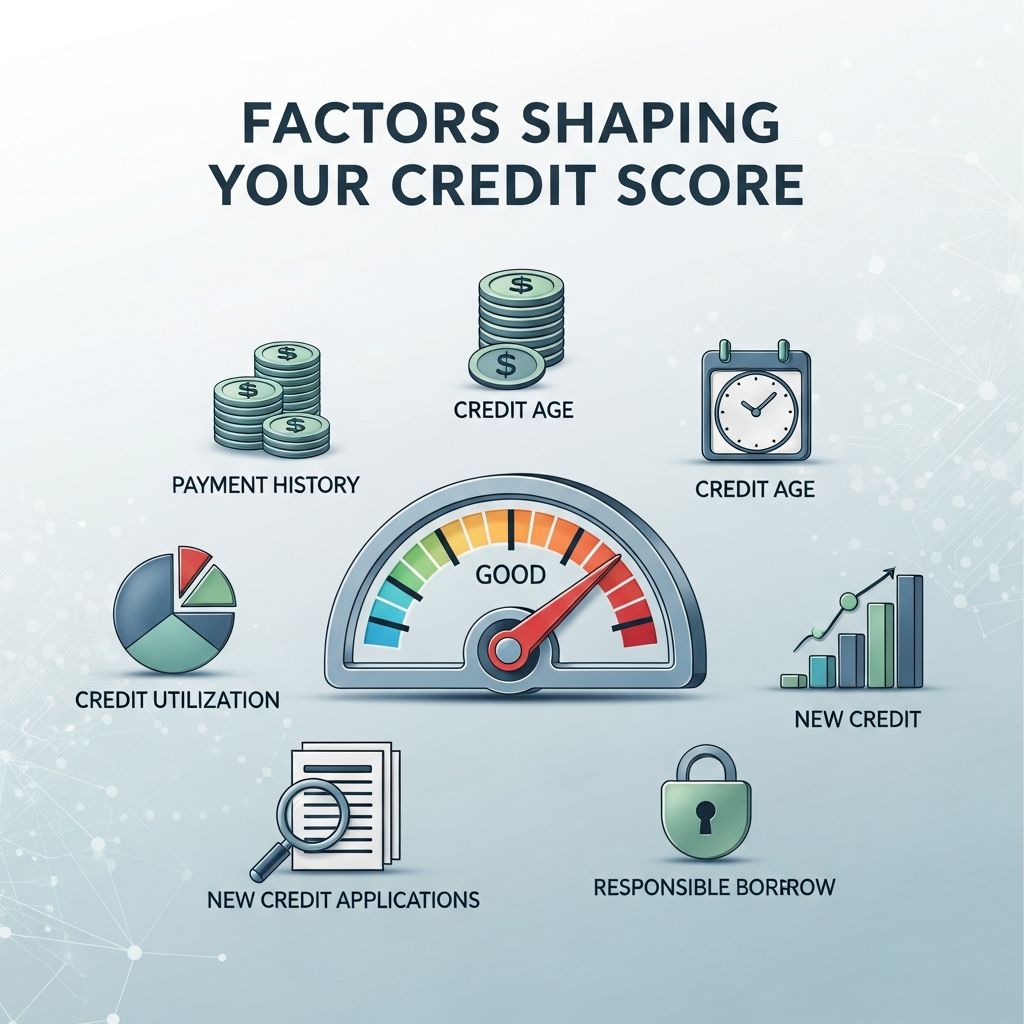
Your credit score serves as a critical benchmark for lenders, landlords, and even employers, summarizing your financial reliability in a three-digit number typically ranging from 300 to 850. Understanding what drives this score empowers you to make informed decisions that enhance your financial health. This guide delves into the core components, drawing from established models like FICO and VantageScore, to explain how everyday financial choices impact your rating.
Understanding the Foundation: How Credit Scores Are Built
Credit scoring models aggregate data from your credit reports, provided by agencies such as Equifax, Experian, and TransUnion. FICO, the most widely used model, categorizes information into five primary areas, each with distinct weights that reflect their relative importance. These weights can shift slightly based on your individual profile, but the framework remains consistent across millions of consumers.
A strong score opens doors to favorable loan terms, lower insurance premiums, and higher credit limits. Conversely, a lower score can lead to rejections or higher costs. By focusing on these factors, you can proactively manage and elevate your score over time.
Payment Reliability: The Cornerstone at 35%
Payment history dominates your credit score, accounting for 35% of the FICO calculation. This factor tracks whether you pay bills on time, including credit cards, loans, and utilities reported to credit bureaus. Consistent on-time payments signal trustworthiness to lenders.
Late payments, defined as 30 or more days past due, can remain on your report for up to seven years, with recent delinquencies carrying the heaviest penalty. For instance, a single late payment might reduce a high score by 50-100 points, especially if your history was otherwise pristine. Frequency matters too: multiple lates amplify the damage.
- Positive actions: Set up autopay, use reminders, and address inaccuracies via disputes.
- Avoid pitfalls: Collections, charge-offs, bankruptcies, and public records like foreclosures.
To safeguard this factor, prioritize minimum payments during tight months, even if carrying a balance incurs interest.
Debt Management: Balancing What You Owe at 30%
Amounts owed, or credit utilization, comprises 30% of your score. This measures how much of your available credit you’re using, calculated both per account and overall. Lenders prefer utilization under 30%, ideally below 20-25%, as high ratios suggest overextension.
Revolving debt like credit cards is scrutinized most, but installment loans (e.g., auto, student) factor in via paydown progress. Balances reported to bureaus—often your statement balance—directly influence this metric, so pay down before closing dates.
| Utilization Level | Impact on Score | Recommendation |
|---|---|---|
| Under 10% | Highly positive | Optimal for top scores |
| 10-30% | Neutral to good | Safe range |
| Over 30% | Negative | Pay down immediately |
| Over 90% | Severe drop | Seek limit increases or consolidation |
Requesting credit limit increases can lower utilization without new debt, but avoid if it prompts a hard inquiry.
Credit Age: The Value of Time at 15%
Length of credit history contributes 15%, evaluating the age of your oldest account, average account age, and time since recent activity. Longer histories demonstrate sustained responsibility, with top scorers averaging 25 years for their first account and 11 years overall.
Don’t close old accounts, as this shortens your average age. New users can build solid scores faster with flawless management of other factors. Recent inactivity on accounts may also weigh in negatively.
- Build longevity: Retain veteran accounts; use them periodically.
- For beginners: Start with secured cards or become an authorized user.
Diversifying Credit Types: 10% Mix Matters
Credit mix, at 10%, assesses variety in your portfolio—revolving (cards, lines) versus installment (mortgages, auto loans). A balanced mix shows versatility in handling different debts, but it’s minor compared to payments and utilization.
Over-relying on one type, like only cards, might limit this boost. Naturally diversify as life demands (e.g., a car loan), without forcing unnecessary debt.
New Credit Activity: Inquiries and Accounts at 10%
New credit, also 10%, monitors recent applications and openings. Multiple hard inquiries in a short period signal risk, though shopping for mortgages or autos within 14-45 days counts as one.
A surge of new accounts dilutes history length and raises red flags. Space applications and limit to needs.
What Doesn’t Influence Your Score
Certain personal details stay irrelevant: race, gender, marital status, religion, age (per FICO), address, salary, or employer. Lenders might review these separately, but scores remain neutral.
Strategies to Elevate Your Score
Improving takes months, but consistent effort pays off:
- Automate payments for 100% on-time record.
- Reduce balances below 30% utilization monthly.
- Preserve old accounts; avoid closing unused ones.
- Limit new applications to essentials.
- Diversify responsibly over time.
- Check reports annually at AnnualCreditReport.com for errors.
Tools like credit monitoring apps track progress. For thin files, consider credit-builder loans.
Frequently Asked Questions (FAQs)
What is a good credit score range?
Scores above 740 are excellent, 670-739 good, 580-669 fair, and below 580 poor. Ranges vary slightly by model.
How long do late payments affect my score?
Up to seven years, but impact fades over time, especially after two years.
Does checking my own score hurt it?
No, soft inquiries don’t affect scores; only lender hard pulls do.
Can I improve my score in a month?
Yes, via utilization drops or disputes, but major gains take 3-6 months.
Is VantageScore different from FICO?
Similar factors, but weights and ranges differ slightly; both are lender staples.
Long-Term Financial Wellness
Mastering these factors fosters not just a higher score but disciplined habits. Regularly review statements, budget wisely, and align debt with income. As your score climbs, reap rewards like premium rewards cards and prime rates, securing a brighter fiscal future.
References
- What affects your FICO credit score & how is your score calculated? — Nav. 2023. https://www.nav.com/resource/5-main-credit-scoring-factors/
- 5 things that make up your credit score — Banner Bank. 2023. https://www.bannerbank.com/financial-resources/blog/five-things-that-make-up-your-credit-score
- How is Your Credit Score Calculated? — Discover. 2024. https://www.discover.com/credit-cards/card-smarts/how-is-credit-score-calculated/
- How are FICO Scores Calculated? — myFICO. 2024. https://www.myfico.com/credit-education/whats-in-your-credit-score
- Credit Scores handout — University of Wisconsin Extension (finances.extension.wisc.edu). 2020-11-18. https://finances.extension.wisc.edu/files/2020/11/Credit-Scores-handout-5.18.pdf
- Understand your credit score — Consumer Financial Protection Bureau (.gov). 2024. https://www.consumerfinance.gov/consumer-tools/credit-reports-and-scores/understand-your-credit-score/
Similar Articles








Read full bio of medha deb