Factors of Production: The 4 Types and Who Owns Them
Understand the four essential factors of production and discover who owns and controls them in modern economies.
Understanding Factors of Production: The Building Blocks of Economics
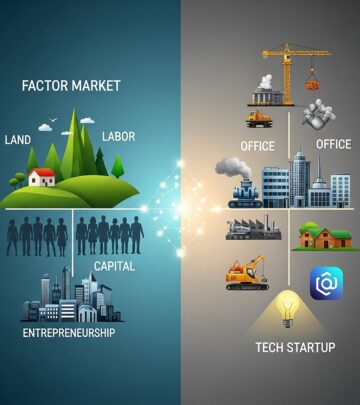
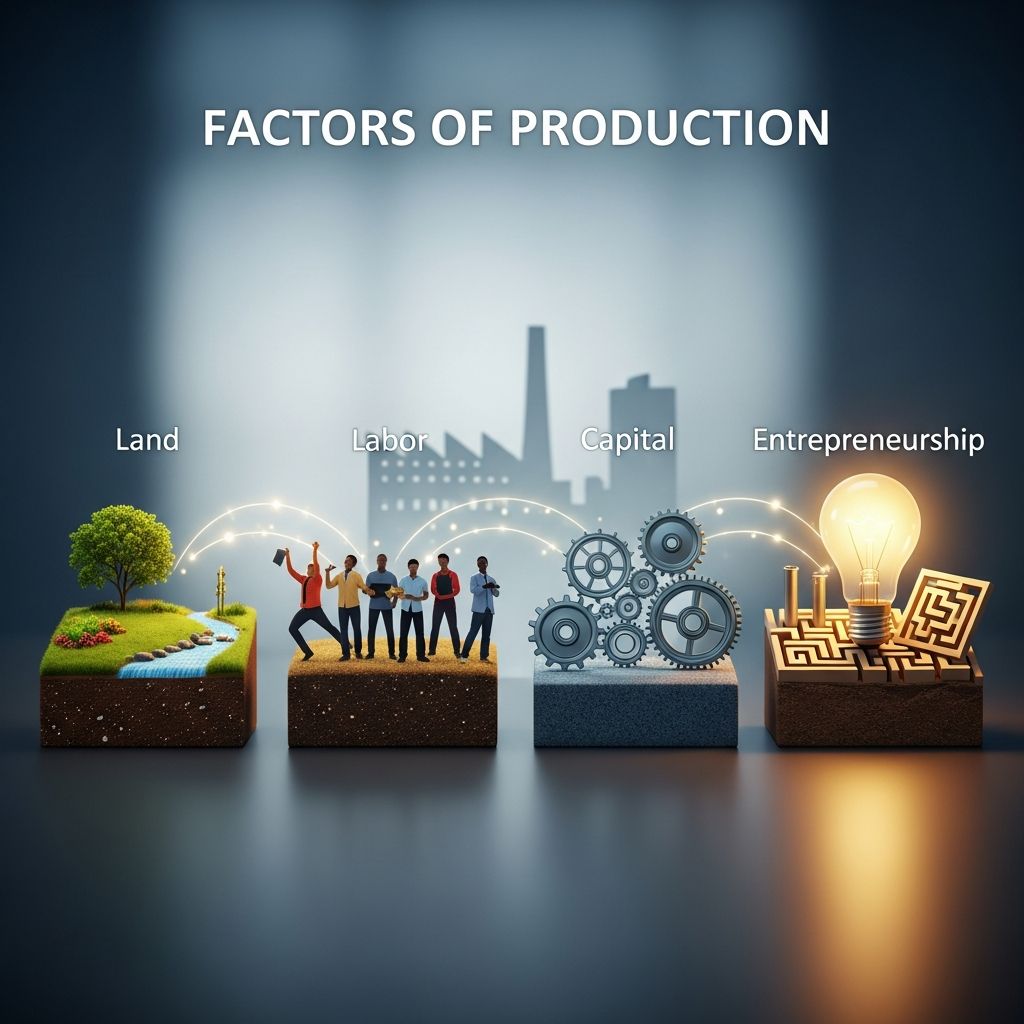
In every economy around the world, the creation of goods and services depends on the same fundamental elements. These elements, known as factors of production, are the essential resources that businesses, governments, and individuals combine to generate economic output. Whether a small bakery produces fresh bread or a multinational corporation manufactures automobiles, the process relies on the same four core factors: land, labor, capital, and entrepreneurship.
The factors of production represent more than just economic theory; they form the practical foundation upon which all economic activity is built. Understanding these factors and knowing who owns them is crucial for entrepreneurs, policymakers, investors, and anyone seeking to comprehend how modern economies function. By examining each factor individually and exploring their interconnected relationships, we can gain deeper insights into how wealth is created, how economies grow, and how resources are distributed across society.
What Are Factors of Production?
Factors of production, also referred to as productive resources or inputs, are the tangible and intangible elements that combine to create goods and services. These are distinct from the finished products themselves or the raw materials that become part of the final product. Instead, factors of production are the tools, resources, and human effort employed throughout the production process.
Economists categorize factors of production into primary and secondary categories. The primary factors—land, labor, and capital—are considered the most fundamental, while secondary factors like energy and materials are derived from or depend upon the primary factors. The distinction matters because primary factors have independent value in the production process, whereas secondary factors are essentially byproducts or derivatives of the primary factors.
The Four Factors of Production Explained
Factor 1: Land (Natural Resources)
Land, in economic terminology, represents all natural resources available in an economy. This encompasses far more than just soil or territory; it includes minerals, forests, water bodies, fossil fuels, agricultural land, and real estate. The geographical location and availability of these resources significantly influence a country’s economic development and competitive advantages.
Land ownership typically falls into three categories: government ownership, private ownership, and communal ownership. Governments often own and manage public lands, national parks, and mineral rights. Private individuals and corporations own residential properties, farms, and commercial real estate. In some regions, communities collectively manage certain resources, though this model is less common in modern capitalist economies.
The availability and accessibility of land resources directly impact which industries can thrive in a particular region. Countries rich in arable land develop strong agricultural sectors, while nations with significant mineral deposits become centers for mining and extraction industries. Coastal nations have advantages in fishing and maritime trade, demonstrating how land ownership and access shape economic specialization.
Factor 2: Labor (Human Resources)
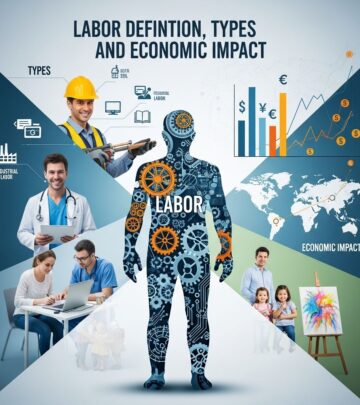
Labor encompasses all human effort, skills, time, and creativity dedicated to production. This includes manual work, intellectual contributions, management expertise, and specialized professional services. Labor is arguably the most dynamic factor of production because it combines physical effort with cognitive abilities and innovation.
Workers, either as individuals or through their union representatives, technically own their own labor. They sell this labor to employers in exchange for wages or salaries. However, the relationship between workers and employers involves complex dynamics. Some workers are self-employed and retain full control of their labor, while others work for companies where managers direct how their labor is utilized.
The quality, quantity, and skill level of a nation’s labor force significantly influence its productive capacity. Investment in education and training enhances labor’s value and productivity. Conversely, labor shortages or inadequately trained workforces can constrain economic growth. Modern economies increasingly recognize human capital—the accumulated knowledge and skills of workers—as a critical factor in determining competitiveness.
Factor 3: Capital (Physical and Financial Resources)
Capital represents the manufactured resources and financial instruments used to facilitate production. Capital exists in two primary forms: physical capital and financial capital. Physical capital includes machinery, equipment, tools, buildings, factories, vehicles, computers, and infrastructure like roads and electrical grids. Financial capital consists of money, investments, loans, and savings available for business expansion and productive ventures.
Capital ownership typically rests with businesses, corporations, and wealthy individuals. In capitalist economies, private entities own most physical capital, though governments also own significant capital assets including public utilities, transportation systems, and institutional buildings. Financial capital is controlled by banks, investment firms, governments, and individuals with accumulated wealth.
The distinction between physical and financial capital is important for understanding how economies function. Physical capital is tangible and observable—you can see a factory or a computer. Financial capital, by contrast, is abstract but equally essential because it flows through the economy to fund the acquisition and maintenance of physical capital. Without adequate financial capital, businesses cannot purchase or upgrade their equipment and facilities.
Factor 4: Entrepreneurship (Organization and Innovation)
Entrepreneurship is perhaps the most intangible yet transformative factor of production. It represents the initiative, vision, risk-taking, and organizational ability that brings the other three factors together into a productive enterprise. Entrepreneurs identify market opportunities, make critical decisions about resource allocation, and bear the financial risk of their ventures.
Entrepreneurs own the businesses they create, though ownership structures vary considerably. Some entrepreneurs remain sole proprietors with complete ownership and control. Others establish partnerships, corporations, or cooperatives that distribute ownership among multiple stakeholders. In large corporations, ownership often rests with shareholders, while professional managers handle day-to-day operations.
The entrepreneurial factor drives innovation and economic growth. By identifying inefficiencies, recognizing unmet needs, and implementing new production methods or business models, entrepreneurs push economies forward. They create jobs, generate wealth, and foster competition that benefits consumers through improved products and lower prices. Without entrepreneurship, the other three factors would remain static and underutilized.
Who Owns the Factors of Production?
Land Ownership Structures
Land ownership varies significantly across different countries and economic systems. In most market economies, land is primarily privately owned, meaning individuals, families, and corporations control specific parcels. However, governments retain ownership of substantial land holdings designated for public use, including national parks, public forests, and government office buildings.
Some nations have implemented land redistribution programs to promote equity, while others maintain concentrated landownership among wealthy families or corporations. Indigenous communities in various countries have claimed traditional land rights, leading to legal disputes over ownership and usage rights. Urban land tends to command higher prices than rural land due to population density and economic activity concentration.
Labor Ownership and Control
Workers inherently own their own labor and have the fundamental right to sell it or withhold it. However, the practical exercise of this ownership varies based on labor market conditions, legal protections, and negotiating power. In strong labor markets with worker shortages, employees exercise greater control over their labor, commanding higher wages and better conditions.
Labor unions collectively represent workers’ interests, negotiating on behalf of members to secure better compensation and working conditions. In some countries, strong union traditions grant workers significant influence over production decisions. Conversely, in economies with weak labor protections or abundant labor supply, individual workers may have limited bargaining power, reducing their effective control over their labor.
Capital Ownership
In capitalist economies, capital ownership is the most concentrated among the four factors. Wealthy individuals, large corporations, financial institutions, and investment firms own the vast majority of productive capital. This concentration of capital ownership creates wealth inequality, as capital generates returns—profits, interest, and dividends—that flow to owners.
Government ownership of capital varies by nation and economic system. Socialist-oriented economies maintain greater government ownership of capital assets, while capitalist nations typically limit government capital to essential infrastructure and public services. Public pension funds, investment vehicles designed to provide retirement income for workers, represent a significant form of democratized capital ownership, though professional managers control these funds on behalf of beneficiaries.
Entrepreneurship and Business Ownership
Entrepreneurship ownership is perhaps the most variable factor. Individual entrepreneurs who found and personally manage businesses retain complete ownership and control. However, as businesses grow, many entrepreneurs sell equity stakes to investors or go public, distributing ownership among shareholders while potentially losing direct control through dilution of their ownership percentage.
In modern corporations, ownership is often separated from management. Shareholders technically own the company, but professional executives and boards of directors make operational decisions. This separation creates potential conflicts of interest, where managers might prioritize short-term profits over long-term sustainability or worker welfare.
How These Factors Work Together
Understanding each factor individually provides only partial insight into how economies function. The true power of factors of production emerges when examining their synergistic relationships. No factor alone can create value; instead, they must combine effectively.
Consider a manufacturing scenario: an entrepreneur identifies market demand for a product, assembles a team of workers (labor), secures financing (financial capital), acquires machinery and a facility (physical capital), and sources raw materials from land-based resources. Each factor contributes essential elements to the production process. Remove any single factor, and production halters entirely.
The productivity of each factor depends partly on the quality and availability of other factors. Workers become more productive when equipped with advanced capital and working under skilled entrepreneurial leadership. Capital becomes more productive when operated by skilled workers under effective management. Land becomes more valuable when capital improvements are made and skilled labor is applied.
Economic growth occurs when factors of production increase in quantity or improve in quality. Nations that invest in education enhance their labor factor. Countries that develop infrastructure improve their capital. Promoting entrepreneurship through business-friendly policies encourages innovation and efficient resource allocation. Protecting property rights and sound governance facilitate productive use of land resources.
The Relationship Between Factors and Economic Output
Economists use the production function to describe how factors of production combine to generate output. This relationship is not linear—doubling inputs does not necessarily double output. Instead, the productivity of additional inputs often follows the principle of diminishing returns.
Consider a bakery with fixed capital (one oven) and variable labor. The first employee dramatically increases output. The second worker further increases production. However, as more workers are added to operate the single oven, each additional worker contributes less to total output. Eventually, adding more workers may actually decrease efficiency as they interfere with one another. This principle demonstrates that optimal production requires balanced use of all factors rather than maximizing any single factor.
Understanding these relationships helps businesses allocate resources efficiently. Companies must determine the optimal combination of labor, capital, and materials to minimize costs while achieving desired output levels. Similarly, policymakers seek to create conditions where factors of production are abundant, accessible, and efficiently utilized to maximize national economic output.
Ownership Models Across Different Economies
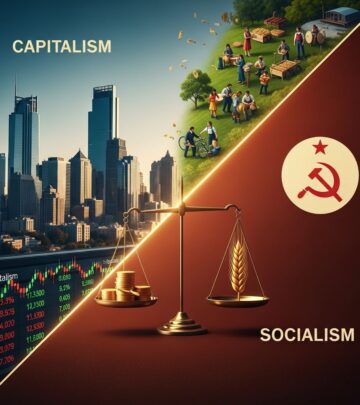
Different economic systems approach factor ownership distinctly. Capitalist economies emphasize private ownership of capital and entrepreneurial ventures, with land ownership also predominantly private. This system creates incentives for efficiency and innovation but can result in significant wealth inequality.
Socialist and communist systems historically emphasized collective or state ownership of productive capital, aiming to distribute wealth more equitably. However, these systems often struggled with inefficiency and innovation challenges. Most modern economies employ mixed systems, combining private ownership with government regulation and selective state ownership of key assets.
Scandinavian countries demonstrate successful hybrid models, maintaining private enterprise and capital ownership while implementing strong labor protections, progressive taxation, and extensive public services. This approach balances private incentives with public welfare considerations.
Modern Challenges and Evolving Factors of Production
Contemporary economies face new challenges regarding factors of production. Digital technology has created intangible capital—data, software, and intellectual property—that doesn’t fit neatly into traditional categories. Artificial intelligence and automation raise questions about labor’s future role and value.
Environmental concerns highlight how treating land solely as an economic resource overlooks sustainability considerations. Climate change, resource depletion, and pollution represent externalities not captured in traditional production function analysis. Modern economic thought increasingly incorporates environmental factors into considerations of long-term productive capacity.
Globalization has changed factor mobility. Capital and entrepreneurship move fluidly across borders, while labor movements face greater restrictions. This creates opportunities for specialization but also vulnerability to economic disruption when factors relocate unexpectedly.
Frequently Asked Questions About Factors of Production
Q: Can factors of production be substituted for one another?
A: To some degree, yes. Labor can be replaced with capital (machines replacing workers), and sometimes land can be substituted through technological innovation (vertical farms reducing land requirements). However, complete substitution is impossible—some minimum of each factor is typically necessary for production.
Q: How do factors of production differ from resources?
A: Resources are potential inputs; factors of production are those resources actively engaged in creating output. A forest is a resource; timber extracted and processed for use in production becomes part of the land factor. This distinction emphasizes that factors must be productive inputs, not merely potential ones.
Q: Why is entrepreneurship considered a factor of production?
A: Entrepreneurship combines and coordinates the other three factors. Without entrepreneurial initiative and organization, land, labor, and capital remain unproductive. Entrepreneurs drive innovation and efficiency, making entrepreneurship indispensable to economic production.
Q: Can governments regulate factor ownership?
A: Yes, absolutely. Governments regulate ownership through property laws, labor regulations, licensing requirements, taxation, and environmental rules. These regulations influence how factors are owned, controlled, and used, significantly shaping economic outcomes and income distribution.
Q: Why do some economists propose a fifth factor of production?
A: Some economists argue that technology or information should be recognized as distinct factors since they significantly influence productivity independent of the traditional four. However, mainstream economics typically incorporates technology as an enhancement to existing factors rather than a separate factor.
Conclusion: The Foundation of Economic Activity
Factors of production represent the fundamental building blocks upon which all economic activity rests. Land provides natural resources, labor contributes human effort and creativity, capital furnishes tools and financing, and entrepreneurship organizes these elements into productive enterprises. Understanding who owns each factor illuminates how wealth is created, distributed, and concentrated within economies.
The efficient combination and productive use of factors determines an economy’s output and growth potential. Nations that invest in developing their labor force, maintaining capital stock, protecting property rights, and encouraging entrepreneurship achieve higher productivity and living standards. Conversely, economies where factors are underdeveloped, poorly managed, or inefficiently allocated struggle with stagnation and poverty.
As economies evolve and face new challenges from technology, environmental concerns, and globalization, understanding factors of production remains essential. This framework provides analytical power for evaluating economic policies, business strategies, and societal decisions about resource allocation. By comprehending both the theoretical foundations and practical ownership structures of factors of production, individuals and policymakers can make more informed decisions contributing to sustainable economic growth and improved prosperity.
References
- Factors of Production — Wikipedia. Accessed November 2025. https://en.wikipedia.org/wiki/Factors_of_production
- Factors of Production – Definition and Explanation — Economics Help. Accessed November 2025. https://www.economicshelp.org/blog/glossary/factors-of-production/
- Factors of Production – Overview and Characteristics — Corporate Finance Institute. Accessed November 2025. https://corporatefinanceinstitute.com/resources/economics/factors-of-production/
- Factors of Production: Land, Labor, Capital and Entrepreneurship — Wall Street Prep. Accessed November 2025. https://www.wallstreetprep.com/knowledge/factors-of-production/
- What Are the Factors of Production? Definition and Examples — Indeed. Accessed November 2025. https://www.indeed.com/career-advice/career-development/factors-of-production
Similar Articles








Read full bio of Sneha Tete