FAANG Stocks: Definition, History, and Investment Guide
Complete guide to FAANG stocks: understand the evolution of big tech investments and how to build your portfolio.
Understanding FAANG Stocks
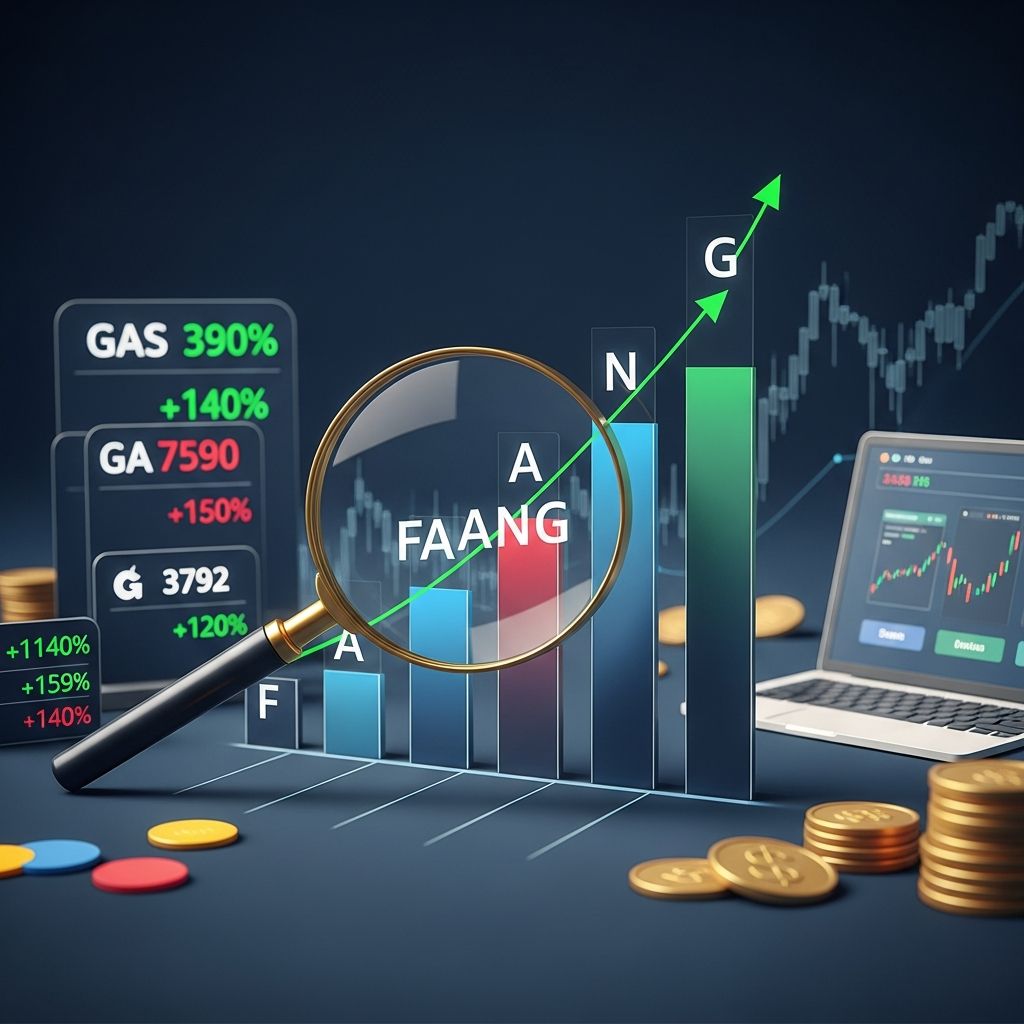
FAANG is an acronym that represents five of the most influential and recognizable technology companies in the world. The term originated as FANG, representing Facebook, Amazon, Netflix, and Google—four cornerstone technology stocks that have shaped the modern investment landscape. In 2017, investment analyst Jim Cramer expanded the acronym to FAANG by adding Apple to the group, creating one of the most discussed investment categories in modern finance.
These companies have become synonymous with technology sector strength and market growth. They represent the pinnacle of digital innovation, from cloud computing and e-commerce to streaming entertainment and artificial intelligence. For many investors, understanding FAANG stocks is essential to comprehending contemporary market dynamics and technology sector trends.
The Original FANG Concept
The FANG acronym was first popularized in 2013 by investment professionals who recognized the exceptional performance and market influence of these four technology giants. Facebook led the social media revolution, Amazon dominated e-commerce and cloud services, Netflix transformed entertainment consumption, and Google (now Alphabet) controlled digital advertising and search. These companies shared common characteristics: rapid growth, massive user bases, strong profit margins, and transformative business models that disrupted traditional industries.
During the mid-to-late 2010s, FANG stocks demonstrated remarkable resilience and growth. At the end of 2014, FANG stocks represented approximately 7.4% of the S&P 500’s total market capitalization. This significant concentration of market value in four companies raised questions about market diversification and tech sector dominance. Despite these concerns, investors continued allocating capital to these high-growth companies.
Evolution to FAANG: Adding Apple
Jim Cramer’s decision to include Apple in the group created the FAANG acronym, recognizing Apple’s tremendous market value and influence on the technology sector and broader economy. Apple’s inclusion reflected the company’s transformation from a computer manufacturer to a dominant force in mobile devices, wearables, and services. The addition of Apple strengthened the acronym’s relevance and better represented the true leaders in technology innovation.
The FAANG stocks experienced explosive growth from 2015 through 2019. Between the end of 2014 and the end of 2019, these five stocks combined to achieve approximately 178.5% growth, substantially outpacing the S&P 500’s approximately 46.5% return during the same period. By 2019, FAANG stocks accounted for nearly 14.4% of the S&P 500’s market capitalization—nearly double their 2014 weight. This concentration demonstrated both the exceptional performance of these companies and their increasing influence over overall market returns.
Market Challenges and 2022 Turbulence
Despite their historically strong performance, FAANG stocks faced significant headwinds beginning in 2022. Rising inflation, elevated interest rates, and economic uncertainty created a challenging environment for technology stocks. Higher interest rates particularly affected growth-oriented companies, as investors reassessed future cash flows and profit expectations. Additionally, multiple compression—where investors paid lower valuations for each dollar of earnings—further pressured stock prices.
The 2022 market correction demonstrated that even the strongest technology companies remain vulnerable to macroeconomic cycles and interest rate environments. This period tested investor conviction and highlighted the importance of diversification within technology portfolios. Many investors who had concentrated holdings in FAANG stocks experienced substantial losses during this volatile period.
The Evolution Beyond FAANG: FAAMG and MAMAA
As the technology landscape evolved, the original FAANG acronym became increasingly outdated for several reasons. Google’s parent company, Alphabet, changed its corporate structure and name in October 2015, though it continued trading under the ticker symbols GOOG and GOOGL. More significantly, Facebook rebranded to Meta Platforms in 2021, creating confusion with the acronym’s original meaning.
Investment professionals began proposing alternative acronyms to better reflect the current landscape of dominant technology companies. FAAMG emerged as a more practical alternative, substituting Microsoft for Netflix to create the acronym F-A-A-M-G. While technically unpronounceable, FAAMG gained wider adoption because Microsoft’s $3 trillion market capitalization and dominant position in cloud computing, productivity software, and artificial intelligence better reflected contemporary market leaders than Netflix.
Jim Cramer proposed MAMAA as another alternative—Meta, Apple, Microsoft, Amazon, and Alphabet—to properly account for Meta’s rebrand and Microsoft’s ascendancy. However, FAAMG remained more commonly used despite its pronunciation challenges, reflecting investor habit and the gradual nature of terminology evolution in financial markets.
Current Composition and Performance
The FAANG/FAAMG group currently includes:
| Ticker | Company | One-Year Performance |
|---|---|---|
| GOOG | Alphabet Inc. | 61.44% |
| NFLX | Netflix Inc. | 43.99% |
| AMZN | Amazon.com Inc. | 25.80% |
| MSFT | Microsoft Corporation | 25.02% |
| AAPL | Apple Inc. | 20.67% |
| META | Meta Platforms Inc. | 12.04% |
As of November 2025, FAANG stocks have demonstrated recovery from the 2022 downturn. Year-to-date performance shows FAANG stocks producing returns close to 5%, outpacing the broader S&P 500’s returns of more than 2% over the same period. This recovery reflects renewed investor confidence in technology sector fundamentals and the resilience of these market leaders, though valuations remain elevated compared to historical averages.
Why the FAANG Label Persists Despite Challenges
Despite the acronym’s technical inaccuracies, FAANG remains widely recognized and used in financial media, investment discussions, and market analysis. The term has achieved remarkable staying power in financial language, similar to how NASDAQ continues to be used despite significant sector composition changes since its inception. Investors and analysts continue referencing FAANG as shorthand for mega-cap technology stocks, even when the specific companies included in discussions may vary.
This persistence reflects the emotional and practical resonance of the original acronym. FAANG stocks represent the most successful and influential technology companies, regardless of specific corporate names or structures. The term transcends technical accuracy to represent a category of investments: large-cap, highly profitable, globally dominant technology companies with transformative business models.
Investment Strategies for FAANG Stocks
Direct Stock Ownership
Individual investors can purchase FAANG stocks directly through brokerage accounts. However, individual stock ownership requires significant capital, as these stocks typically trade at prices ranging from $100 to $400 per share. Direct ownership provides complete control over portfolio allocation and allows investors to hold specific positions matching their conviction level. The primary disadvantage is concentration risk and the capital requirement for meaningful positions.
Exchange-Traded Funds (ETFs)
No pure-play FAANG-only ETFs exist, as such concentrated portfolios would exceed regulatory diversification requirements. However, many technology-focused ETFs include FAANG stocks as primary holdings. Technology sector ETFs and Nasdaq-100 index funds provide exposure to FAANG stocks alongside other quality technology companies, offering broader diversification while maintaining significant FAANG weighting.
Options Trading
Sophisticated investors may utilize call options on FAANG stocks as a potentially lower-cost entry method. Call options provide leveraged exposure to underlying stocks, requiring substantially less capital than direct stock ownership. However, options trading involves complexity, time decay, and the risk of total loss if stock prices decline. Investors considering options should thoroughly understand derivatives mechanics, Greeks, and risk management before committing capital.
Opening a Brokerage Account
The first step for any investor interested in FAANG stocks is opening a brokerage account. Most major brokerages offer commission-free stock trading, making account opening simple and cost-effective. Investors should compare account features, available research tools, customer service quality, and platform usability when selecting a broker. Once an account is funded, purchasing FAANG stocks or relevant ETFs is straightforward through online trading platforms.
Risk Considerations for FAANG Investors
Concentration risk represents the primary concern for FAANG-focused portfolios. These five companies represent a substantial portion of the S&P 500 and Nasdaq indexes. Market downturns affecting technology stocks therefore disproportionately impact concentrated FAANG portfolios. Regulatory scrutiny, antitrust concerns, and competitive threats also pose unique risks to these dominant platforms.
Valuation risk merits consideration, as FAANG stocks often trade at significant premiums to historical average valuations. Rising interest rates particularly impact growth stock valuations, as investors discount future cash flows at higher rates. Finally, execution risk persists—even dominant companies face competitive challenges and shifting consumer preferences that could impact long-term profitability.
Frequently Asked Questions
Q: What does FAANG stand for?
A: FAANG is an acronym representing Facebook (now Meta), Amazon, Apple, Netflix, and Google (now Alphabet). The term was popularized by Jim Cramer and represents five of the most influential technology companies in the world.
Q: Why did the FAANG acronym evolve to FAAMG?
A: FAAMG replaced Netflix with Microsoft to better reflect current market leaders. Microsoft’s $3 trillion market capitalization and dominance in cloud computing and artificial intelligence better represent contemporary technology leadership than Netflix’s entertainment focus.
Q: Can I invest in pure FAANG ETFs?
A: No pure FAANG-only ETFs exist due to diversification requirements. However, technology sector ETFs and Nasdaq-100 index funds include FAANG stocks as major holdings, providing broader exposure to quality technology companies.
Q: What is the minimum capital needed to invest in FAANG stocks?
A: Individual FAANG stocks typically trade between $100-$400 per share, but most brokerages now support fractional share ownership, allowing investors to begin with minimal capital amounts.
Q: How have FAANG stocks performed recently?
A: As of November 2025, FAANG stocks have recovered from 2022 declines, showing year-to-date returns around 5%, outpacing the broader S&P 500’s returns of approximately 2% over the same period.
Q: Are FAANG stocks suitable for all investors?
A: FAANG stocks carry concentration risk and valuation risk, making them more suitable for growth-oriented investors with higher risk tolerance. Conservative investors may prefer diversified approaches or broader market index funds.
References
- What Is a FAANG Stock? FAANG, FAAMG and MAMAA Explained — NerdWallet. 2025-11-05. https://www.nerdwallet.com/investing/learn/fang-stocks-faang-stocks-faamg-stocks-mamaa-stocks
- S&P 500 Index Historical Data — S&P Global. Official index performance data. https://www.spglobal.com/spdji/en/indices/equity/sp-500
- Technology Sector Performance Analysis — Nasdaq Inc. 2025. https://www.nasdaq.com/market-activity/sectors
Similar Articles








Read full bio of Sneha Tete