EXW (Ex Works): Definition, Responsibilities & Examples
Complete guide to EXW Incoterms: understand seller and buyer responsibilities in international trade.
What Is EXW (Ex Works)?
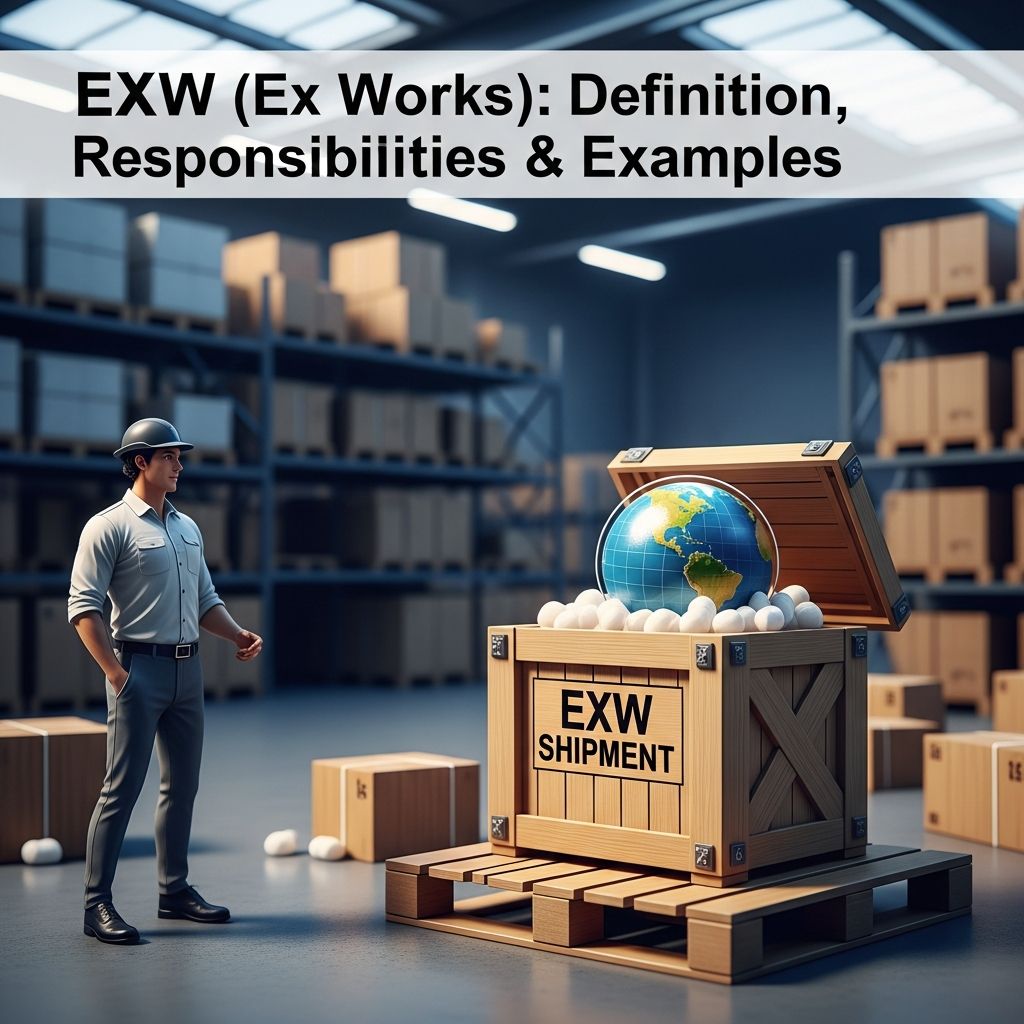
EXW, or Ex Works, is an Incoterms rule established by the International Chamber of Commerce that represents one of the most seller-favorable terms in international commercial transactions. Under EXW, the seller’s obligations are minimal—they are required only to make goods available for pickup at their own premises, typically their factory, warehouse, or distribution center. Once the goods are made available at the named place, the risk of loss and nearly all responsibilities transfer to the buyer. This arrangement makes EXW the most basic shipping term available to suppliers and is often the starting point for price negotiations in international trade.
The term “Ex Works” literally means the goods are available at the works or factory, and from that point forward, the buyer assumes complete responsibility for transportation, insurance, customs clearance, and all associated costs. While EXW is the least expensive option for buyers initially negotiating prices, it places the greatest burden and financial risk on the purchaser.
Understanding Incoterms and Their Role in Trade
Incoterms, short for “international commercial terms,” are a standardized set of rules published by the International Chamber of Commerce that define the rights, responsibilities, and obligations of sellers and buyers in international sales contracts. These rules establish clear guidelines regarding who bears the costs of transportation, insurance, customs clearance, and other expenses associated with moving goods from seller to buyer across borders.
Incoterms can be applied to any mode of transport—whether air, ocean, ground, or multimodal—making them universally applicable across different industries and trade scenarios. The eleven Incoterms rules range from those with minimal seller responsibility, like EXW, to those where the seller assumes nearly complete responsibility, such as Delivered Duty Paid (DDP). Understanding these rules is essential for traders, as they create legal obligations with potentially costly implications if misunderstood or improperly applied.
How EXW Works: The Delivery Point
Under EXW, the seller “delivers” goods simply by placing them at the disposal of the buyer at an agreed-upon point, typically the seller’s own premises or a named location such as a contracted manufacturer’s facility. The delivery must occur on a specifically agreed date (for example, “by March 31”) or within an agreed period (such as “within 90 days after contract date”).
The critical moment in an EXW transaction occurs when the goods are made available for pickup. At this point, two fundamental things happen:
Risk Transfer
The risk of loss transfers to the buyer immediately when the goods are made available, regardless of whether the buyer has physically collected them. This means if the goods are damaged, lost, or destroyed while still at the seller’s location but after being made available, the buyer bears the financial responsibility.
Cost Responsibility
From the moment of availability, the buyer assumes responsibility for all costs associated with the goods, including loading, transportation, insurance, export and import clearance, customs duties, and taxes. The buyer must arrange for carriage of the goods, either personally or through a contracted carrier, at its own cost.
Seller Responsibilities Under EXW
The seller’s obligations under EXW are deliberately minimal, which is why this term is so favorable to suppliers:
Primary Obligations
The seller must provide the goods and their commercial invoice as required by the contract of sale, along with any other evidence of conformity, such as analysis certificates or quality certifications specified in the agreement. The seller must make these goods available at the named place on the agreed date. Additionally, the seller has an obligation to provide the buyer with any information in its possession (including transport-related security requirements) requested by the buyer at the buyer’s risk and expense.
No Loading Responsibility
Critically, under standard EXW terms, the seller does not need to load items onto a truck or any collecting vehicle, nor do they worry about freight charges once goods leave their premises. However, the seller and buyer may agree through contract modification that the seller will be responsible for loading goods onto the collecting transport vehicle, but this would constitute a variant of the standard Incoterms rule, and responsibility for any resulting damage must be clearly allocated in the contract of sale.
No Export Clearance Obligation
The seller has no obligation to arrange export clearance of goods from their territory. This responsibility falls entirely to the buyer, which can present significant complications in international transactions.
Buyer Responsibilities Under EXW
The buyer bears substantially greater obligations and risk in an EXW transaction:
Comprehensive Cost Coverage
The buyer pays for all aspects of the shipping process, including loading charges, delivery to port, export duties and taxes, origin terminal charges, loading on carriage, carriage charges, destination terminal charges, delivery to destination, and import duty and taxes. This represents a complete financial burden for the buyer from the point of pickup onward.
Logistics and Transportation
The buyer must arrange for carriage of goods from the named place of delivery, whether by arranging it themselves or contracting with a carrier. This includes managing all transportation logistics and ensuring goods reach their final destination.
Export and Import Clearance
The buyer is responsible for export clearance from the seller’s territory, which may be difficult, particularly when the buyer is not familiar with local regulations and procedures. Additionally, complications can arise where the seller is incorrectly recorded by authorities as the exporter of record, which can create problems for the seller and further complicate the buyer’s export obligations.
Loading the Goods
The buyer is responsible for loading the goods onto their collecting vehicle, which may prove challenging depending on the nature and weight of the goods. This physical responsibility, combined with all other obligations, makes EXW particularly demanding for buyers.
Advantages and Disadvantages of EXW
Advantages
For Sellers: EXW is the most favorable term for sellers because it minimizes their obligations and financial exposure. Sellers avoid shipping costs, insurance expenses, and the complexities of export clearance. This term also appears favorable when comparing initial price quotes, as the EXW price reflects only the product cost without additional logistics expenses.
For Buyers: While placing greater burden on buyers, EXW does offer one significant advantage: it provides buyers with maximum control over transportation arrangements and the ability to optimize shipping logistics according to their specific needs and preferences. Buyers can select their own freight forwarders and shipping methods to achieve cost efficiencies.
Disadvantages
For Sellers: While EXW minimizes obligations, complications can arise if the seller is incorrectly recorded as the exporter of record by authorities, which can create legal and compliance issues for the seller.
For Buyers: Buyers assume all risk and cost responsibility, making this a financially demanding arrangement. The buyer must handle export clearance, which can be challenging and complex. Additionally, arranging for insurance, managing loading operations, and coordinating all transportation logistics requires significant expertise and effort. This term also makes it extremely difficult to arrange payment by letter of credit.
When to Use EXW: Appropriate Scenarios
EXW is best suited for domestic sales where export formalities, tax refund claims, and similar international complications do not arise. In domestic transactions, the seller has minimal obligations since clearances are not required, and the buyer can typically load goods without encountering local regulatory obstacles.
EXW may also be appropriate when:
- The buyer is highly experienced in international trade and logistics
- The buyer has established relationships with freight forwarders and customs brokers
- The transaction involves frequent, routine shipments between known trading partners
- The buyer seeks maximum control over shipping arrangements
- Price is the primary negotiation factor and lowest initial cost is desired
Conversely, EXW should be avoided for international shipments when the buyer anticipates difficulty with export clearance. In such cases, the Incoterms rule FCA (Free Carrier) might be a better choice, since it requires the seller to clear the goods for export.
EXW Compared to Other Incoterms
To better understand where EXW sits within the broader context of international trade terms, consider how it compares to other commonly used Incoterms:
| Incoterm | Seller Responsibility | Risk Transfer Point | Best For |
|---|---|---|---|
| EXW | Minimal – goods made available only | At seller’s premises | Domestic sales, buyer expertise |
| FCA | Moderate – export clearance included | At named place of delivery | International shipments, buyer needs certainty |
| FOB | Moderate – delivery to vessel | When goods cross ship’s rail | Sea transport, cost splitting |
| CPT | Moderate-High – carriage paid | At place of delivery or destination | Multimodal, seller pays freight |
| CIF | Moderate-High – freight and insurance | When goods cross ship’s rail | Sea transport, seller insures goods |
| DAP | High – delivery at place | At buyer’s location | Buyer assumes only import duty |
| DDP | Maximum – all costs included | At buyer’s location, duty paid | Seller handles everything |
Unlike Free on Board (FOB) or other intermediate terms, EXW places the least responsibility on the seller and the most on the buyer. Neither FOB nor EXW is inherently better than the other; they are merely standardized ways for traders to communicate clearly about who covers costs and bears responsibility for various components of a shipment. Cost, Insurance, and Freight (CIF) and EXW are two different approaches entirely, with CIF typically used for sea and inland waterway transport and explicitly designating seller insurance responsibility, while EXW can be used for any transport mode with minimal seller obligations.
Challenges and Limitations of EXW
Despite its initial appeal through lower quoted prices, EXW presents several practical challenges that make it problematic for many international transactions.
Export Clearance Complications: The requirement that buyers handle export clearance from the seller’s country can be extremely difficult, particularly for buyers unfamiliar with local regulations or procedures. This burden increases transaction risk and complexity.
Letter of Credit Challenges: Arranging payment by letter of credit (LC) under EXW is extremely difficult, which can complicate financing arrangements for international transactions.
Authority Recording Issues: In some cases, sellers have been incorrectly recorded by authorities as the exporter of record despite having no responsibility under EXW, creating compliance and legal problems.
Loading Responsibility Ambiguity: While buyers are technically responsible for loading, disagreements can arise if sellers assist in loading, making damage allocation unclear unless specifically addressed in the contract.
In practice, using EXW as described in Incoterms 2020 is nearly impossible in true international transactions due to these complications. This has led many traders to modify terms or select alternative Incoterms that better suit international commerce realities.
Historical Background and Evolution
The first version of EXW came into force in the original Incoterms 1936 and included in its heading “Ex-factory, ex-mill, ex-plantation, ex-warehouse etc.” in the English section with German and French translations. Its origins in common use trace back even earlier than 1936, making it one of the foundational trade terms in international commerce. Over nearly nine decades, EXW has remained relatively consistent in structure, though interpretations and applications have evolved with changes in trade practices and the publication of updated Incoterms versions in 1953, 1967, 1976, 1980, 1990, 2000, 2010, and most recently 2020.
Important Considerations When Using EXW
When an Incoterms rule is included in a contract of sale, it creates legal obligations for the buyer and seller that can have costly implications. Therefore, it is critical that traders read and understand the precise wording of the Incoterms rules carefully and choose the rule to include in their sales contract thoughtfully.
Matters such as loading responsibility, insurance coverage, payment terms, and any variations from standard EXW should be explicitly specified in the contract of sale. Ambiguity regarding these responsibilities can lead to disputes, unexpected costs, and damaged business relationships. Additionally, traders should be aware that Incoterms 2020 rules cannot address tax laws and regulations that vary from country to country, since the rules must be universal across all countries, continents, markets, and legal jurisdictions. Tax implications, VAT recovery procedures, and other jurisdiction-specific matters should be addressed separately in the sales contract.
Frequently Asked Questions
Q: What does EXW stand for?
A: EXW stands for Ex Works, an Incoterms rule meaning the seller makes goods available at their premises (typically a factory, warehouse, or distribution center), and the buyer assumes all responsibility for transportation, insurance, and customs clearance from that point forward.
Q: When should I use EXW in international trade?
A: EXW is best used for domestic sales where export formalities are not required or for international transactions where the buyer has significant expertise in logistics and export procedures. For international shipments where the buyer lacks such expertise, alternative terms like FCA may be more appropriate.
Q: What is the difference between EXW and FOB?
A: EXW places minimum responsibility on the seller (goods available at their premises only), while FOB requires the seller to deliver goods to the vessel. FOB is typically used for sea transport and represents a middle ground in responsibility allocation. Neither is inherently better than the other—they simply serve different transaction types.
Q: Who is responsible for loading goods under EXW?
A: Under standard EXW terms, the buyer is responsible for loading goods onto their collecting vehicle. However, the seller and buyer may agree otherwise, in which case responsibility for damage during seller-arranged loading must be clearly allocated in the contract.
Q: Can I use EXW for air transport?
A: Yes, EXW can be used for any mode of transport, including air, ocean, ground, or multimodal arrangements. However, it is most practical for simpler transportation scenarios.
Q: Why is EXW difficult to use in international transactions?
A: EXW places complex export clearance obligations on the buyer, which can be difficult to navigate in unfamiliar jurisdictions. Additionally, complications can arise when sellers are incorrectly recorded as exporters of record, and arranging letters of credit becomes problematic.
Q: What costs does the buyer assume under EXW?
A: The buyer assumes all costs including loading charges, delivery to port, export duties and taxes, origin terminal charges, carriage charges, destination terminal charges, delivery to final destination, and import duty and taxes.
Q: What happens to risk under EXW?
A: Risk transfers to the buyer as soon as the goods are made available at the named place, even if the buyer has not yet physically collected them. This means the buyer bears financial responsibility for any damage or loss from that point forward.
References
- Beyond the Terms: Unpacking EXW, FCA, and CPT — Miller Johnson. 2024. https://millerjohnson.com/beyond-the-terms-unpacking-exw-fca-and-cpt/
- EU sanctions factsheet: Incoterms “Ex Works” rule (EXW) — European Commission Finance. 2024. https://finance.ec.europa.eu/eu-and-world/sanctions-restrictive-measures/overview-sanctions-and-related-resources/eu-sanctions-factsheet-incoterms-ex-works-rule-exw_en
- Ex Works (EXW) Definition — UPS Supply Chain Solutions. 2024. https://developer.ups.com/us/en/supplychain/resources/glossary-term/ex-works
- Incoterms Defined: What does EXW, FCA, FOB, DAP, DAT, DDP — Cosmos Sourcing. 2024. https://www.cosmosourcing.com/blog/incoterms-defined-fob-exw
- Ex Works Incoterms (EXW) – 2025 Guide — Trade Finance Global. 2025. https://www.tradefinanceglobal.com/incoterms/ex-works-exw/
- Know Your Incoterms — International Trade Administration, U.S. Department of Commerce. https://www.trade.gov/know-your-incoterms
Similar Articles








Read full bio of Sneha Tete