Exponential Moving Average (EMA): Definition, Calculation & Trading
Master EMA trading: Learn how exponential moving averages work and improve your technical analysis strategy.

What is an Exponential Moving Average (EMA)?
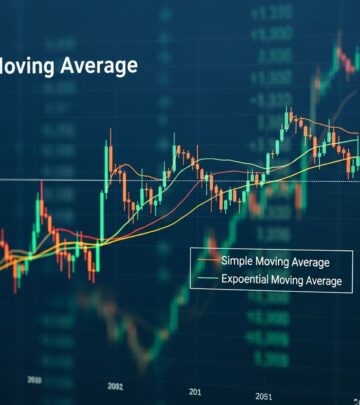
An exponential moving average (EMA) is a type of moving average that places a greater weight and significance on the most recent data points. Unlike a simple moving average (SMA), which treats all data points equally, an EMA assigns exponentially decreasing weights to older data. This makes the EMA more responsive to recent price changes, which can help traders identify trends more quickly and make more timely trading decisions.
The EMA is calculated using a smoothing factor that emphasizes recent prices while still considering historical data. This characteristic makes it particularly useful for traders who want to react quickly to market movements without completely disregarding historical trends. The EMA is widely used in technical analysis across various financial markets, including stocks, currencies, commodities, and cryptocurrencies.
Understanding the Exponential Moving Average
The exponential moving average differs fundamentally from other types of moving averages in how it weights price data. While a simple moving average calculates the arithmetic mean of a set number of prices over a specific period, an EMA assigns more significance to recent prices through a mathematical weighting process.
The key advantage of using an EMA is its sensitivity to recent price action. When the market is trending strongly, an EMA will respond more quickly than an SMA, potentially helping traders catch trends earlier. However, this responsiveness also means that EMAs can generate more false signals during choppy or sideways markets, as they react more quickly to price fluctuations.
Traders often use multiple EMAs with different time periods to confirm trends and identify support and resistance levels. For example, a trader might use a 12-period EMA, a 26-period EMA, and a 50-period EMA simultaneously to gain a comprehensive view of the market direction.
How to Calculate an Exponential Moving Average
The calculation of an EMA involves several steps and requires understanding the smoothing factor, also known as the multiplier. Here’s how the process works:
Step 1: Calculate the Smoothing Factor
The smoothing factor is calculated using the following formula:
Smoothing Factor = 2 ÷ (N + 1)
Where N is the number of periods in the moving average. For example, for a 10-period EMA, the smoothing factor would be 2 ÷ (10 + 1) = 0.1818 or approximately 18.18%.
Step 2: Find the Initial SMA
To begin calculating the EMA, you first need to calculate a simple moving average for the initial period. This serves as the starting point for the exponential calculation. For a 10-period EMA, you would add up the closing prices for the first 10 periods and divide by 10.
Step 3: Calculate Subsequent EMA Values
After obtaining the initial SMA, each subsequent EMA is calculated using the following formula:
EMA = (Closing Price × Smoothing Factor) + (Previous EMA × (1 – Smoothing Factor))
This formula shows how each new EMA value is a weighted combination of the current price and the previous EMA value. The smoothing factor determines the weight given to the most recent price.
Example Calculation
Consider a stock with closing prices of $100, $102, $101, $103, $105, $104, $106, $108, $107, and $109 over 10 periods. After calculating the initial 10-period SMA as $104.50, you would then apply the smoothing factor of 0.1818 to subsequent prices to calculate each new EMA value.
EMA vs. Simple Moving Average (SMA)
Understanding the differences between EMA and SMA is crucial for choosing the right tool for your trading strategy:
| Feature | Exponential Moving Average (EMA) | Simple Moving Average (SMA) |
|---|---|---|
| Weighting | Assigns more weight to recent prices | Assigns equal weight to all prices |
| Responsiveness | More responsive to price changes | Slower to respond to price changes |
| Calculation | Uses smoothing factor and previous EMA | Simple arithmetic average |
| False Signals | More prone to false signals in sideways markets | Fewer false signals in choppy markets |
| Best Use | Trending markets | Identifying support/resistance levels |
| Complexity | More complex to calculate manually | Simpler to calculate |
The main advantage of the EMA is that it reacts more quickly to recent price movements, making it ideal for traders who want to identify trend changes early. However, this increased sensitivity can also lead to more whipsaws and false signals during periods of price consolidation or volatility.
Using EMA in Trading Strategies
The exponential moving average is a versatile technical indicator that can be incorporated into numerous trading strategies:
Trend Identification
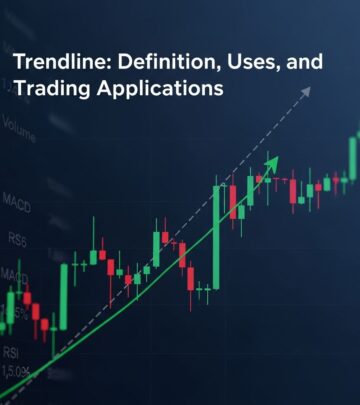
Traders use EMAs to identify the direction and strength of market trends. When price is above an EMA, it generally indicates an uptrend, while price below an EMA suggests a downtrend. Multiple EMAs with different periods can help confirm trend strength and direction.
Support and Resistance Levels
EMAs can act as dynamic support and resistance levels. During an uptrend, the EMA often serves as support where prices bounce back up. Conversely, during a downtrend, the EMA can act as resistance where prices struggle to break through.
Crossover Strategies
One popular trading strategy involves using EMA crossovers. When a shorter-period EMA crosses above a longer-period EMA, it’s often considered a bullish signal. Conversely, when a shorter-period EMA crosses below a longer-period EMA, it’s typically considered bearish. The most common crossover strategy uses the 12-period and 26-period EMAs, which are components of the Moving Average Convergence Divergence (MACD) indicator.
Trend Confirmation
Traders use EMAs to confirm trends identified by other technical indicators. When multiple moving averages align in a specific order (such as the 20-EMA above the 50-EMA above the 200-EMA), it confirms a strong uptrend and can provide confidence in trading decisions.
Key Advantages of Using EMA
- Responsiveness: EMAs quickly respond to recent price movements, helping traders identify trend changes faster than with simple moving averages.
- Reduced Lag: The exponential weighting reduces the lag associated with moving averages, making it more suitable for active trading.
- Flexibility: Traders can customize the period length to suit their trading style, whether short-term, medium-term, or long-term.
- Widely Recognized: Most charting platforms and trading software have built-in EMA calculations, making it easily accessible to all traders.
- Adaptability: EMAs work well across different asset classes and timeframes, from intraday charts to weekly or monthly charts.
Limitations and Drawbacks of EMA
- False Signals: The increased sensitivity to recent prices can generate false signals, especially in sideways or choppy markets.
- Lagging Indicator: Despite being more responsive than SMAs, EMAs are still lagging indicators and may miss the beginning of significant trend reversals.
- Complexity: The calculation is more complex than a simple moving average, which can be challenging for traders without mathematical expertise.
- Not Standalone: EMAs should not be used as the sole basis for trading decisions; they work best when combined with other technical indicators.
- Historical Data Dependency: The EMA value is influenced by all historical prices, which means it can be affected by price gaps and overnight moves.
Common EMA Periods Used by Traders
Different traders use various EMA periods depending on their trading style and objectives:
- 9-EMA and 21-EMA: Common for short-term traders and day traders looking at intraday charts.
- 12-EMA and 26-EMA: Used in the MACD indicator and popular among swing traders.
- 50-EMA: Often used to identify intermediate-term trends and support/resistance levels.
- 100-EMA and 200-EMA: Widely followed for long-term trend identification and major support/resistance levels on daily and weekly charts.
- Multiple EMAs: Many traders use a combination like 10-EMA, 20-EMA, 50-EMA, and 200-EMA simultaneously for multi-timeframe analysis.
EMA Trading Examples
To illustrate how EMAs work in practice, consider a stock trading in an uptrend. When the price pulls back to the 20-EMA and bounces off it as support, a trader might view this as a buying opportunity, confirming the uptrend is intact. If the price breaks below the 20-EMA and closes below the 50-EMA, this could signal that the trend is weakening or reversing.
In another scenario, a trader might place a sell order when a 12-EMA crosses below a 26-EMA, signaling a potential downtrend. This crossover strategy has been particularly effective in trending markets but requires stop-loss orders to manage risk during false signals.
Frequently Asked Questions (FAQs)
Q: What is the main difference between EMA and SMA?
A: The main difference is that an EMA assigns more weight to recent prices through exponential smoothing, making it more responsive to recent price changes. An SMA treats all prices equally over the specified period, making it less responsive but potentially more stable.
Q: What is the best EMA period for day trading?
A: For day trading, shorter-period EMAs like 5-EMA, 9-EMA, and 21-EMA are commonly used. The best period depends on the stock’s volatility and the trader’s preferred trading style, typically ranging from 5 to 30 periods.
Q: Can I use only EMA for trading decisions?
A: While EMA is a useful tool, it should not be used as the sole basis for trading decisions. Combining it with other technical indicators like RSI, MACD, or volume analysis provides better confirmation and reduces false signals.
Q: How do I interpret a price crossing above the EMA?
A: When price crosses above the EMA, it can signal the beginning of an uptrend or the end of a downtrend. However, this should be confirmed by other technical indicators and volume analysis before making trading decisions.
Q: What does it mean when a short-term EMA crosses above a long-term EMA?
A: When a short-term EMA (like 12-EMA) crosses above a long-term EMA (like 26-EMA or 50-EMA), it’s typically considered a bullish signal indicating that momentum is shifting upward. Conversely, a crossover below is considered bearish.
Q: Are EMAs suitable for all market conditions?
A: EMAs work best in trending markets. In sideways or choppy markets, they can generate false signals. Traders should use additional confirmation indicators or adjust their strategies during ranging market conditions.
References
- Technical Analysis from A to Z: Covers Everything from the Basics to Advanced Indicators and Strategies — Steven B. Achelis. McGraw-Hill Education, 2001. https://www.investopedia.com/
- Moving Averages 101 — Securities and Exchange Commission (SEC) Office of Investor Education. U.S. Government. https://www.investor.gov/
- Understanding Technical Analysis: A Guide to Using Moving Averages in Trading — Financial Industry Regulatory Authority (FINRA). https://www.finra.org/investors/learn-to-invest
- Exponential Moving Average Definition and Application in Market Analysis — CFA Institute Research Foundation. https://www.cfainstitute.org/
- Price Action Trading: Technical Analysis for Capturing Profits with Thinkorswim — Trade Station. https://www.investopedia.com/terms/t/technical_analysis.asp
Similar Articles








Read full bio of Sneha Tete