Investment Vehicles: 2025 Essential Guide For Investors
Discover the essential types of investment vehicles, their risks, returns, and how to choose the right ones for your financial goals and portfolio diversification.

Investment vehicles serve as the foundational tools for growing wealth, offering various ways to allocate capital based on individual risk tolerance, time horizons, and objectives. These instruments range from straightforward ownership stakes to complex pooled arrangements, each carrying distinct potential rewards and uncertainties. Understanding their mechanics empowers investors to construct resilient portfolios.
Core Categories of Investment Options
Investments generally fall into direct and indirect categories. Direct options involve purchasing assets outright, granting full control but demanding hands-on management. Indirect vehicles pool resources from multiple participants, managed by experts to spread exposure and simplify decision-making.
- Direct Investments: These include individual securities like equities and debt instruments, where owners bear direct exposure to performance.
- Indirect Investments: Professional oversight defines these, often through collective funds that invest in diverse underlying assets.
Ownership-Based Investments: Stocks and Equities
Stocks represent partial ownership in corporations, entitling holders to potential dividends and voting rights. Common shares offer growth prospects tied to company success, while preferred variants prioritize fixed payouts. Equity markets fluctuate with economic cycles, delivering historically superior long-term gains but with volatility.
Investors select stocks via fundamental analysis—evaluating earnings, management, and market position—or technical indicators tracking price patterns. Blue-chip firms provide stability, whereas growth stocks in tech or biotech promise explosive appreciation at higher risk.
| Stock Type | Risk Level | Typical Return | Liquidity |
|---|---|---|---|
| Common Stocks | High | 8-12% annually (historical avg.) | High (exchange-traded) |
| Preferred Stocks | Medium | 5-8% via dividends | Medium |
| Growth Stocks | Very High | Variable, potentially 15%+ | High |
Lending Instruments: Bonds and Fixed Income
Bonds function as loans to governments or corporations, repaid with interest over predetermined terms. Treasuries from the U.S. government offer safety backed by full faith and credit, ideal for conservative strategies. Corporate bonds yield more but carry default risk, rated by agencies like Moody’s or S&P.
Maturities span short-term (under 3 years) for liquidity to long-term (over 10 years) for higher yields amid interest rate sensitivity. Bond prices inversely correlate with rates: rising rates depress values, while falls boost them.
- Government bonds: Lowest risk, modest returns.
- Municipal bonds: Tax-exempt, appealing for high earners.
- High-yield (junk) bonds: Elevated returns offset by default probability.
Cash Equivalents for Stability
Cash equivalents prioritize capital preservation with minimal volatility. Certificates of deposit (CDs) lock funds at banks for set periods, insured by FDIC up to $250,000, earning predictable interest. Money market funds invest in ultra-short debt, offering check-writing access and yields tracking federal funds rates.
Annuities, contracts with insurers, provide guaranteed income streams post-retirement. Fixed annuities deliver steady payments; variable ones link to market subaccounts, blending safety with growth potential.
Pooled Funds: Mutual Funds and ETFs
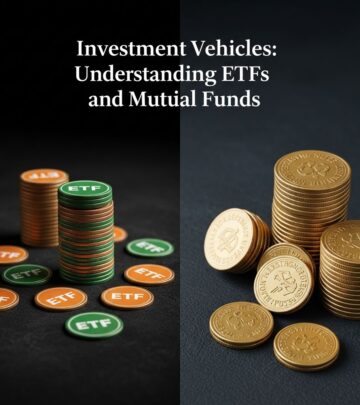
Mutual funds aggregate investor capital for diversified holdings managed actively or passively. Open-end funds issue redeemable shares daily at net asset value (NAV); closed-end trade like stocks at premiums or discounts to NAV.
Exchange-traded funds (ETFs) mirror indices or sectors, trading intraday on exchanges with low expense ratios. They excel in tax efficiency via in-kind redemptions and enable tactical shifts.
| Vehicle | Management | Costs (Avg. Expense Ratio) | Trading |
|---|---|---|---|
| Mutual Funds | Active/Passive | 0.5-1.0% | End-of-day |
| ETFs | Mostly Passive | 0.03-0.5% | Intraday |
| Index Funds | Passive | 0.05-0.2% | End-of-day (mutual) or Intraday (ETF) |
Advanced and Alternative Vehicles
Beyond basics, separately managed accounts (SMAs) customize portfolios for high-net-worth clients, offering tax optimization unavailable in pools. Commingled funds blend assets for institutions, balancing cost and scale.
Private vehicles like hedge funds employ strategies (long/short equity, arbitrage) targeting absolute returns, restricted to accredited investors. Real estate investment trusts (REITs) provide property exposure via dividends from rentals and sales. Venture capital funds back startups, yielding outsized wins or total losses.
Evaluating Investment Choices
Key attributes guide selection: expected returns reflect historical data and projections; risk gauges volatility via standard deviation; liquidity measures sale speed without loss; costs encompass fees eroding gains; structure dictates tax treatment and accessibility.
Public vehicles suit retail investors via brokerages; private ones demand qualifications like $1M net worth. Diversification across vehicles mitigates systemic shocks.
- Low-risk profile: Bonds, CDs, money markets.
- Growth-oriented: Stocks, ETFs.
- Income-focused: Dividend stocks, REITs, annuities.
Strategies for Portfolio Construction
Asset allocation underpins success: stocks for growth, bonds for ballast, alternatives for uncorrelated returns. Rebalancing maintains targets amid drifts. Dollar-cost averaging invests fixed sums regularly, harnessing volatility.
Tax efficiency favors ETFs and index funds minimizing realizations. Horizon matters—young savers tilt equities; near-retirees favor fixed income.
Risks and Mitigation Tactics
Market risk imperils all; inflation erodes purchasing power; interest rate shifts hit bonds; credit risk threatens issuers. Diversification, hedging, and due diligence counter these. Regulatory bodies like FINRA oversee transparency.
Fees compound destructively: a 1% drag halves long-term growth. Scrutinize expense ratios, loads, and turnover.
Common Pitfalls to Avoid
Chasing past performance ignores context. Emotional trading amplifies losses. Neglecting fees and taxes undermines returns. Overconcentration heightens vulnerability. Regularly review and adjust based on life changes.
FAQs
What is the safest investment vehicle?
U.S. Treasuries and FDIC-insured CDs offer principal protection with low yields.
Are ETFs better than mutual funds?
ETFs often win on costs, liquidity, and taxes, but mutual funds suit active strategies or retirement accounts.
How do I start investing?
Open a brokerage account, assess risk tolerance, and begin with low-cost index funds or ETFs.
What role do bonds play in a portfolio?
They provide income, stability, and diversification against stock downturns.
Can beginners invest in private vehicles?
Typically no; accreditation requires high income or assets.
References
- Investment Vehicles | Definition, Types & Examples – Lesson — study.com. 2023. https://study.com/learn/lesson/investment-vehicles-types-features.html
- A Complete Guide to Investment Vehicles — moneyfortherestofus.com. 2023. https://moneyfortherestofus.com/investment-vehicles/
- Types of Investment Vehicles: An Important Choice — NEPC. 2023. https://www.nepc.com/investment-vehicles-important-choice/
- Investment Products — FINRA.org. 2025-02-01. https://www.finra.org/investors/investing/investment-products
- Investing Basics: Bonds Stocks Mutual Funds and ETFs — finred.usalearning.gov. 2024. https://finred.usalearning.gov/saving/StocksBondsMutualFunds
Similar Articles








Read full bio of Sneha Tete