Exchange Rate: Definition, Types, and Impact
Complete guide to currency exchange rates and their role in international trade and investment.
What Is an Exchange Rate?
An exchange rate represents the value of one nation’s currency in relation to another nation’s currency. In other words, it indicates how much of one currency you need to exchange to obtain a unit of another currency. Exchange rates are crucial in international commerce, as they determine the cost of goods and services traded across borders, influence investment decisions, and affect the overall competitiveness of businesses in the global marketplace.
The exchange rate between two currencies is determined by supply and demand forces in the foreign exchange market, also known as the forex market. When demand for a particular currency increases while its supply remains constant, the currency tends to appreciate, meaning it becomes more valuable relative to other currencies. Conversely, when supply exceeds demand, a currency depreciates and loses value.
For example, if the exchange rate between the U.S. dollar and the Euro is 1.10, this means one U.S. dollar can be exchanged for 1.10 Euros. Understanding exchange rates is essential for international traders, investors, multinational corporations, and anyone engaging in cross-border transactions.
How Exchange Rates Work
Exchange rates fluctuate constantly throughout trading hours in the foreign exchange market, which operates 24 hours a day, five days a week across different financial centers worldwide. Banks, financial institutions, hedge funds, corporations, and individual traders participate in this market, buying and selling currencies to facilitate international trade, investment, and speculation.
Several factors influence exchange rate movements, including:
- Interest Rate Differentials: Higher interest rates in one country attract foreign investors seeking better returns, increasing demand for that country’s currency.
- Inflation Rates: Countries with lower inflation rates typically see their currencies appreciate, as their purchasing power remains stronger.
- Economic Growth: Strong economic performance increases investor confidence and demand for a country’s currency.
- Political Stability: Political uncertainty or instability can weaken a currency as investors seek safer alternatives.
- Trade Balances: A country with a trade surplus typically sees currency appreciation, while trade deficits can lead to depreciation.
- Capital Flows: Large movements of investment capital across borders can significantly impact exchange rates.
- Central Bank Policies: Monetary policy decisions and interventions by central banks can directly influence currency values.
Types of Exchange Rate Systems
Different countries adopt various exchange rate regimes to manage their currency values. Understanding these systems helps explain why some currencies fluctuate more dramatically than others.
Fixed Exchange Rate
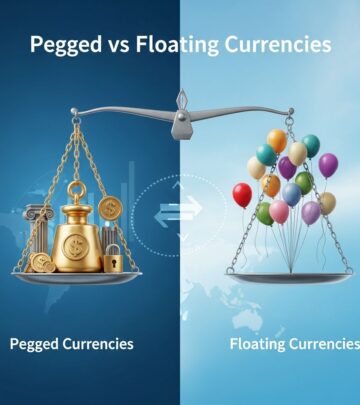
Under a fixed exchange rate system, a country’s central bank maintains its currency’s value at a fixed level relative to another currency, typically a major reserve currency like the U.S. dollar or gold. The central bank commits to buying and selling its currency at the predetermined rate to maintain stability. This system was commonly used under the Bretton Woods system, established after World War II, where many countries pegged their currencies to the U.S. dollar, which was in turn pegged to gold at $35 per ounce.
Advantages of fixed exchange rates include price stability, predictability for international trade, and reduced currency speculation. However, they require substantial foreign exchange reserves and limit monetary policy flexibility. If the fixed rate becomes misaligned with market fundamentals, it can lead to currency crises.
Floating Exchange Rate
A floating exchange rate system allows currency values to be determined entirely by market forces of supply and demand. Central banks do not intervene to maintain a specific rate, though they may occasionally enter the market to reduce excessive volatility. Most developed economies, including the United States, European Union, Japan, and the United Kingdom, operate under floating exchange rate systems.
Floating rates provide monetary policy flexibility and automatically adjust to economic imbalances. However, they introduce uncertainty and volatility, which can complicate international trade planning and investment decisions. Currency fluctuations can create winners and losers among different sectors of the economy.
Managed Float (Dirty Float)
Many countries employ a managed floating exchange rate system, where the market primarily determines the currency value, but central banks occasionally intervene to influence the rate or reduce excessive volatility. This hybrid approach attempts to balance the benefits of both fixed and floating systems, providing some stability while maintaining flexibility.
Pegged Exchange Rate
Some countries peg their currency to another major currency or a basket of currencies. For instance, many small island nations and emerging market countries peg their currencies to the U.S. dollar to promote trade and investment stability. The Chinese Yuan has been managed through a peg to the dollar, although with greater flexibility in recent years.
Nominal vs. Real Exchange Rates
Economists distinguish between nominal and real exchange rates, each serving different analytical purposes.
Nominal Exchange Rate: This is the quoted market price at which one currency exchanges for another. For instance, if you see that one pound sterling equals 1.27 U.S. dollars, that’s the nominal exchange rate. It’s what most people encounter when traveling or conducting international business.
Real Exchange Rate: The real exchange rate adjusts the nominal rate for differences in inflation rates between countries. It reflects the true purchasing power of currencies and provides a better measure of international price competitiveness. The real exchange rate is calculated by multiplying the nominal exchange rate by the ratio of price levels between countries.
For international trade analysis and long-term economic comparisons, the real exchange rate is more meaningful, as it accounts for inflation’s erosion of purchasing power over time.
Impact of Exchange Rates on International Trade
Exchange rates significantly influence the competitiveness and profitability of international trade. When a country’s currency weakens, its exports become cheaper for foreign buyers, potentially increasing export demand. Conversely, imports become more expensive for domestic consumers, which can help protect domestic industries but may increase consumer prices.
For multinational corporations with operations across multiple countries, exchange rate fluctuations create both opportunities and risks. A company earning revenues in foreign currencies faces exposure to exchange rate movements that can affect its reported earnings and profitability. To manage this risk, many companies use hedging strategies, including forward contracts, currency options, and derivatives.
Exchange Rates and Investment
Exchange rates play a crucial role in foreign investment decisions. When investors consider investing in another country, they must account for potential currency appreciation or depreciation, which can significantly impact their returns. For example, if an investor buys foreign stocks and the currency depreciates, the investor’s return is reduced even if the stock price appreciates in local currency terms.
Central bank policies, interest rate differentials, and economic growth prospects drive investor decisions to allocate capital across countries, creating capital flows that influence exchange rates. Countries offering higher returns and lower risk typically attract more foreign investment, strengthening their currencies.
Purchasing Power Parity
Purchasing Power Parity (PPP) is a theory suggesting that exchange rates should adjust so that an identical basket of goods costs the same in different countries when converted to a common currency. According to PPP theory, if a basket of goods costs $100 in the United States and £80 in the United Kingdom, the exchange rate should be 1.25 dollars per pound.
While PPP provides a useful long-term benchmark for exchange rates, actual market rates often deviate from PPP due to transportation costs, trade barriers, differences in taxes and regulations, and non-tradable services. However, over very long periods, exchange rates tend to move toward PPP levels as these imbalances gradually adjust.
How to Calculate Exchange Rates
Exchange rates are quoted in currency pairs, with the first currency called the base currency and the second the quote currency. For example, in the EUR/USD pair, the Euro is the base currency and the U.S. dollar is the quote currency.
To calculate how much of one currency you need to purchase another:
- Identify the exchange rate for the currency pair you’re interested in.
- Multiply the amount of the base currency by the exchange rate to determine how much of the quote currency you’ll receive.
- For reverse calculations, divide the amount by the exchange rate.
For example, if EUR/USD is trading at 1.10 and you want to exchange 1,000 Euros, you would receive approximately 1,100 U.S. dollars (1,000 × 1.10 = 1,100).
Bid-Ask Spread
In practice, exchange rates are quoted as a bid-ask spread. The bid price is what currency dealers are willing to pay to buy a currency, while the ask price is what they charge to sell it. The difference between these two prices, called the spread, represents the dealer’s profit and varies based on market liquidity and trading volume.
For highly traded currencies like EUR/USD, spreads are typically very tight, often less than one pip (the smallest unit of price movement). For exotic or less-traded currencies, spreads can be significantly wider, reflecting lower liquidity and higher transaction costs.
Exchange Rates and Inflation
There is typically an inverse relationship between inflation and exchange rates. According to the inflation differential theory, a country with higher inflation will see its currency depreciate relative to countries with lower inflation. This occurs because higher inflation reduces a currency’s purchasing power and makes that country’s exports less competitive on the international market.
Central banks often use interest rate adjustments to manage both inflation and exchange rates. By raising interest rates to combat inflation, central banks typically also attract foreign investment, which strengthens the currency. Conversely, lowering rates to stimulate growth may weaken the currency but can increase inflation pressures.
Frequently Asked Questions
Q: What determines exchange rates?
A: Exchange rates are determined by supply and demand in the foreign exchange market. Factors affecting supply and demand include interest rate differentials, inflation rates, economic growth, political stability, trade balances, and central bank policies.
Q: What is the difference between a fixed and floating exchange rate?
A: A fixed exchange rate is maintained at a predetermined level by a central bank, while a floating exchange rate is determined by market forces. Fixed rates offer stability but limit monetary flexibility, while floating rates are flexible but more volatile.
Q: How do exchange rates affect international trade?
A: When a country’s currency weakens, its exports become cheaper and more competitive, potentially increasing export volumes. Imports become more expensive, which can protect domestic industries but increase costs for consumers.
Q: What is Purchasing Power Parity?
A: Purchasing Power Parity (PPP) suggests that exchange rates should adjust so identical goods cost the same in different countries when converted to a common currency. While useful as a long-term benchmark, actual rates often deviate from PPP due to various market factors.
Q: How can investors protect against exchange rate risk?
A: Investors can use hedging strategies including forward contracts, currency options, currency swaps, and diversification across multiple currencies to protect against exchange rate fluctuations and minimize potential losses.
Q: Why do central banks intervene in currency markets?
A: Central banks intervene to reduce excessive volatility, maintain price stability, support export competitiveness, manage inflation, and achieve broader monetary policy objectives. However, prolonged intervention can be costly and ultimately ineffective against market fundamentals.
References
- Exchange Rates and International Financial Economics — International Monetary Fund (IMF). 2024. https://www.imf.org/external/np/fin/exchratmon.htm
- The Federal Reserve’s Role in Foreign Exchange Markets — Board of Governors of the Federal Reserve System. 2024. https://www.federalreserve.gov/monetarypolicy/bst_forexmarket.htm
- Understanding Currency Markets and Exchange Rates — World Bank. 2023. https://www.worldbank.org
- BIS Quarterly Review: Foreign Exchange Markets — Bank for International Settlements (BIS). 2024. https://www.bis.org/publ/qtrpdf/r_qt2411.pdf
- Purchasing Power Parity: Theory and Evidence — Organization for Economic Co-operation and Development (OECD). 2023. https://www.oecd.org
- Managing Exchange Rate Volatility in Emerging Markets — Asian Development Bank (ADB). 2023. https://www.adb.org
Similar Articles








Read full bio of Sneha Tete