Exceeding $250K in Savings: Key Risks and Solutions
Discover what occurs when your savings surpass the FDIC limit and how to safeguard your funds effectively with proven strategies.

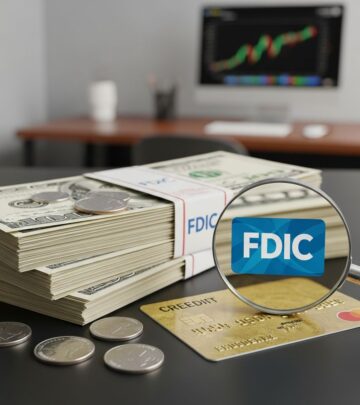
Holding savings beyond $250,000 in a single bank account exposes funds to risks beyond federal insurance limits. The FDIC insures deposits up to $250,000 per depositor, per insured bank, per ownership category, leaving excess amounts vulnerable in case of bank failure.
Understanding Federal Deposit Insurance Basics
The Federal Deposit Insurance Corporation (FDIC) protects depositors by reimbursing losses up to specified limits if an insured institution fails. This coverage applies to checking accounts, savings accounts, money market deposit accounts, and certificates of deposit (CDs) held in FDIC-insured banks. Coverage caps at $250,000 for each depositor in each ownership category, such as individual accounts, joint accounts, or trusts.
For example, a single individual with $300,000 in a personal savings account at one bank would have $250,000 insured and $50,000 uninsured. Joint accounts double the limit to $500,000 for two owners. To confirm FDIC insurance, use the FDIC’s Electronic Deposit Insurance Estimator tool on their official website.
Consequences of Uninsured Deposits
If a bank fails and deposits exceed insured limits, the FDIC prioritizes payouts, but uninsured portions may face delays or partial recovery. Historical data from the 2008 financial crisis shows that while most depositors recovered funds through asset sales, uninsured amounts took months or years, often at reduced value.
In 2023 bank failures like Silicon Valley Bank, uninsured depositors experienced temporary access issues, highlighting ongoing risks. Excess funds could also earn lower interest if relegated to riskier institutions chasing higher yields without adequate safeguards.
Effective Strategies to Maximize Coverage
Diversifying across multiple FDIC-insured banks is the primary method to protect larger sums. Spreading $750,000 across three banks ensures full $250,000 coverage per institution.
- Multiple Accounts: Open accounts at different banks, each under $250,000.
- Ownership Categories: Use individual, joint, payable-on-death (POD), or trust accounts to multiply limits.
- Bank Networks: Services like IntraFi Network (formerly CDARS) distribute funds across a network of banks, providing coverage up to millions while using one master account.
Table comparing basic diversification options:
| Method | Coverage per Bank | Best For | Drawbacks |
|---|---|---|---|
| Separate Banks | $250K individual | Simple control | Multiple logins |
| Joint Accounts | $500K (2 owners) | Families | Requires co-owner |
| IntraFi/CDARS | Up to $50M+ | Large sums | Fees possible |
| Trust/POD | $1.25M+ (5 beneficiaries) | Estate planning | Legal setup |
High-Yield Options for Protected Savings
Online banks offer competitive rates while maintaining FDIC insurance. As of early 2026, top high-yield savings accounts (HYSAs) provide APYs around 4% to 5%, far exceeding the national average of 0.39% to 0.6%.
Current standout rates include:
- Varo Money: Up to 5.00% APY (on balances up to $5,000 with requirements).
- Axos Bank: 4.21% APY, no minimum deposit.
- Newtek Bank and Wealthfront: 4.20% APY.
- Bask Bank: Up to 4.00% with $10,000 minimum for boost (through June 2026).
These rates compound daily or monthly, potentially yielding $4,000+ annually on $100,000. Always verify current APYs, as they fluctuate with Federal Reserve policies.
Building a CD Ladder for Steady Returns
Certificates of Deposit (CDs) lock in rates for terms from 3 months to 5 years, ideal for portions of savings not needed immediately. A CD ladder staggers maturities to balance liquidity and yield.
Steps to create a ladder:
- Divide funds into equal parts (e.g., $250,000 into 5 segments of $50,000).
- Invest in CDs of 1-, 2-, 3-, 4-, and 5-year terms.
- Reinvest maturing CDs into new 5-year terms.
This provides periodic access while capturing higher long-term rates. FDIC insures CDs up to $250,000 per bank, so ladder across institutions. Early withdrawal penalties apply, typically 3-6 months’ interest.
Evaluating Money Market Accounts and Funds
Money market deposit accounts (MMDAs) at banks are FDIC-insured and offer check-writing or debit access with yields near HYSAs. They suit emergency funds needing slight liquidity.
Money market funds (MMFs) at brokerages like Vanguard or Fidelity invest in short-term securities, yielding 4-5% but lack FDIC protection—covered by SIPC up to $500,000 (securities only). Prefer insured MMDAs for principal safety.
Tax Implications and Inflation Considerations
Interest from savings, CDs, and MMDAs is taxable federally and often at state levels, reported on Form 1099-INT. High earners may face higher brackets, reducing net returns.
With inflation around 2-3% in 2026, aim for yields exceeding this to preserve purchasing power. A 4% APY on $250,000 nets about $10,000 pre-tax, outpacing modest inflation.
Practical Steps for High-Net Savers
Review statements quarterly to track balances against limits. Use FDIC’s BankFind tool to confirm insurance status. For sums over $1 million, consult advisors for revocable trusts expanding coverage.
Automate transfers to maintain balances under limits. Monitor credit unions via NCUA, mirroring FDIC rules.
Frequently Asked Questions
Is $250,000 the absolute FDIC limit?
No, it applies per depositor, per ownership category, per bank. Multiple categories can exceed this safely.
Are online banks FDIC-insured?
Yes, most reputable ones like Ally, Marcus, or those listed are fully insured. Check FDIC membership.
What if I have joint accounts?
Coverage doubles to $500,000 per joint account.
Do CDs have better rates than savings?
Often yes for longer terms, but less liquid.
How do I spread funds without hassle?
IntraFi services handle distribution seamlessly.
Advanced Protection for Ultra-High Balances
For millions, private banking or sweep programs at firms like Schwab or Merrill distribute across networks. These maintain one relationship while ensuring coverage.
International diversification via U.S. branches of foreign banks may apply, but verify home-country rules. Treasury securities or I Bonds offer alternatives, backed by the U.S. government.
In summary, proactive diversification turns potential risk into opportunity. With rates at 4-5%, protected growth is achievable.
References
- What’s a good high-yield savings account interest rate in 2026? — CBS News. 2026-01 (approx). https://www.cbsnews.com/news/whats-good-high-yield-savings-account-interest-rate-in-2026/
- The top high-yield savings rates: Up to 5.00% on March 25, 2026 — Fortune. 2026-03-25. https://fortune.com/article/best-savings-account-rates-3-25-2026/
- Best High-Yield Savings Accounts Of March 2026 — Bankrate. 2026-03. https://www.bankrate.com/banking/savings/best-high-yield-interests-savings-accounts/
- Best High-Yield Savings Accounts for March 2026 — NerdWallet. 2026-03-18. https://www.nerdwallet.com/banking/best/high-yield-online-savings-accounts
Similar Articles








Read full bio of medha deb