The Evolution of American Home Financing
From Depression-era reforms to modern lending: how mortgages shaped homeownership

The ability to finance a home through a long-term, fixed-rate mortgage is so commonplace in contemporary America that most borrowers take it for granted. Yet this financial instrument represents one of the most significant economic innovations of the twentieth century, fundamentally reshaping property ownership and wealth accumulation for millions of households. Understanding how the 30-year mortgage emerged and became dominant reveals much about the intersection of financial markets, government policy, and social change.
The Precarious Mortgage Landscape Before Reform
For most of American history before the 1930s, obtaining financing to purchase a home was an entirely different proposition than it is today. The mortgage system that existed prior to the Great Depression bore little resemblance to modern lending practices and created significant barriers to homeownership for average Americans.
Mortgages of this era were characterized by extreme unpredictability and borrower vulnerability. Loan terms typically ranged from five to seven years, far shorter than modern standards. More problematic was the structure of these loans: borrowers would make interest-only payments for the duration of the loan term, then face an enormous final payment—known as a balloon payment—that required them to repay the entire principal amount in a single lump sum. This arrangement created an inherent instability, as homeowners depended entirely on their ability to refinance the balloon payment when it came due.
Variable interest rates compounded these challenges. Unlike today’s fixed-rate mortgages where monthly payments remain constant throughout the loan term, historical mortgages subjected borrowers to fluctuating interest rates that could change substantially based on market conditions. This uncertainty made long-term financial planning nearly impossible for families trying to budget for housing costs. The combination of short terms, balloon payments, and variable rates meant that homeownership was far more precarious than it appears in the modern era.
Additionally, lenders required substantial down payments—often 50 percent or more—effectively restricting homeownership to the wealthy and upper-middle classes. This financial gatekeeping meant that the vast majority of American workers had no realistic pathway to property ownership. The mortgage market functioned primarily as a tool for the already-affluent to leverage their capital, not as a mechanism for wealth building among broader populations.
The Crisis That Sparked Change
The stock market collapse of October 1929 initiated a cascade of failures throughout the financial system and housing markets. When banks failed and credit evaporated, homeowners discovered they could not refinance their balloon payments. The consequences were catastrophic: approximately 273,000 families lost their homes in 1932 alone. By 1933, the foreclosure rate had accelerated to approximately one thousand homes per day. During the worst years of the Great Depression, roughly 50 percent of all mortgages were in default, with approximately 25 percent already proceeding toward foreclosure.
This systemic collapse threatened not only individual families but the entire financial infrastructure. The housing crisis became a central concern for policymakers seeking to stabilize the economy and restore confidence in financial markets. President Franklin D. Roosevelt’s administration recognized that without fundamental reform to the mortgage system, recovery would remain elusive.
Government Intervention and Structural Reform
The Roosevelt administration responded with innovative institutional solutions designed to stabilize housing markets and prevent future crises. In 1933, Congress established the Home Owners’ Loan Corporation (HOLC), which purchased distressed mortgages from lenders and refinanced them on more favorable terms for borrowers. This intervention prevented millions of additional foreclosures and provided immediate relief to homeowners facing impossible financial situations.
Building on this initial intervention, Congress created the Federal Housing Administration (FHA) in 1936. The FHA represented a more comprehensive reform, introducing several transformative concepts to American mortgage lending:
- Standardized underwriting: The FHA developed consistent criteria for evaluating borrowers, reducing arbitrary discrimination and creating predictable lending standards
- Mortgage insurance: The FHA offered insurance that protected lenders against borrower default, substantially reducing lender risk and encouraging capital flow into mortgage markets
- Extended loan terms: With FHA backing, lenders became willing to offer mortgages extending 15, 20, and eventually 30 years, dramatically reducing required monthly payments
- Amortizing loans: The FHA promoted fully amortizing mortgages where regular payments gradually paid down both principal and interest, eliminating the destabilizing balloon payment structure
The Path to 30-Year Dominance
Interestingly, the 30-year mortgage did not immediately become the standard lending product. During the 1930s and 1940s, 15-year and 20-year mortgages actually dominated the market. The 30-year mortgage wasn’t officially authorized by Congress until 1948 for new construction and 1954 for existing homes.
The transformation accelerated in the mid-1950s when the Federal Reserve began raising interest rates to combat inflation. As rates climbed, the monthly payment advantage of the 30-year mortgage became increasingly attractive to borrowers. A 30-year term stretched payments over a longer period, keeping monthly obligations manageable even as rates increased. Simultaneously, in 1938, Congress created the Federal National Mortgage Association—commonly known as Fannie Mae—to purchase mortgages from lenders and bundle them into securities sold to investors.
Fannie Mae’s role proved crucial to the 30-year mortgage’s success. By guaranteeing mortgages and removing lender risk, Fannie Mae essentially solved a fundamental market problem: individual lenders had been reluctant to hold 30-year mortgages on their balance sheets because the long time horizon created substantial interest rate risk. By purchasing and guaranteeing these mortgages, then selling them as securities to investors, Fannie Mae distributed that risk across the broader financial market. Later, the Federal Home Loan Mortgage Corporation (Freddie Mac) and Government National Mortgage Association (Ginnie Mae) provided similar functions, creating a robust secondary market for mortgages.
By the early 1960s, the 30-year fixed-rate mortgage had become the clear dominant lending product. More than 90 percent of home purchases today are financed with 30-year fixed-rate mortgages, a market share that reflects both the product’s inherent appeal and the government-backed infrastructure supporting it.
Economic Advantages of the 30-Year Structure
The 30-year fixed-rate mortgage provides benefits that extend beyond individual borrowers to encompass the broader financial system and economy. For homebuyers, the advantages are substantial and multifaceted:
Predictability and stability: A fixed interest rate means monthly payment amounts never change, regardless of broader economic conditions. This predictability enables families to make reliable budget decisions and plan for other financial goals. Unlike borrowers in pre-Depression era, modern homeowners face no risk that rising interest rates will increase their mortgage payments.
Manageable monthly payments: By extending repayment across 30 years rather than 15 or 20, the 30-year mortgage substantially reduces the monthly payment burden. Lower monthly obligations increase the pool of potential homebuyers who can qualify for mortgages, democratizing access to property ownership.
Refinancing flexibility: If market interest rates decline, borrowers can refinance their mortgages at the lower rate, reducing their remaining payment obligations. This built-in flexibility provides borrowers the benefit of declining rates without the risk of rising rates.
Wealth building potential: As property values historically appreciate over time, homeownership enables families to build equity and accumulate wealth. The 30-year mortgage makes homeownership accessible to middle-class families, allowing them to participate in property appreciation that was previously restricted to the wealthy.
Financial markets also benefit from the 30-year mortgage structure. Fannie Mae, Freddie Mac, and other mortgage aggregators purchase pools of 30-year mortgages and guarantee them, then sell securities backed by these mortgages to investors worldwide. This process channels investment capital into housing finance while spreading the interest rate risk across diversified investors. The secondary mortgage market created by this system has become essential to the functioning of modern housing finance.
Historical Interest Rate Trends
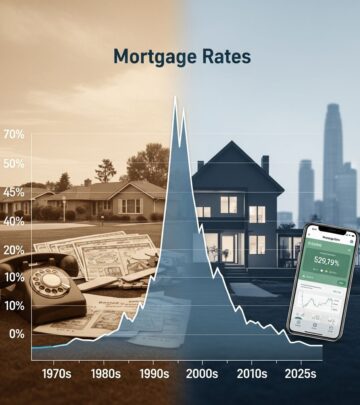
Since the Federal Reserve began tracking 30-year mortgage rates in April 1971, rates have experienced substantial volatility reflecting broader economic conditions. The highest rates occurred in October 1981, when 30-year fixed rates briefly exceeded 18 percent as the Federal Reserve under Chair Paul Volcker dramatically raised rates to combat double-digit inflation. The early 1980s represented the most challenging borrowing environment for homebuyers since the mortgage system’s reformation.
Rates gradually declined through the 1980s and 1990s as inflation was brought under control. The 2000s saw a dramatic decline, with rates reaching historic lows near 3 percent in 2021. However, this rate environment proved temporary, as inflation resurged in 2021-2022, prompting Federal Reserve rate increases. As of early 2026, 30-year rates have stabilized in the mid-6 percent range. Historically, rates have averaged approximately 7.7 percent from 1971 through 2025, providing context for evaluating current rate environments.
Long-Term Impact on Homeownership
The introduction of the 30-year fixed-rate mortgage represented a fundamental democratization of property ownership. Prior to the 1930s, only one in ten Americans owned their homes. The combination of government-backed lending, standardized underwriting, mortgage insurance, and secondary market support transformed homeownership from an upper-class privilege into an attainable goal for middle-class families.
The 30-year mortgage connected homeownership to retirement planning and intergenerational wealth transfer. As property values appreciated, homeowners accumulated equity that could be leveraged for other investments, support children’s education, or provide retirement income. This wealth-building mechanism has enabled successive generations to accumulate capital and improve their economic circumstances.
The market for 30-year mortgages remains distinctive to the United States. Most other developed nations employ different mortgage structures, typically with shorter amortization periods, adjustable rates, or different refinancing mechanisms. The American 30-year fixed-rate mortgage, supported by government-backed secondary market institutions, remains unique in the degree of payment stability and rate certainty it provides borrowers.
Ongoing Debates and Considerations
While the 30-year mortgage has proven enormously successful in expanding homeownership, economists and policymakers continue to debate its long-term implications. Some argue that by extending loan terms, borrowers ultimately pay substantially more in total interest than they would with shorter-term mortgages. A 30-year mortgage requires borrowers to make payments for a full three decades, compared to fifteen or twenty years for alternative products.
Others contend that government backing of 30-year mortgages through Fannie Mae and Freddie Mac creates moral hazard, encouraging excessive risk-taking by lenders and investors. Proposals for privatization or reduced government involvement continue to emerge periodically, though such reforms face political obstacles and concerns about their impact on housing affordability.
Nevertheless, the 30-year fixed-rate mortgage has become so integral to American financial markets and homeownership patterns that its fundamental structure seems likely to persist. The combination of predictable payments, built-in refinancing flexibility, and secondary market support has proven resilient across changing economic conditions.
References
- How 30-year fixed-rate mortgages became the U.S. standard — Marketplace. 2025-06-17. https://www.marketplace.org/story/2025/06/17/how-30-year-fixed-rate-mortgages-became-the-us-standard
- History & Appeal of the 30-year Mortgage — Guaranteed Rate Affinity. https://www.grarate.com/article/history-30-year-mortgage
- Mortgage Rate History: 1970s To 2025 — Bankrate. https://www.bankrate.com/mortgages/historical-mortgage-rates/
- 30-Year Fixed Rate Mortgage Average in the United States — Federal Reserve Economic Data (FRED). https://fred.stlouisfed.org/series/MORTGAGE30US
- Historical mortgage rates: 1971 to 2025 — Rocket Mortgage. https://www.rocketmortgage.com/learn/historical-mortgage-rates-30-year-fixed
- What Is a 30-Year Fixed Mortgage? — Chase Bank. https://www.chase.com/personal/mortgage/education/financing-a-home/history-of-30-year-mortgage
Similar Articles








Read full bio of Sneha Tete