EV/EBITDA and P/E Ratio: Complementary Valuation Metrics
Master valuation by combining EV/EBITDA and P/E ratio for comprehensive investment analysis.
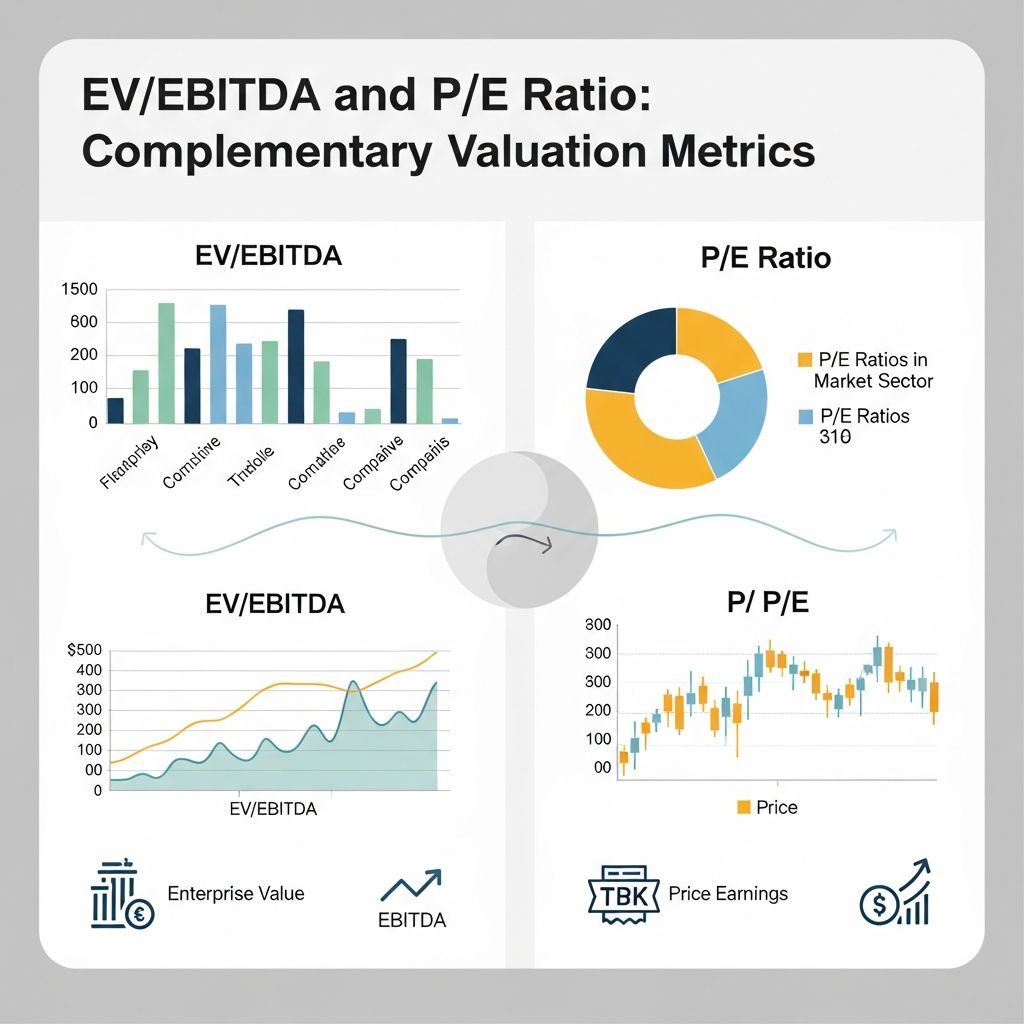
How Can EV/EBITDA Be Used in Conjunction with P/E Ratio?
Investors and financial analysts rely on multiple valuation metrics to gain a comprehensive understanding of a company’s financial health and investment potential. While individual metrics provide valuable insights, combining different measures creates a more robust analytical framework. Two of the most widely used metrics in equity analysis are the EV/EBITDA ratio and the P/E (price-to-earnings) ratio. Understanding how to use these metrics together can significantly enhance your investment decision-making process and help you identify undervalued or overvalued opportunities in the market.
Understanding EV/EBITDA Ratio
The EV/EBITDA ratio, also known as the enterprise value to earnings before interest, taxes, depreciation, and amortization ratio, is a valuation metric that compares a company’s total enterprise value to its earnings before certain expenses. Enterprise value represents the total value of a company, calculated as market capitalization plus total debt minus cash and cash equivalents. EBITDA, conversely, measures operational earnings before the impact of capital structure, taxation, and non-cash charges.
The primary advantage of EV/EBITDA is that it normalizes differences in capital structure and accounting methods across companies. By focusing on operational earnings rather than net income, this metric allows investors to compare companies with different debt levels, tax situations, or depreciation policies. This makes EV/EBITDA particularly useful when analyzing companies within the same industry or across different sectors.
- EV/EBITDA accounts for capital structure differences
- Removes impact of non-cash charges like depreciation
- Provides a clearer picture of operational efficiency
- Useful for comparing companies with different tax situations
- Less influenced by accounting method variations
Understanding the P/E Ratio
The price-to-earnings ratio, commonly referred to as the P/E ratio, is perhaps the most widely recognized valuation metric in investing. It divides a company’s stock price by its earnings per share (EPS), providing a straightforward assessment of how much investors are willing to pay for each dollar of earnings. The P/E ratio is easy to calculate, readily available through financial platforms, and widely understood by market participants.
However, the P/E ratio has several limitations. It reflects the impact of capital structure decisions, as higher debt levels reduce net income and thus artificially lower the P/E ratio. Additionally, the P/E ratio can be distorted by one-time charges, changes in tax rates, and differences in depreciation policies across companies. Despite these limitations, the P/E ratio remains an essential tool for quick valuation assessments and is deeply embedded in market psychology and investment analysis.
- Simple to calculate and widely understood
- Readily available from financial data providers
- Sensitive to capital structure and financial leverage
- Affected by one-time charges and tax variations
- Reflects market sentiment about growth prospects
Key Differences Between EV/EBITDA and P/E Ratio
While both metrics serve valuation purposes, they approach the task from different angles and provide distinct perspectives on company worth. Understanding these differences is crucial for effective combined analysis.
| Aspect | EV/EBITDA | P/E Ratio |
|---|---|---|
| Calculation Base | Enterprise Value / EBITDA | Stock Price / Earnings Per Share |
| Impact of Debt | Includes debt in valuation | Reflects debt through net income |
| Tax Sensitivity | Tax-neutral metric | Affected by tax rates |
| Non-Cash Items | Excludes depreciation and amortization | Includes all non-cash charges |
| Best Use Case | Capital-intensive industries, M&A | General market screening, growth stocks |
| Comparability | Better across different structures | Limited across different structures |
Advantages of Using Both Metrics Together
Combining EV/EBITDA and P/E ratio analysis provides investors with a more comprehensive valuation framework. Each metric compensates for the limitations of the other, creating a more robust analytical approach.
Complementary Coverage
The P/E ratio is straightforward and immediately reflects market sentiment about a company’s earnings potential. It’s particularly useful for quick market assessments and identifying obvious market outliers. However, when combined with EV/EBITDA, it provides context. If a company has a low P/E but high EV/EBITDA, this might indicate high debt levels distorting the P/E metric. Conversely, if both metrics are aligned in showing similar valuations, this creates stronger confirmation of whether a stock is fairly valued.
Capital Structure Insights
A company with a significantly higher EV/EBITDA than P/E multiple typically has a highly leveraged balance sheet. This disparity alerts investors to the company’s financial risk profile. Understanding this relationship helps investors assess whether a low P/E ratio represents genuine value or merely reflects inflated earnings due to financial leverage.
Operational vs. Total Value Assessment
The P/E ratio focuses on net profits available to equity holders, while EV/EBITDA emphasizes operational profitability regardless of financing decisions. Together, these metrics allow you to separate operational efficiency from financial structure efficiency. A company might have excellent operations but poor financial management, or vice versa.
Industry-Specific Applications
Different industries benefit from emphasizing one metric over the other, and using both together provides industry-specific insights.
Capital-Intensive Industries
In sectors like manufacturing, utilities, telecommunications, and real estate, companies carry significant debt and have large depreciation expenses. For these industries, EV/EBITDA is often the preferred primary metric because it normalizes these factors. However, combining it with P/E ratio reveals how effectively management uses leverage. A capital-intensive company with favorable EV/EBITDA but poor P/E might be overleveraged and vulnerable to economic downturns.
Technology and Service Sectors
Companies with minimal debt and few tangible assets, such as software firms or consulting services, often show more aligned EV/EBITDA and P/E multiples. When these metrics diverge significantly, it warrants investigation into unusual financing decisions or accounting practices.
Growth Companies
For rapidly growing companies, the P/E ratio may be extremely high, reflecting investor expectations about future earnings. Using EV/EBITDA alongside P/E helps distinguish between genuine growth potential and speculative pricing. A company with both high multiples might still be fairly valued if growth prospects justify the premium.
Practical Analysis Example
Consider comparing two companies in the same industry, Company A and Company B. Company A shows a P/E ratio of 12 and EV/EBITDA of 18. Company B shows a P/E ratio of 18 and EV/EBITDA of 12. Without combined analysis, Company A might appear cheaper based on P/E alone. However, the reversed EV/EBITDA and P/E relationship suggests Company A is leveraged heavily, while Company B maintains a cleaner balance sheet. Depending on your risk tolerance and investment thesis, Company B might actually represent better value despite its higher P/E ratio.
Limitations and Considerations
While combining these metrics provides robust analysis, investors should remain aware of inherent limitations.
- Industry Variations: Different industries have vastly different average multiples, making absolute comparison meaningless without industry context
- Cyclicality: Both metrics can be distorted during economic cycles when earnings are abnormally high or low
- Quality of Earnings: Neither metric directly addresses earnings quality or sustainability
- Growth Prospects: These are backward-looking metrics that don’t inherently capture future growth potential
- EBITDA Manipulation: EBITDA can be influenced by how companies classify and recognize expenses
Best Practices for Combined Analysis
To effectively use EV/EBITDA and P/E ratio together, follow these best practices:
- Always compare metrics within the same industry to ensure meaningful comparison
- Look at historical trends for individual companies to identify valuation shifts
- Compare to industry averages to contextualize individual company multiples
- Investigate significant divergences between the two metrics to understand underlying causes
- Consider the company’s growth stage when evaluating multiple levels
- Combine metric analysis with qualitative factors like competitive position and management quality
- Monitor changes in capital structure that might explain metric movements
Frequently Asked Questions
Q: Which metric is more important, EV/EBITDA or P/E ratio?
A: Neither metric is inherently more important; they serve different purposes. EV/EBITDA is superior for comparing companies with different capital structures, while P/E ratio is better for quick market assessments. Using both together provides the most comprehensive valuation picture.
Q: Can EV/EBITDA and P/E ratio be used for all industries?
A: While generally applicable, these metrics are most reliable for profitable, established companies. For startups, unprofitable companies, or highly cyclical industries, alternative metrics or supplementary analysis may be necessary.
Q: What should I do if EV/EBITDA and P/E ratio suggest different valuations?
A: Divergence between metrics typically indicates leverage differences, tax situations, or accounting practices. Investigate the balance sheet to understand the discrepancy before making investment decisions.
Q: How do I find EV/EBITDA and P/E ratio values for stocks?
A: Most financial websites including Yahoo Finance, Google Finance, and Bloomberg provide these metrics. You can also calculate them manually using company financial statements and current stock price.
Q: Are these metrics suitable for value investing?
A: Yes, both metrics are cornerstone tools for value investors. Lower multiples relative to historical averages and peer groups often indicate undervalued opportunities, though additional analysis is essential.
Q: How frequently should I reassess these metrics?
A: For active investors, quarterly reviews when companies report earnings make sense. For long-term investors, annual reviews typically suffice, though significant market movements might warrant more frequent assessments.
Conclusion
The EV/EBITDA ratio and P/E ratio represent complementary valuation tools that, when used together, provide investors with significantly deeper analytical insights than either metric alone. The EV/EBITDA ratio excels at normalizing differences in capital structure and accounting methods, making it ideal for comparing companies with different financing strategies or asset bases. The P/E ratio, while simpler and more widely recognized, directly reflects market sentiment and is essential for quick market screening.
By understanding the strengths and limitations of each metric, and by recognizing how they interact, you can develop a more sophisticated investment analysis framework. This combined approach helps you distinguish between genuinely undervalued opportunities and companies whose metrics are distorted by financial decisions rather than operational performance. Remember to always contextualize these metrics within industry standards, historical trends, and broader qualitative factors to make well-informed investment decisions.
References
- Understanding Enterprise Value-to-EBITDA (EV/EBITDA) — U.S. Securities and Exchange Commission. Investor Information. https://www.sec.gov
- Equity Valuation Methods and Analysis — CFA Institute. Financial Analyst Standards & Guidelines. https://www.cfainstitute.org
- Price-to-Earnings Ratio: An Investor’s Guide — Federal Reserve Education. https://www.federalreservehistory.org
- Financial Ratio Analysis for Investment Decisions — Financial Accounting Standards Board (FASB). https://www.fasb.org
- Comparative Company Analysis in Equity Research — MSCI Inc. ESG and Equity Research Methodologies. https://www.msci.com
Similar Articles








Read full bio of medha deb