EV/EBITDA Ratio: Definition, Formula, and Valuation
Master EV/EBITDA: The essential valuation metric for comparing company values.
The EV/EBITDA ratio is one of the most widely used valuation metrics in finance and investment analysis. Whether you’re a seasoned investor, financial analyst, or someone new to investing, understanding this metric is essential for making informed decisions about company valuations and investment opportunities. This guide will walk you through everything you need to know about EV/EBITDA, from its definition to practical applications.
What is EV/EBITDA?
EV/EBITDA stands for Enterprise Value divided by Earnings Before Interest, Taxes, Depreciation, and Amortization. It is a valuation ratio that measures a company’s total value relative to its operating earnings. This metric is particularly useful because it normalizes for differences in capital structure, tax rates, and accounting methods that can distort other valuation metrics.
Enterprise Value (EV) represents the total value of a company and is calculated by adding a company’s market capitalization, total debt, and preferred stock, then subtracting cash and cash equivalents. EBITDA, on the other hand, represents a company’s operating performance before the impact of financing, taxation, and non-cash charges.
Understanding the Components
Enterprise Value (EV)
Enterprise Value is a comprehensive measure of a company’s value that reflects what a buyer would theoretically pay to acquire the entire business. Unlike market capitalization, which only considers equity value, Enterprise Value accounts for the company’s complete capital structure.
The formula for Enterprise Value is:
- Market Capitalization
- Plus: Total Debt (short-term and long-term)
- Plus: Preferred Stock
- Plus: Minority Interest
- Minus: Cash and Cash Equivalents
EBITDA (Earnings Before Interest, Taxes, Depreciation, and Amortization)
EBITDA is a measure of a company’s operating performance that excludes the effects of financing, taxation, and non-cash charges. It provides a clearer picture of a company’s operational profitability by removing distortions created by different capital structures, tax rates, and accounting treatments.
EBITDA is calculated as:
- Net Income
- Plus: Interest Expense
- Plus: Taxes
- Plus: Depreciation
- Plus: Amortization
How to Calculate EV/EBITDA
Calculating the EV/EBITDA ratio is straightforward once you have determined both the Enterprise Value and EBITDA:
EV/EBITDA = Enterprise Value ÷ EBITDA
For example, if a company has an Enterprise Value of $500 million and EBITDA of $100 million, the EV/EBITDA ratio would be 5. This means the company is valued at 5 times its annual operating earnings.
Interpreting EV/EBITDA Ratios
Understanding what an EV/EBITDA ratio means is crucial for investment decision-making. The interpretation depends on various factors, including the company’s industry, growth prospects, and economic conditions.
- Low Ratios: A lower EV/EBITDA ratio suggests that a company may be undervalued relative to its peers. This could indicate a good investment opportunity, but it may also signal underlying business problems or slower growth prospects.
- High Ratios: A higher ratio suggests that the market values the company highly relative to its current earnings, potentially indicating strong growth expectations or superior competitive advantages.
- Industry Comparison: Comparing EV/EBITDA ratios within the same industry provides more meaningful insights than cross-industry comparisons, as different industries have different average multiples.
Advantages of Using EV/EBITDA
The EV/EBITDA ratio offers several significant advantages for investors and analysts:
- Comparability: By normalizing for capital structure and tax differences, EV/EBITDA allows for more accurate comparisons between companies of different sizes and structures.
- Industry-Agnostic: Unlike metrics that focus solely on equity value, EV/EBITDA can be effectively used across different industries and capital structures.
- Unaffected by Accounting Methods: Because it excludes depreciation and amortization, EV/EBITDA is less susceptible to distortions caused by different accounting treatments.
- Useful for Leverage Analysis: The metric is particularly valuable when analyzing companies with varying levels of debt, as it captures the effect of different financing decisions.
- Good for M&A Analysis: Private equity firms and acquisition specialists frequently use EV/EBITDA to evaluate potential targets and determine appropriate purchase prices.
Limitations of EV/EBITDA
While EV/EBITDA is a powerful analytical tool, it has several notable limitations that investors should be aware of:
- Excludes Capital Expenditures: EBITDA does not account for capital expenditures required to maintain or grow the business. A company may have impressive EBITDA but insufficient free cash flow.
- Ignores Tax Burden: By excluding taxes from the calculation, EV/EBITDA may overstate a highly-taxed company’s value or understate the value of tax-advantaged firms.
- Doesn’t Reflect Debt Service: Two companies with identical EBITDA but vastly different debt levels will have different abilities to service their obligations, which EV/EBITDA doesn’t capture.
- Subject to Manipulation: EBITDA can be manipulated through accounting adjustments and the exclusion of one-time items, making it vulnerable to earnings management.
- Limited for Growth Companies: Young, fast-growing companies with minimal EBITDA may have unreasonably high EV/EBITDA multiples that don’t reflect true value.
- Historical Data: EV/EBITDA uses historical EBITDA figures, which may not accurately reflect future earning potential.
EV/EBITDA vs. Other Valuation Multiples
EV/EBITDA vs. P/E Ratio
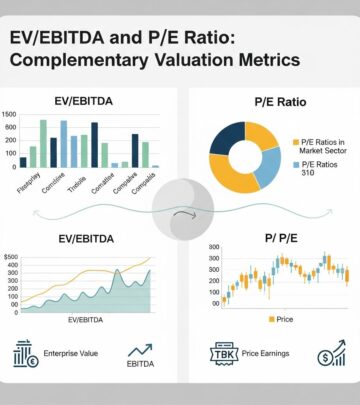
The Price-to-Earnings (P/E) ratio divides a company’s market capitalization by its net income. While both metrics are valuation tools, EV/EBITDA provides a more comprehensive view by considering the entire capital structure and removing the impact of taxes and financing decisions. P/E ratios are more affected by capital structure and tax rates, making them less suitable for comparing companies with different financing arrangements.
EV/EBITDA vs. Price-to-Sales Ratio
The Price-to-Sales (P/S) ratio divides market capitalization by total revenue. While P/S is useful when net income or EBITDA is negative or unreliable, it doesn’t account for profitability. EV/EBITDA provides better insight into operational efficiency and earning power.
EV/EBITDA vs. Free Cash Flow
Free Cash Flow (FCF) is often considered more reliable than EBITDA because it accounts for capital expenditures and working capital changes. However, EV/EBITDA is easier to calculate and is more standardized across industries, making it a practical tool for quick comparisons.
Industry Benchmarks and Typical Multiples
EV/EBITDA multiples vary significantly across industries due to differences in capital intensity, growth rates, and profitability. For context:
- Mature, stable industries like utilities or consumer staples typically trade at lower multiples (8-12x)
- Technology and high-growth sectors often command higher multiples (15-25x or more)
- Cyclical industries like manufacturing may have lower multiples (6-10x)
- Healthcare and defensive sectors typically fall in the middle range (12-20x)
Practical Applications of EV/EBITDA
Investment Analysis
Investors use EV/EBITDA to identify undervalued companies relative to their peers. By comparing a target company’s multiple to industry averages, investors can determine if a stock offers good value or if it appears overpriced.
Mergers and Acquisitions
In M&A transactions, EV/EBITDA multiples help establish fair purchase prices. Buyers use industry multiples to determine reasonable valuations for target companies, while sellers use them to justify asking prices.
Credit Analysis
Lenders and credit analysts use EV/EBITDA to assess leverage levels and repayment capacity. A company with a lower EV/EBITDA multiple relative to its debt levels may present less credit risk.
Performance Benchmarking
Companies compare their EV/EBITDA multiples to competitors to understand how the market perceives their performance relative to peers.
Calculating EV/EBITDA: Step-by-Step Example
Let’s walk through a practical example to solidify your understanding:
Assume Company ABC has the following financial data:
- Market Capitalization: $1 billion
- Total Debt: $300 million
- Cash and Equivalents: $100 million
- Net Income: $100 million
- Interest Expense: $15 million
- Taxes: $30 million
- Depreciation: $25 million
- Amortization: $10 million
Step 1: Calculate Enterprise Value
EV = $1,000 + $300 – $100 = $1,200 million
Step 2: Calculate EBITDA
EBITDA = $100 + $15 + $30 + $25 + $10 = $180 million
Step 3: Calculate EV/EBITDA
EV/EBITDA = $1,200 ÷ $180 = 6.67x
This means Company ABC is valued at approximately 6.67 times its EBITDA.
Key Considerations When Using EV/EBITDA
- Always compare multiples within the same industry for meaningful analysis
- Consider whether the company is in a growth phase or mature stage
- Analyze trends in multiples over time to identify valuation expansion or contraction
- Combine EV/EBITDA with other metrics for a comprehensive valuation analysis
- Understand the quality of earnings and potential one-time items affecting EBITDA
- Consider the company’s competitive position and market dynamics
Frequently Asked Questions
Q: What is a good EV/EBITDA ratio?
A: A good EV/EBITDA ratio depends on the industry and economic conditions. Generally, ratios between 10-15x are considered reasonable for stable, mature companies. However, high-growth companies may justify higher multiples (20x+), while declining or troubled companies may trade at lower multiples (5x or less).
Q: Can EV/EBITDA be negative?
A: Yes, EV/EBITDA can be negative if a company has negative EBITDA (operating losses). In such cases, the metric becomes less meaningful as a valuation tool. Investors should investigate the underlying reasons for losses and consider alternative metrics.
Q: Why is EV/EBITDA preferred over P/E ratio?
A: EV/EBITDA is often preferred because it accounts for differences in capital structure, taxes, and financing methods. It provides a more apples-to-apples comparison between companies, especially those with different debt levels or tax situations.
Q: How often should I check EV/EBITDA ratios?
A: EV/EBITDA should be reviewed quarterly when companies report earnings. This allows investors to track changes in valuation multiples and identify trends that might indicate shifting market sentiment.
Q: Is EBITDA the same as operating profit?
A: No. Operating profit (EBIT) excludes interest, taxes, depreciation, and amortization, but it includes operating expenses. EBITDA adds back depreciation and amortization, making it higher than operating profit.
Q: How do I find EV/EBITDA data for companies?
A: Most financial websites, including Yahoo Finance, Google Finance, and investment platforms like Bloomberg Terminal, provide EV/EBITDA ratios. You can also calculate it manually using financial statements from the company’s investor relations website or SEC filings.
References
- U.S. Securities and Exchange Commission (SEC) — Financial Reporting Standards — SEC. https://www.sec.gov/cgi-bin/browse-edgar
- Financial Accounting Standards Board (FASB) — GAAP Standards — FASB. https://www.fasb.org
- Damodaran, A. (2012). Investment Valuation: Tools and Techniques for Determining the Value of Any Asset — John Wiley & Sons. ISBN: 978-1118011522
- CFA Institute — Level I Curriculum: Financial Statement Analysis — CFA Institute. https://www.cfainstitute.org
- Palepu, K., Healy, P., & Peek, E. (2020). Business Analysis & Valuation: Using Financial Statements — Cengage Learning
Similar Articles








Read full bio of medha deb