Investment Vehicles: Understanding ETFs and Mutual Funds
Comprehensive comparison of ETF and mutual fund structures, costs, and suitability for different investment approaches.
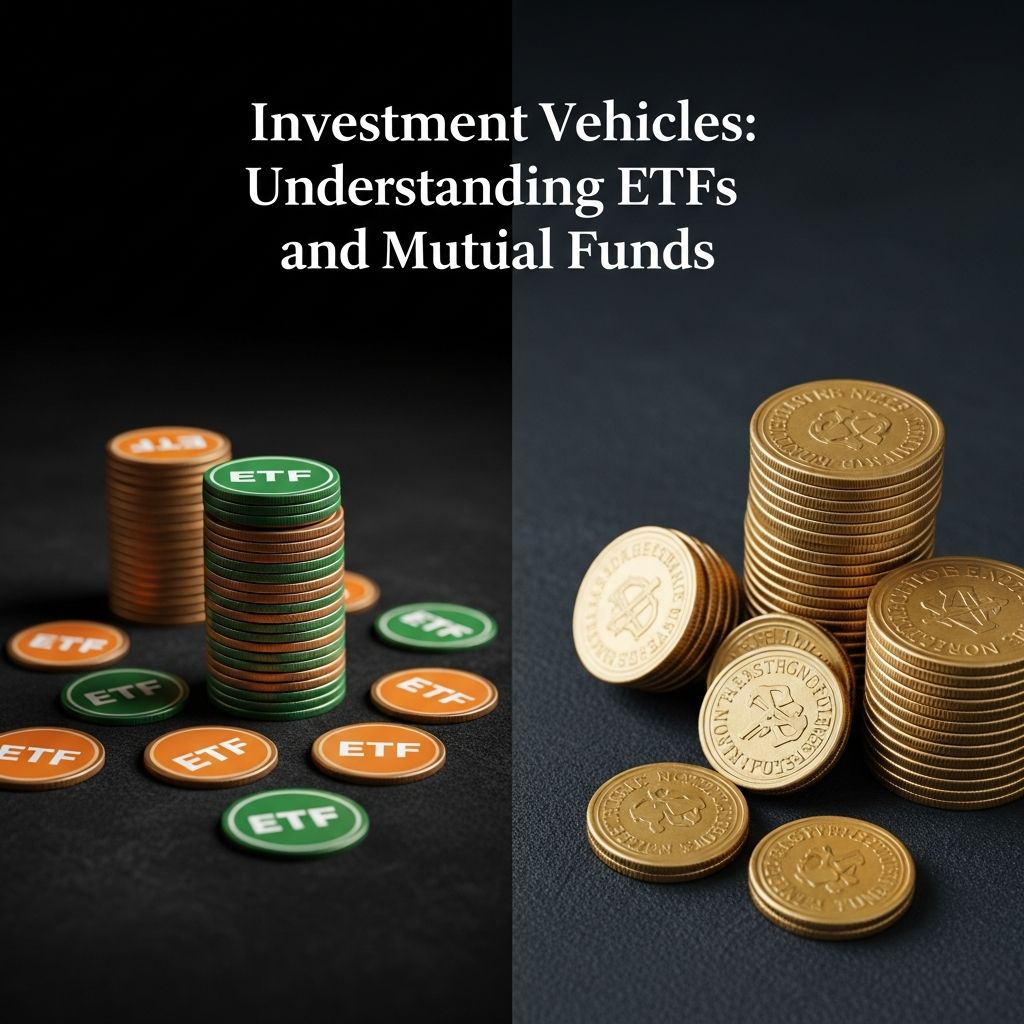
When building a diversified investment portfolio, investors typically encounter two primary vehicles for gaining broad market exposure: exchange-traded funds (ETFs) and mutual funds. Both serve as pooled investment structures that allow individuals to access professionally managed baskets of securities without purchasing individual stocks or bonds directly. Understanding the distinctions between these two options is essential for making informed decisions that align with your financial objectives, investment timeline, and trading preferences.
The Foundation: Similarities Between ETFs and Mutual Funds
Before examining their differences, it’s important to recognize that ETFs and mutual funds share several core characteristics that make them valuable investment tools for most investors.
Both structures function as managed collections of securities, allowing investors to gain exposure to diversified holdings through a single purchase. Whether you’re interested in tracking broad market indices like the S&P 500 or investing in specific sectors or asset classes, both ETFs and mutual funds offer comparable variety in their investment strategies.
Additionally, both can be structured as index funds that passively track market benchmarks or as actively managed funds where professional managers attempt to outperform specific market indices. This flexibility means that regardless of whether you prefer a hands-off approach or believe in the value of active management, both vehicle types can accommodate your philosophy.
Trading Mechanics and Market Access
One of the most significant operational differences between these investment vehicles relates to how and when you can buy and sell them. This distinction influences both the trading experience and the potential returns investors receive.
ETFs function like stocks. Once trading begins on the exchange, their prices fluctuate throughout the trading day based on real-time supply and demand. This means an ETF’s market price may trade at a premium (higher than the underlying asset value) or discount (lower than the underlying asset value) depending on investor demand. Investors benefit from the ability to execute trades immediately during market hours, use limit orders to specify entry or exit prices, and even employ more advanced strategies like short selling or buying on margin.
Mutual funds operate differently. They trade only once per day at their net asset value (NAV), which is calculated after the market closes. This means all orders placed during a single trading day execute at the same price, regardless of when during the day the investor submitted the order. This structure eliminates the possibility of trading at a premium or discount, as the price is always the true underlying value of the fund’s holdings.
Implications for Different Investor Types
- Active traders may prefer ETFs because of their intraday liquidity and the ability to use sophisticated trading strategies
- Buy-and-hold investors may find the single daily pricing of mutual funds sufficient for their needs
- Cost-conscious traders should consider that the ability to trade ETFs throughout the day doesn’t necessarily mean lower costs if frequent trading incurs commissions or bid-ask spreads
Initial Investment Requirements
The financial barriers to entry differ meaningfully between these two investment types, which can significantly impact accessibility for different investor profiles.
ETFs can be purchased at a remarkably low cost due to their stock-like trading structure. You can buy a single share of most ETFs for the price of that share—often ranging from $50 to $500 depending on the specific fund. This means an investor might begin an ETF position with just a few hundred dollars or sometimes less. Some ETF providers, including Vanguard, allow purchases for as little as $1.
Mutual funds typically establish flat dollar amount minimums for initial investments, which don’t correlate to the fund’s share price. Most traditional mutual funds require initial investments of $1,000 to $5,000, with some institutional or admiral-class shares requiring substantially higher minimums. However, once you’ve met the minimum, mutual funds allow investors to purchase fractional shares, enabling precise dollar-based investing without worrying about whole share prices.
For investors with smaller account balances or those just beginning their investment journey, the lower entry cost of ETFs provides a significant advantage. However, investors who participate in automatic investment programs—dollar-cost averaging strategies where fixed amounts are invested regularly—may find mutual funds more suitable, as most brokerages don’t yet offer automated ETF investment plans.
Tax Efficiency and Cost Structures
The tax implications of investing in ETFs versus mutual funds deserve careful consideration, particularly for taxable investment accounts where capital gains taxes can substantially reduce after-tax returns.
The Tax Efficiency Advantage of ETFs
ETFs generally demonstrate superior tax efficiency compared to mutual funds, though the extent of this advantage varies based on the fund’s management style.
The structural difference stems from how these funds handle investor transactions and securities sales. In a mutual fund, when investors redeem their shares, the fund manager must sell securities to raise cash to pay those redemptions. These sales can trigger capital gains that are distributed to all remaining shareholders, potentially creating tax liabilities even for investors who haven’t sold their shares and may actually have losses on their positions.
ETFs avoid this problem through their unique creation and redemption mechanism. When ETF shares are sold on the exchange, the transaction occurs between buyers and sellers in the secondary market—the fund company itself isn’t involved in selling securities. Additionally, ETFs can use in-kind redemption processes, where investors exchange fund shares directly for the underlying securities rather than receiving cash. This structural difference means ETFs rarely trigger capital gains distributions, allowing investors to control when they realize gains by determining when to sell their shares.
Expense Ratios and Management Fees
| Fund Type | Typical Expense Structure | Additional Considerations |
|---|---|---|
| Passive ETFs | Generally lowest among all options | Minimal trading activity keeps costs down |
| Passive Mutual Funds | Low but typically higher than passive ETFs | May involve operational inefficiencies from daily redemptions |
| Active ETFs | Higher than passive options but generally lower than comparable mutual funds | Structural efficiencies help maintain competitive pricing |
| Active Mutual Funds | Generally highest expense ratios | Must account for all investor transaction costs |
Both index-based mutual funds and index ETFs tend to offer lower expense ratios than actively managed funds, as lower turnover reduces trading costs. However, even among comparable investment strategies, ETFs typically maintain a cost advantage. This happens because ETFs’ structural design—where investor trading occurs outside the fund—means individual investor transaction costs don’t affect the fund’s expense ratio.
Portfolio Transparency and Information Access
Modern investors increasingly value the ability to monitor their holdings and understand their portfolio composition frequently. The transparency available through these different vehicles differs notably.
ETFs provide daily visibility into their current holdings, allowing investors to review exactly which securities comprise their investment and assess portfolio risk characteristics as they change. This transparency supports investors who want to actively manage their asset allocation or monitor potential overlap between different holdings.
While mutual funds disclose their holdings, this information is typically reported less frequently—quarterly or semi-annually in many cases—rather than daily. For passive investors with a long-term focus, this less frequent disclosure poses no practical disadvantage. However, investors who prioritize real-time knowledge of their investments may prefer ETFs’ greater transparency.
Strategic Advantages for Different Investor Profiles
When ETFs May Be the Better Choice
- Active traders: Investors who execute frequent trades benefit from intraday pricing, limit orders, and other sophisticated trading strategies available exclusively with ETFs
- Tax-conscious investors: Those in high tax brackets or with substantial taxable accounts gain significant advantage from ETFs’ superior tax efficiency
- Low-balance investors: Beginning investors or those with limited capital appreciate ETFs’ ability to start with minimal investment amounts
- Margin traders: Investors seeking leverage can use ETFs for margin purchases (though restrictions apply for 30 days after settlement)
- Cost-sensitive investors: Even among index funds, ETFs typically feature lower expense ratios
When Mutual Funds May Be Advantageous
- Dollar-cost averaging investors: Those committed to systematic investing through automatic monthly contributions benefit from mutual fund automation features not yet widely available for ETFs
- Fractional share buyers: Investors who want to invest specific dollar amounts rather than whole shares may prefer mutual funds’ flexibility
- Retirement account investors: Certain retirement plans, particularly 401(k) plans, more commonly feature mutual funds than ETFs, though this landscape is evolving
- Predictable pricing needs: Investors who want to avoid any possibility of premium or discount pricing prefer mutual funds’ NAV pricing
- Zero-load fund investors: Many mutual funds charge no sales loads, commissions, or transaction fees, making them cost-competitive with ETFs for buy-and-hold strategies
Investment Strategy Considerations
Both ETFs and mutual funds support a comprehensive range of investment approaches. You can construct a diversified portfolio using either vehicle by selecting funds that collectively cover your desired asset allocation across stocks, bonds, sectors, and geographic regions.
Index-tracking versions of both vehicle types provide broad market exposure at minimal cost, ideal for passive investors seeking to match market returns. Active management is available through both ETFs and mutual funds, though actively managed ETFs remain less numerous than actively managed mutual funds, and certain complex investment strategies are still more readily available through mutual fund structures.
Frequently Asked Questions
Can I use both ETFs and mutual funds in the same portfolio?
Absolutely. Many investors maintain a mixed approach, using ETFs for certain positions and mutual funds for others based on their specific characteristics and how they fit within the overall strategy. Some investors use mutual funds in retirement accounts and ETFs in taxable accounts to optimize for tax efficiency.
Do ETFs or mutual funds offer better diversification?
Both structures provide equivalent diversification benefits when you select comparable funds. A total market index ETF offers the same diversification as a total market index mutual fund. The diversification comes from the fund’s composition, not the vehicle type.
What happens to my mutual fund shares if I want to sell?
When you sell mutual fund shares, they are redeemed at the next calculated NAV, which occurs after the market closes. All sales executed during a single trading day occur at the same price.
Are ETFs suitable for retirement accounts?
While ETFs can be held in IRAs and other retirement accounts, they aren’t as commonly featured in employer-sponsored 401(k) plans unless the plan includes a self-directed brokerage window. Mutual funds remain more prevalent in retirement plans.
How do I choose between an ETF and mutual fund with identical underlying holdings?
Compare expense ratios, consider your trading frequency, evaluate tax implications for your account type, and assess whether you need intraday trading flexibility. For many investors, the tax efficiency of ETFs provides meaningful long-term value.
Conclusion: Making Your Selection
The choice between ETFs and mutual funds ultimately depends on your specific financial situation, investment goals, trading style, and account composition. ETFs excel for investors prioritizing tax efficiency, trading flexibility, and low entry costs. Mutual funds remain valuable for those using automated investing strategies, seeking specific complex investment approaches, or participating in retirement plans where they predominate.
Rather than viewing this as a binary choice, many investors find that a combination of both vehicles allows them to optimize their overall portfolio structure while accommodating their unique circumstances and preferences.
References
- Mutual funds vs. ETFs: Which is right for you? — Fidelity Investments. 2024. https://www.fidelity.com/viewpoints/investing-ideas/mutual-fund-or-etf
- ETFs vs. Mutual Funds: Which To Choose — Vanguard. 2024. https://investor.vanguard.com/investor-resources-education/etfs/etf-vs-mutual-fund
- Mutual funds vs. ETFs: Which is best for your investment strategy? — T. Rowe Price. 2024. https://www.troweprice.com/personal-investing/resources/insights/mutual-funds-vs-etfs-which-best-for-your-investment-strategy.html
- ETFs vs. Mutual Funds – What’s the Difference? — Charles Schwab. 2024. https://www.schwab.com/etfs/mutual-funds-vs-etfs
- The ETF vs. Mutual Fund Debate: Investment Strategy Matters — Dimensional. 2024. https://www.dimensional.com/us-en/insights/the-etf-versus-mutual-fund-debate-investment-strategy-matters
- ETF vs mutual fund: 9 strategic considerations for asset managers — VettaFi. 2024. https://www.vettafi.com/insights/enterprise-article-etf-vs-mutual-fund-9-strategic-considerations-for-asset-managers
Similar Articles








Read full bio of Sneha Tete