ETFs vs. Mutual Funds: Key Differences Explained
Understand the critical distinctions between ETFs and mutual funds to make informed investment decisions.
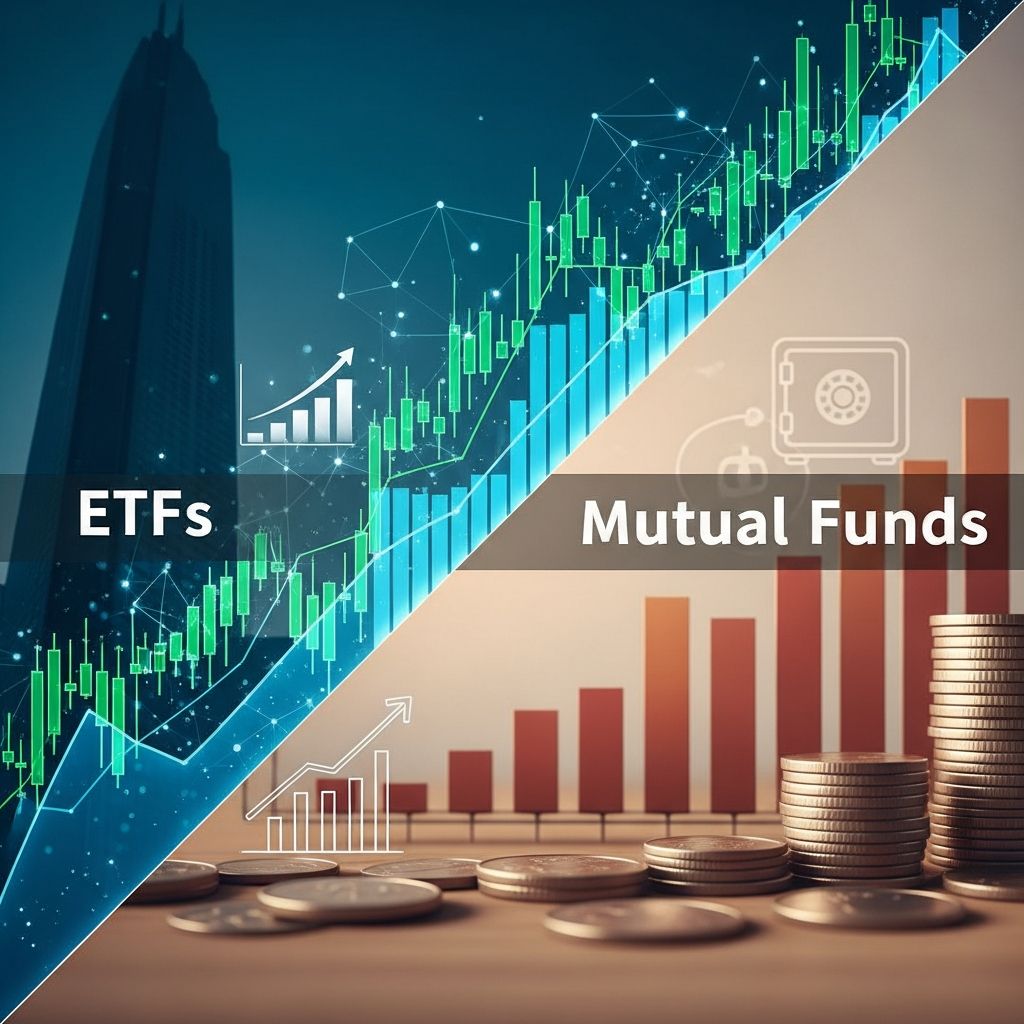
ETFs vs. Mutual Funds: Understanding the Key Differences
When it comes to investing, two of the most popular investment vehicles are exchange-traded funds (ETFs) and mutual funds. While both offer diversified portfolios and professional management options, they differ significantly in structure, trading mechanics, costs, and tax efficiency. Understanding these differences is crucial for investors seeking to optimize their investment strategy and align their portfolio with their financial goals.
Whether you are a novice investor just starting your investment journey or an experienced trader looking to diversify your holdings, comprehending the distinctions between ETFs and mutual funds can help you make more informed decisions about where to allocate your capital. This comprehensive guide explores the fundamental differences between these two investment vehicles and helps you determine which might be better suited to your individual circumstances.
What Are Exchange-Traded Funds (ETFs)?
An exchange-traded fund is an investment fund that trades on stock exchanges much like a stock. ETFs are designed to track specific indices, commodities, or a basket of assets. They combine the diversification benefits of mutual funds with the trading flexibility of individual stocks. Unlike mutual funds, ETFs can be bought and sold throughout the trading day at market prices that fluctuate based on supply and demand.
ETFs offer investors exposure to a wide range of assets without having to purchase each security individually. They can track broad market indices like the S&P 500, sector-specific indices, international markets, bonds, commodities, or alternative investments. The structure of ETFs allows them to provide transparent portfolio holdings and real-time pricing information.
What Are Mutual Funds?
A mutual fund is an investment pool that collects money from multiple investors to purchase a diversified portfolio of securities such as stocks, bonds, or other assets. Unlike ETFs, mutual funds are priced once per day after the market closes, and all trades execute at this single daily net asset value (NAV). Mutual funds can be actively managed, where professional fund managers make investment decisions, or passively managed to track an index.
Mutual funds have been a cornerstone of individual investor portfolios for decades, offering accessibility, professional management, and instant diversification. They can be purchased directly from fund companies, through brokerage firms, or via retirement accounts.
Key Differences Between ETFs and Mutual Funds
1. Trading and Pricing Mechanics
One of the most significant differences between ETFs and mutual funds lies in how they are traded and priced:
- ETFs: Trade continuously throughout the stock market day, similar to individual stocks. Prices fluctuate in real-time based on market supply and demand, allowing investors to buy or sell at any time during trading hours.
- Mutual Funds: Are priced once daily after the market closes at 4 PM ET. All buy and sell orders execute at this single net asset value price, regardless of when during the day the order was placed.
This distinction has important implications for investors. ETF traders can take advantage of intraday price movements, execute stop-loss orders, or use other trading strategies that require real-time pricing. Conversely, mutual fund investors benefit from simplified trading without worrying about timing their orders within market hours.
2. Expense Ratios and Costs
Expense ratios represent the annual cost of owning a fund expressed as a percentage of your investment. This is typically one of the most important factors in long-term investment returns:
- ETFs: Generally have lower expense ratios, particularly passive index-tracking ETFs. Annual expense ratios for broad market ETFs often range from 0.03% to 0.20% annually. The passive structure and efficient creation/redemption mechanism keep costs minimal.
- Mutual Funds: Tend to have higher expense ratios, especially actively managed funds. Actively managed mutual funds typically charge 0.50% to 2.00% or more annually, while passively managed mutual funds may have expense ratios closer to 0.10% to 0.50%.
Additionally, ETF trading may involve brokerage commissions, though many brokers now offer commission-free ETF trading. Mutual funds typically charge no trading commissions when purchased directly from the fund company, though they may include sales loads (upfront or back-end charges).
3. Tax Efficiency
Tax implications are a critical consideration for taxable investment accounts:
- ETFs: Are highly tax-efficient due to their unique creation/redemption structure. This mechanism allows ETFs to minimize capital gains distributions to shareholders. ETF shareholders typically experience fewer taxable events, making them particularly suitable for taxable accounts.
- Mutual Funds: Often generate capital gains distributions when the fund manager sells securities at a profit or when investors redeem their shares. These distributions are taxable events for shareholders, even if they reinvest the dividends. This can result in higher tax liability for fund holders.
The tax efficiency advantage of ETFs can be substantial over time, particularly for buy-and-hold investors in taxable accounts. Over decades, this tax advantage can significantly impact after-tax returns.
4. Minimum Investment Requirements
Investment minimums present another important distinction:
- ETFs: Typically require only the cost of a single share. Since ETF shares often trade between $20 and $200, the minimum investment is relatively accessible to most investors. Some brokers offer fractional share purchases, reducing the barrier even further.
- Mutual Funds: Often impose minimum initial investments ranging from $500 to $3,000 or more, though some funds offer lower minimums for retirement accounts or automatic investment plans. Some institutions may require $10,000 or higher minimums.
This difference makes ETFs more accessible to small investors or those just beginning their investment journey with limited capital.
5. Management Style and Flexibility
Both ETFs and mutual funds can be actively or passively managed, though each has characteristic tendencies:
- ETFs: Are predominantly index-based and passively managed, though the number of actively managed ETFs has grown in recent years. Passive ETFs replicate the performance of specific indices with minimal trading.
- Mutual Funds: Include both actively and passively managed options. Active mutual fund managers frequently trade securities attempting to outperform market benchmarks, resulting in higher turnover and potentially higher capital gains.
Detailed Comparison Table
| Feature | ETFs | Mutual Funds |
|---|---|---|
| Trading Method | Continuous during market hours | Once daily at closing price |
| Price Determination | Real-time, market-driven | Once daily (NAV) |
| Average Expense Ratio | 0.03% – 0.50% | 0.50% – 2.00% |
| Tax Efficiency | Highly tax-efficient | Less tax-efficient |
| Minimum Investment | Cost of one share | $500 – $3,000+ |
| Management Style | Mostly passive/indexed | Both active and passive |
| Trading Costs | May have commission (often free) | Usually no commission |
| Sales Loads | None | Up to 8.5% |
Advantages of ETFs
- Lower expense ratios reduce costs and improve long-term returns
- Superior tax efficiency minimizes capital gains distributions
- Trading flexibility with real-time pricing and intraday execution
- Lower minimum investments increase accessibility
- Transparent holdings updated regularly
- Wide variety of investment strategies and asset classes available
- No sales loads or front-end charges
Advantages of Mutual Funds
- Access to experienced active managers who attempt to beat market benchmarks
- Automatic reinvestment of dividends and capital gains
- Simplified purchasing directly from fund companies
- No need to monitor intraday price fluctuations
- Potential for higher returns through active management (though not guaranteed)
- Established track records spanning decades
- Educational resources and support from fund companies
Which Investment Vehicle Is Right for You?
Choosing between ETFs and mutual funds depends on your individual circumstances, investment goals, and preferences. Consider the following factors:
Choose ETFs if you: Are a cost-conscious investor prioritizing low fees, prefer tax efficiency for taxable accounts, want real-time trading flexibility, have limited capital to invest, prefer passive index-tracking strategies, or favor transparency in portfolio holdings.
Choose Mutual Funds if you: Prefer active management and believe skilled managers can outperform the market, prefer simplicity and automated investing, want to avoid monitoring market prices, have substantial capital and can meet minimum investment requirements, desire professional guidance and support, or prefer dividend and capital gains reinvestment handled automatically.
Hybrid Approach
Many sophisticated investors utilize both ETFs and mutual funds within their portfolio. A balanced approach might include index-tracking ETFs for core holdings, providing cost efficiency and tax benefits, combined with actively managed mutual funds for specific market segments or strategies where active management may add value. This hybrid approach allows investors to benefit from both the efficiency of passive index funds and the potential upside of active management.
Frequently Asked Questions
Q: Can I buy ETFs and mutual funds through the same broker?
A: Yes, most brokers offer both ETFs and mutual funds. Many brokers now provide commission-free trading for both investment types, though mutual fund offerings may be limited to certain fund families or no-load funds.
Q: Are ETFs safer than mutual funds?
A: Neither is inherently safer. Safety depends on the underlying investments, not the fund structure. Both ETFs and mutual funds can invest in conservative bonds or aggressive stocks. The risk profile depends on the specific holdings, not whether it’s packaged as an ETF or mutual fund.
Q: Can I lose money in ETFs or mutual funds?
A: Yes, both can decline in value. When the underlying securities held within the fund decrease in value, so does the fund’s value. However, diversification within these funds helps reduce individual security risk.
Q: How do I know which fund performs best?
A: Compare historical performance, but remember past performance doesn’t guarantee future results. Compare expense ratios, holdings, and management philosophy. Consider your personal investment goals and time horizon rather than chasing past performance.
Q: Can I hold ETFs and mutual funds in retirement accounts?
A: Yes, both can be held in IRAs, 401(k)s, and other retirement accounts. Within these accounts, the tax efficiency differences between ETFs and mutual funds diminish since the accounts themselves provide tax-deferral benefits.
Q: What is the difference between a stock ETF and a bond ETF?
A: The difference is based on underlying holdings, not on the ETF structure itself. Stock ETFs hold equity securities and typically offer growth potential with higher volatility, while bond ETFs hold fixed-income securities providing more stable income with lower volatility. Both can be structured as ETFs or mutual funds.
Conclusion
Both ETFs and mutual funds offer valid pathways to building a diversified investment portfolio. ETFs generally provide superior cost efficiency, tax advantages, and trading flexibility, making them ideal for cost-conscious investors seeking passive index exposure. Mutual funds, particularly those actively managed, appeal to investors who believe professional management can add value and who prefer simplified investing without monitoring daily price fluctuations.
The best choice ultimately depends on your individual circumstances, investment philosophy, and financial objectives. Many investors benefit from a blended approach utilizing both investment vehicles to optimize their overall portfolio. Regardless of which you choose, maintaining a long-term perspective, diversifying appropriately, and consistently investing toward your goals remain the most important factors in building wealth.
References
- Exchange-Traded Funds (ETFs) — U.S. Securities and Exchange Commission. 2024. https://www.sec.gov/investor/pubs/etfs.pdf
- Mutual Fund Investing — Financial Industry Regulatory Authority (FINRA). 2024. https://www.finra.org/investors/learn-to-invest/types-investments/mutual-funds
- Tax Implications of ETFs vs. Mutual Funds — Internal Revenue Service. 2024. https://www.irs.gov/taxtopics/tc409
- Understanding Expense Ratios and Fund Costs — FINRA. 2024. https://www.finra.org/investors/learn-to-invest/types-investments/mutual-funds/understanding-expense-ratios-and-fund-costs
- Guide to ETF Trading and Mechanics — Investor.gov (SEC). 2024. https://www.investor.gov/introduction-investing/investing-basics/investment-products/mutual-funds-and-etfs
Similar Articles








Read full bio of medha deb