ETF Splits: How Regular and Reverse ETF Splits Work
Master ETF splits: Learn how regular and reverse splits impact your investments and portfolio strategy.
Understanding ETF Splits: A Comprehensive Guide
Exchange-traded funds (ETFs) occasionally undergo splits, an action that can confuse investors who are unfamiliar with how these corporate events work. Whether you’re a seasoned investor or just beginning to build your portfolio, understanding ETF splits—both regular and reverse—is essential for making informed investment decisions. ETF splits don’t change the fundamental value of your investment, but they do alter the number of shares you own and the price per share, which can have implications for trading and liquidity.
What Is an ETF Split?
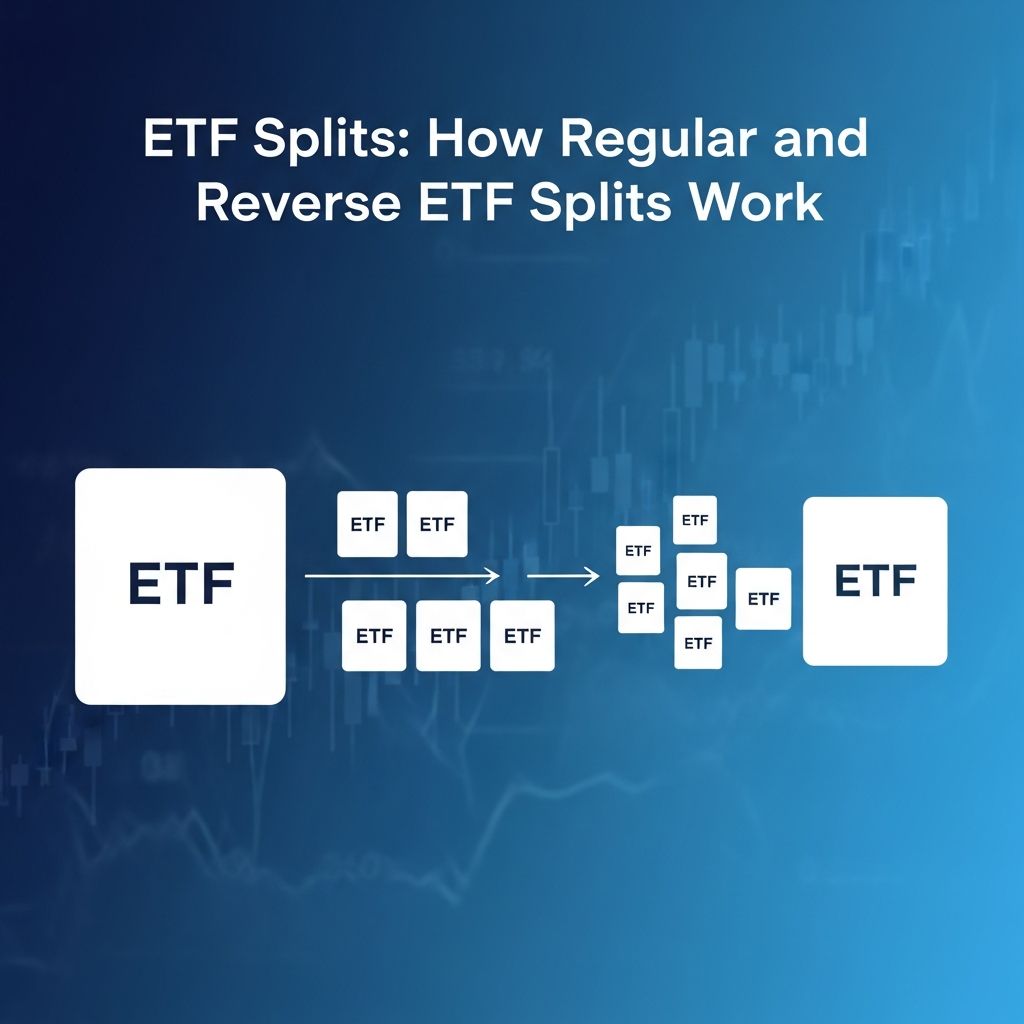
An ETF split occurs when the fund issuer divides the existing shares of the fund into a larger or smaller number of shares. The total value of your investment remains unchanged, but the number of shares you own and their individual prices adjust accordingly. Think of it like exchanging a ten-dollar bill for two five-dollar bills—the total value is the same, but you now have more individual units.
ETF splits come in two primary forms: regular splits and reverse splits. Each serves different purposes and is executed under different market conditions. Understanding the mechanics of both types helps investors anticipate potential effects on their portfolios and market conditions.
Regular ETF Splits Explained
A regular ETF split, also known as a forward split, occurs when an ETF issuer increases the number of shares outstanding while proportionally decreasing the share price. The most common ratios are 2:1 (splitting one share into two), 3:1 (splitting one share into three), or higher multiples.
Why Do ETF Issuers Execute Regular Splits?
ETF issuers typically execute regular splits when a fund’s share price becomes too high, making it appear less attractive to potential investors. For example, an ETF trading at $100 per share might feel expensive compared to a similar fund trading at $50 per share, even if the underlying performance is comparable. By executing a 2:1 split, the $100 share becomes two $50 shares, creating a more inviting entry point for retail investors.
The primary motivation behind regular splits is increasing competitiveness in the marketplace. A lower share price can attract new investors and boost trading volume, which enhances market liquidity. When an ETF has more liquidity, bid-ask spreads tighten, meaning the difference between what buyers are willing to pay and what sellers are asking decreases. This benefits all investors by reducing transaction costs.
The Mechanics of a Regular Split
Let’s illustrate with a concrete example. Suppose an investor owns 100 shares of an ETF trading at $99 per share. If the fund issuer announces a 3:1 regular split, the investor would receive 300 shares at approximately $33 per share post-split. The total value remains the same: 100 × $99 = $9,900 before the split, and 300 × $33 = $9,900 after the split.
WisdomTree executed several notable regular splits in 2017, affecting multiple funds including the U.S. MidCap Dividend Fund (DON), U.S. SmallCap Dividend Fund (DES), U.S. Earnings 500 Fund (EPS), and U.S. Total Earnings Fund (EXT). All these funds underwent 3:1 splits, creating more favorable price points for investors seeking exposure to these market segments.
Benefits of Regular Splits
Regular splits offer several advantages to both investors and fund issuers. First, they increase the attractiveness of the fund by presenting a lower per-share price. Second, they boost trading volume as investors lock in at more favorable price points. Third, the increased liquidity resulting from higher trading volume creates better market conditions with tighter spreads. These benefits, while sometimes temporary, can generate lasting positive sentiment toward the fund.
Reverse ETF Splits Explained
A reverse ETF split is the opposite of a regular split. In a reverse split, an ETF issuer decreases the number of shares outstanding while proportionally increasing the share price. Common reverse split ratios include 1:2 (combining two shares into one), 1:5 (combining five shares into one), or higher multiples like 1:10.
Why Do ETF Issuers Execute Reverse Splits?
Reverse splits occur when an ETF’s share price becomes too low, creating several problems for the fund and its investors. A declining share price can signal financial distress or poor performance to potential investors, deterring new capital inflows. Additionally, exchange listing rules often establish minimum price requirements. If an ETF’s share price drops below these thresholds, the fund risks delisting—being removed from the exchange entirely, which would severely impact trading and accessibility.
Beyond listing requirements, reverse splits serve other strategic purposes. Some ETF issuers use reverse splits to reduce the number of outstanding shares, potentially discouraging short-selling activity. In other cases, reverse splits help maintain the fund’s viability and prevent technical issues that arise when share prices fall too low.
The Mechanics of a Reverse Split
Here’s how a reverse split works in practice. If an investor owns 100 shares of an ETF trading at $10 per share and the fund executes a 1:2 reverse split, the investor would end up with 50 shares trading at $20 per share. Again, the total value remains constant: 100 × $10 = $1,000 before the split, and 50 × $20 = $1,000 after the split.
A more dramatic example involves an ETF with 500,000 shares trading at $25 each. After executing a 1:2 reverse split, the fund would have 250,000 shares trading at $50 per share. The market capitalization and total investor wealth remain unchanged, but the technical characteristics of the fund shift significantly.
Challenges of Reverse Splits
While reverse splits are sometimes necessary, they can present challenges in the short term. Reverse splits often widen the bid-ask spread, increasing the cost of trading the ETF. This occurs because liquidity temporarily decreases following the announcement of a reverse split, as market participants adjust to the new share price. Additionally, reverse splits can deter trading in the short term until investors acclimate to the new price structure.
Comparative Analysis: Regular vs. Reverse Splits
| Characteristic | Regular Split | Reverse Split |
|---|---|---|
| Share Price Direction | Decreases | Increases |
| Number of Shares | Increases | Decreases |
| Primary Motivation | Attract investors, boost competitiveness | Meet minimum price requirements, prevent delisting |
| Impact on Liquidity | Generally increases liquidity | May temporarily decrease liquidity |
| Bid-Ask Spread Effect | Typically tightens spreads | May widen spreads initially |
| Investor Perception | Generally positive | Can be perceived negatively |
How Frequently Do ETF Splits Occur?
ETF splits and reverse splits are not common occurrences, but they’re far from rare. While comprehensive historical data on all ETF splits is limited, certain issuers regularly execute them. Direxion, for instance, has announced dozens of splits in recent years, particularly among its leveraged and volatility-based products.
Leveraged and volatility ETFs experience splits and reverse splits more frequently than traditional ETFs. This higher frequency occurs because these specialized products can experience dramatic price movements. For example, during the explosive rally in the CBOE VIX Volatility Index in February 2018, inverse volatility products suffered massive declines. ProShares, a leading provider of volatility ETFs, was compelled to implement reverse splits of 1:4 on products like ProShares Short VIX Short-Term Futures (SVXY) and ProShares Ultra VIX Short-Term Futures (UVXY).
Additionally, the iShares MSCI Singapore ETF (EWS) executed a notable reverse split, climbing from $10 to $20 in November 2017. Direxion also executed reverse splits on multiple bearish 3X leveraged products, including Direxion Daily Technology Bear 3X Shares (TECS), Direxion Daily Energy Bear 3X Shares (ERY), Direxion Daily Emerging Markets Bear 3X Shares (EDZ), Direxion Daily S&P Biotech Bear 3x Shares (LABD), and Direxion Daily China 3x Bear Shares (YANG), with reverse split ratios varying between 1:5 and 1:10.
What Investors Need to Know About ETF Splits
Impact on Your Investment Value
The most important thing to understand is that neither regular nor reverse splits change the fundamental value of your investment. Your total wealth remains the same before and after the split. If you invested $1,000 in an ETF, that $1,000 value remains intact regardless of how many times the fund splits.
Automatic Adjustment
ETF splits are handled automatically by your brokerage firm. You don’t need to take any action. The number of shares in your account will adjust automatically on the split effective date, and your brokerage will update the share price to reflect the new split ratio.
Tax Implications
For tax purposes, ETF splits are generally non-taxable events. Your cost basis adjusts proportionally to reflect the split, so you won’t face unexpected tax bills due to a split or reverse split. However, it’s prudent to verify this with your tax advisor or review your brokerage’s guidance on specific splits.
Notification and Timing
ETF issuers announce splits well in advance, typically providing investors with several weeks’ notice before the split becomes effective. This advance notice allows investors to understand what’s happening and adjust their portfolios if desired. Announcements include the exact split ratio, the ex-date (the date on which the split adjustment occurs), and any other relevant details.
Strategic Considerations for Investors
While splits don’t directly change your investment value, they can have indirect effects worth considering. A regular split that increases liquidity and tightens spreads can reduce your transaction costs if you sell the ETF. Conversely, a reverse split that temporarily widens spreads might increase costs if you need to exit the position quickly.
For long-term buy-and-hold investors, splits are typically inconsequential beyond the technical adjustments. However, active traders and those considering selling in the near term should pay attention to how splits affect bid-ask spreads and overall trading volume.
Real-World Examples of ETF Splits
The WisdomTree splits of 2017 provide an excellent illustration of how regular splits work in practice. These funds all underwent 3:1 splits, creating more accessible entry points for retail investors. The splits contributed to improved trading dynamics and potentially attracted new capital to these dividend-focused funds.
On the reverse split side, the volatility ETF examples demonstrate how extreme market conditions necessitate immediate action. When inverse volatility products collapsed during the VIX spike, reverse splits were essential to prevent delisting and maintain market integrity. Similarly, the Singapore ETF and Direxion bear products show how reverse splits are used across different market conditions and asset classes.
Frequently Asked Questions About ETF Splits
Q: Do I lose money when an ETF reverse splits?
A: No. Your total investment value remains the same. While the number of shares decreases and the per-share price increases, the mathematical result is identical to your starting position.
Q: Will a regular split increase my investment returns?
A: Not directly. A regular split won’t change the fund’s underlying performance or your returns. However, by increasing liquidity and reducing trading costs, it could have minor positive indirect effects on future trading expenses.
Q: How much advance notice do investors typically receive before a split?
A: ETF issuers typically announce splits several weeks in advance, providing sufficient time for investors to understand the change and plan accordingly.
Q: Are there tax consequences to ETF splits?
A: Generally, no. ETF splits are non-taxable events, and your cost basis adjusts proportionally. However, consult your tax advisor for specific guidance on your situation.
Q: Do all ETFs split regularly?
A: No. Most ETFs never undergo splits. Splits are most common among leveraged ETFs, volatility products, and funds that experience significant price appreciation or depreciation.
Q: Should I sell an ETF before it splits?
A: There’s no investment advantage to selling before a split. The split doesn’t change your investment value or the fund’s fundamentals. Make selling decisions based on your overall investment strategy, not the timing of a split.
Conclusion
ETF splits—both regular and reverse—are technical corporate events that require investor understanding but shouldn’t drive panic or hasty decisions. Regular splits aim to increase competitiveness and liquidity by making funds more attractive to new investors. Reverse splits address problems like low share prices and delisting risks. In both cases, your total investment value remains unchanged. By understanding how these splits work, staying informed through advance notifications, and recognizing that splits are automatic adjustments handled by your broker, you can approach ETF splits with confidence and maintain focus on your long-term investment objectives.
References
- Stock Splits Explained — Charles Schwab. 2025. https://www.schwab.com/learn/story/stock-splits-explained
- How Do Regular and Reverse ETF Splits Work? — ETF Database. 2025. https://etfdb.com/etf-education/how-do-regular-and-reverse-etf-splits-work/
- Understanding ETF Distributions and Types of NAV Fluctuations — Kurv Invest. 2025. https://www.kurvinvest.com/resources/understanding-distributions-and-nav-fluctuations
- 10 Things You Should Know About Stock Splits — Hartford Funds. 2025. https://www.hartfordfunds.com/practice-management/client-conversations/investing-for-growth/10-things-you-should-know-about-stock-splits.html
- Division of shares for an ETF (Split) — justETF. 2025. https://www.justetf.com/en/tutorial/transactions/division-of-shares-for-an-etf.html
Similar Articles








Read full bio of medha deb