Estimated Ultimate Recovery (EUR): Oil & Gas Definition
Understanding EUR: The key metric for evaluating oil and gas reserves and project profitability.
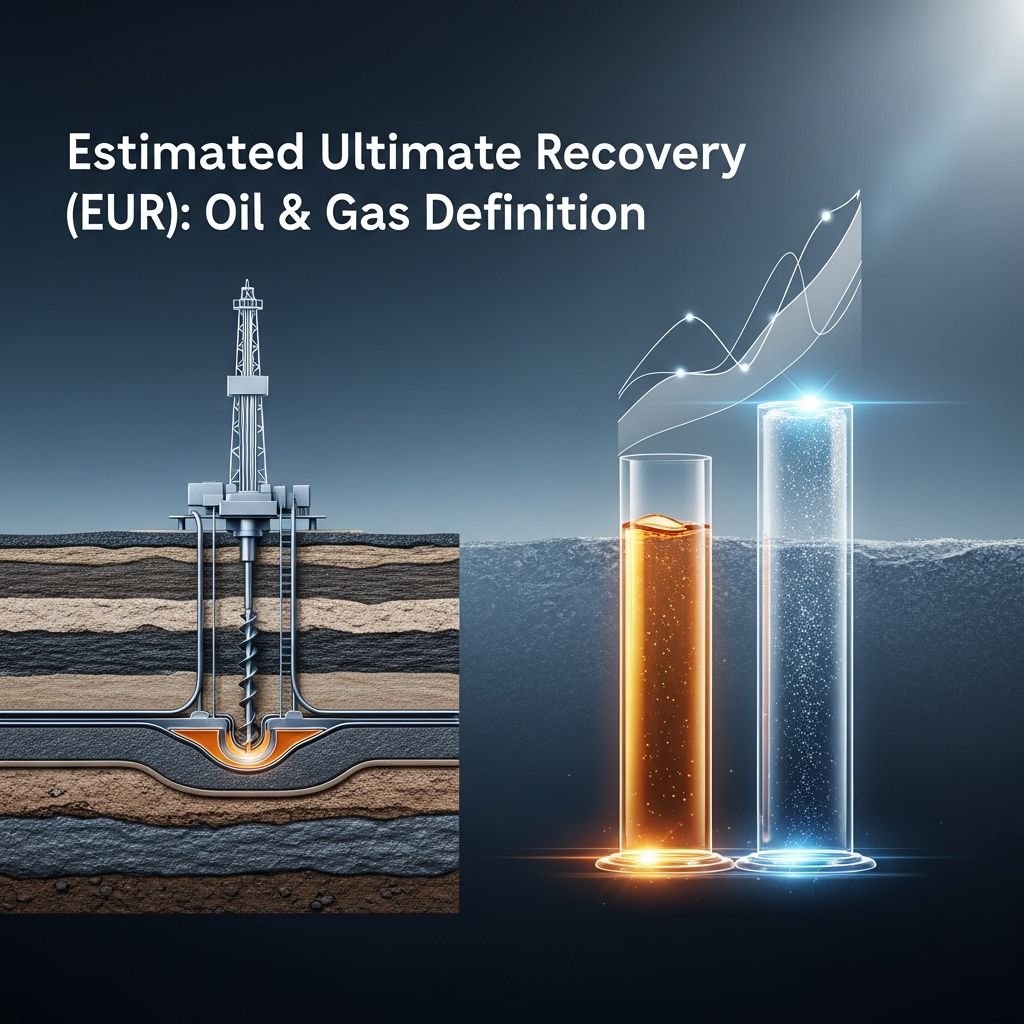
Understanding Estimated Ultimate Recovery (EUR)
Estimated Ultimate Recovery, commonly abbreviated as EUR, is a fundamental concept in the oil and gas industry that represents the total quantity of oil or gas expected to be economically recoverable from a reserve, field, or individual well over its entire productive lifetime. This metric serves as a critical tool for evaluating the economic viability and profitability of petroleum projects, making it essential for exploration companies, investors, and financial analysts seeking to assess the true value of hydrocarbon assets.
EUR is more than just a technical measurement; it functions as a cornerstone metric for investment decision-making. By estimating the total recoverable volume of hydrocarbons from a given asset, companies and investors can determine whether a project will generate sufficient returns to justify the capital investment required for development and production. This makes EUR calculations vital to the financial planning and asset valuation processes throughout the oil and gas industry.
What Is Estimated Ultimate Recovery?
Estimated Ultimate Recovery refers specifically to the total amount of oil and gas that can ultimately be extracted from a reservoir using current technology and under economic conditions that make the extraction financially viable. Unlike simple estimates of in-place reserves, EUR focuses on what can actually be recovered and sold profitably, taking into account extraction technology, infrastructure capabilities, and market prices.
The concept acknowledges a fundamental reality of petroleum engineering: not all hydrocarbons present in a reservoir can be economically recovered. Recovery rates vary significantly based on reservoir characteristics, well design, production technology, and commodity prices. EUR provides a realistic assessment of productive potential by accounting for these variables.
EUR is sometimes compared to the Net Present Value (NPV) metric, as both serve to determine the economic feasibility and profitability of petroleum projects. However, while NPV represents the discounted value of all future cash flows, EUR specifically quantifies the physical volume of hydrocarbons expected to be recovered, providing the foundation upon which NPV calculations are built.
How EUR Is Calculated
Calculating Estimated Ultimate Recovery involves a sophisticated analysis combining historical production data, geological and reservoir characteristics, and recovery technology capabilities. The calculation process typically requires a minimum of several months of production data from existing wells to ensure accuracy and avoid compromising the integrity of estimates.
The EUR calculation incorporates several key parameters and data sources. These include:
- Historical production volumes and rates from comparable wells or fields
- Reservoir characteristics such as permeability, porosity, and pressure conditions
- Production costs and capital expenditures required for extraction
- Oil and gas prices that determine economic viability
- Extraction technology specifications and recovery methods
- Infrastructure capabilities for transportation and processing
Professionals typically employ simulation models and statistical methods to process this data and generate EUR estimates. These sophisticated analytical approaches help account for uncertainty and provide ranges of possible recovery scenarios. The primary source of production data in the United States comes from the IHS Production Database maintained by the IHS Energy Group, which stores comprehensive monthly oil and gas production data on a lease-by-lease basis. State and governmental sources also provide supplementary production data that contributes to more accurate EUR calculations.
Categories of Reserves Within EUR
The EUR framework divides total recoverable resources into three distinct categories, each reflecting different levels of confidence in the recoverability of oil and gas using current technology and infrastructure. These classifications provide investors and analysts with a clearer picture of resource reliability:
Proven Reserves represent hydrocarbons where there is a 90% or greater probability of recovery using existing technology under current economic conditions. These represent the highest-confidence resource category and are typically supported by actual production history or well-established geological and engineering data.
Probable Reserves indicate resources where recovery probability falls between 50% and 90%. These reserves are identified through geological data and engineering analysis but lack the extensive production history or certainty of proven reserves. They represent resources likely to be recovered but subject to greater technical or commercial uncertainty.
Possible Reserves consist of hydrocarbons with less than 50% probability of recovery. These resources are speculative and depend on more significant technological advances, favorable price movements, or improved infrastructure to become economically viable. While possible reserves contribute to total resource potential, they carry substantial uncertainty regarding actual recovery.
A unique aspect of these reserve categories is their dynamic nature. Over time, with additional production data, technological improvements, and changing economic conditions, reserves can be reclassified from lower to higher confidence categories, effectively increasing a company’s proven resource base.
Factors That Influence EUR Values
Estimated Ultimate Recovery is not a static figure but rather a dynamic metric that changes as various operational and market factors evolve. Understanding these influencing factors is crucial for investors monitoring reserve valuations and companies updating their resource assessments.
Technological Advancements represent one of the most significant drivers of EUR changes. Innovations in extraction, completion, and production optimization techniques can substantially increase the percentage of hydrocarbons recoverable from a given reservoir. Enhanced oil recovery methods, improved drilling technologies, and advanced reservoir management can all contribute to higher EUR estimates over time.
Commodity Price Fluctuations directly impact EUR calculations by determining the economic viability of extraction projects. When oil and gas prices rise, reserves that were previously uneconomical become profitable, effectively increasing the EUR estimate. Conversely, price declines can render marginal production uneconomical, reducing EUR figures. This price sensitivity explains why EUR estimates typically change following significant commodity market movements.
Infrastructure Improvements enhance transportation capabilities, processing capacity, and market access, making production from previously marginal wells economically viable. New pipeline construction, expanded processing facilities, or improved access to high-value markets can substantially increase EUR estimates by improving project economics.
Production Technology Changes in drilling, completion, and artificial lift methods can enhance recovery rates and extend well productive lives. Advancements in horizontal drilling, multi-stage fracturing, and enhanced completions have particularly enabled significant EUR increases in unconventional reservoirs.
Time Duration allows accumulation of additional production data, reducing estimation uncertainty and often leading to EUR revisions. As wells produce over longer periods, engineers gain better understanding of actual reservoir performance and recovery potential.
Financial Impact and Application
Estimated Ultimate Recovery carries profound implications for how oil and gas companies value their assets and communicate with investors. EUR directly impacts several critical financial metrics and corporate decision-making processes.
EUR estimates influence asset valuation by determining the productive lifespan and revenue-generating potential of petroleum properties. Higher EUR estimates typically correlate with higher asset values, assuming stable commodity prices and production costs. This valuation impact is why EUR revisions frequently move stock prices and affect acquisition valuations in the industry.
Depreciation schedules for oil and gas properties often incorporate EUR estimates through unit-of-production depreciation methods. These methods allocate the depreciable value of assets based on the proportion of reserves produced relative to total EUR, ensuring that asset book values decline proportionally with resource depletion.
Future revenue projections for both individual wells and entire portfolios depend fundamentally on EUR estimates. Cash flow forecasts, discounted cash flow valuations, and reserve-based lending decisions all rely on these recovery estimates to project future production volumes and associated revenue streams.
EUR figures are typically disclosed in financial statements, 10-K regulatory filings, and investor presentations to provide transparency regarding a company’s resource base and future earning potential. These disclosures allow investors and creditors to assess the sustainability of production rates, the adequacy of reserve replacement, and the long-term viability of the company’s cash generation capabilities.
EUR in Investment Analysis
For investors and analysts, EUR serves as a fundamental metric for evaluating oil and gas projects and companies. By understanding the total recoverable resources from a given asset, professionals can calculate returns, compare investment opportunities, and assess whether exploration and drilling projects merit capital allocation.
EUR enables the calculation of key investment metrics including cost per barrel of oil equivalent, finding and development costs, and lifecycle profitability. These metrics provide standardized frameworks for comparing diverse petroleum properties and assessing management’s capital allocation efficiency.
Reserve-based lending institutions utilize EUR estimates as primary determinants of lending capacity, as the reserve base secures the loan. Larger, more certain EUR estimates support larger loan balances, providing important financing capacity for capital-intensive petroleum companies.
Frequently Asked Questions
What is the primary purpose of calculating EUR in the oil and gas industry?
The primary purpose of EUR calculation is to assess the economic feasibility and profitability of oil and gas projects. By estimating total recoverable volumes, companies determine whether a project will generate adequate returns to justify development and production investment.
How many months of production data are required for an accurate EUR estimate?
EUR calculations typically require a minimum of several months of production data to ensure estimation accuracy and maintain the integrity of the approximation. This timeframe allows engineers to identify production trends and reservoir behavior patterns necessary for reliable forecasting.
Can EUR estimates change over time?
Yes, EUR estimates are dynamic and frequently change over time in response to technological advancements, commodity price movements, infrastructure improvements, and accumulating production data. These changes can result in reserve reclassifications from lower to higher confidence categories.
What is the relationship between EUR and Net Present Value?
EUR provides the physical volume estimate of recoverable hydrocarbons that serves as the foundation for NPV calculations. While EUR quantifies recovery volumes, NPV translates these volumes into discounted cash flows to assess project financial viability.
Why do higher oil prices typically increase EUR estimates?
Higher oil prices increase the economic threshold at which marginal production becomes profitable. Reserves that were previously uneconomical become viable at higher price points, thereby increasing the total economically recoverable volume and raising EUR estimates.
Which reserve category carries the highest confidence level?
Proven reserves carry the highest confidence level, with a 90% or greater probability of recovery. These reserves are supported by extensive production history and established geological and engineering data.
References
- Estimated Ultimate Recovery (EUR) — Enverus. 2025. https://www.enverus.com/glossary/estimated-ultimate-recovery-eur/
- Estimated Ultimate Recovery (EUR) — Corporate Finance Institute. 2025. https://corporatefinanceinstitute.com/resources/valuation/estimated-ultimate-recovery-eur/
- What is EUR (Estimated Ultimate Recovery)? — Novi Labs. 2025. https://novilabs.com/glossary/eur-estimated-ultimate-recovery/
- What is Estimated Ultimate Recovery? — YouTube. January 13, 2024. https://www.youtube.com/watch?v=ZILXuqsaIPQ
Similar Articles








Read full bio of medha deb