Essential Bankruptcy Facts
Discover critical insights into U.S. bankruptcy laws, types, processes, and long-term impacts to make informed financial decisions.

Bankruptcy serves as a federal legal mechanism enabling individuals and businesses overwhelmed by debt to seek relief and restructure their finances under court supervision. Governed by Title 11 of the United States Code, it balances debtor protection with creditor rights through structured chapters tailored to different needs.
Understanding the Core Purpose of Bankruptcy
The primary aim of bankruptcy is to provide a fresh financial start by discharging unmanageable debts while ensuring equitable asset distribution to creditors. Upon filing, an automatic stay immediately halts most collection actions, such as lawsuits, foreclosures, repossessions, and wage garnishments, offering immediate breathing room. This process creates a bankruptcy estate encompassing all the debtor’s legal and equitable interests in property as of the filing date.
United States bankruptcy judges oversee cases, deciding eligibility, discharges, and disputes, while trustees handle administrative duties like asset management and plan oversight. The system promotes fairness by requiring detailed schedules of assets, liabilities, income, and expenses to inform creditors and the court.
Major Types of Bankruptcy Filings
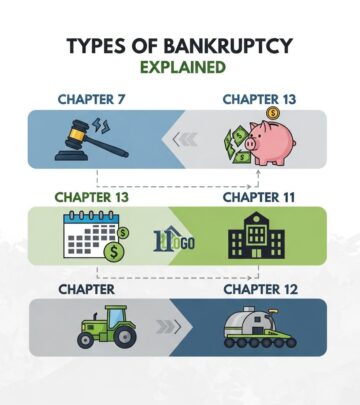
U.S. bankruptcy law outlines several chapters, each suited to specific debtors and situations. The most common for individuals are Chapters 7 and 13, while businesses often use Chapter 11.
- Chapter 7: Liquidation Bankruptcy – Involves liquidating non-exempt assets to pay creditors, with remaining eligible debts discharged. Ideal for low-income debtors with few assets.
- Chapter 13: Wage-Earner Reorganization – Allows debtors with regular income to repay debts over 3-5 years via a court-approved plan, keeping assets.
- Chapter 11: Business Reorganization – Enables businesses (and some individuals) to restructure debts while continuing operations, often resulting in a confirmed repayment plan.
- Chapter 12: Family Farmer/Fisherman Adjustment – Specialized for family farmers or fishermen to reorganize debts and sustain operations.
Chapter 7 Bankruptcy in Depth
Chapter 7, known as liquidation bankruptcy, provides swift debt relief by selling non-exempt property through a court-appointed trustee. Most consumer cases involve minimal liquidation due to generous exemptions, allowing debtors to retain essentials like clothing, household goods, and limited equity in homes or vehicles—exemptions vary by state.
To qualify, debtors undergo a means test, comparing income to state medians and accounting for expenses. Failure converts the case to Chapter 13 or dismissal, preventing system abuse. The process typically spans 4-6 months, culminating in discharge of unsecured debts like credit cards and medical bills, excluding student loans, child support, and recent taxes.
| Aspect | Chapter 7 Details |
|---|---|
| Duration | 4-6 months |
| Eligibility | Pass means test; limited assets |
| Outcome | Asset liquidation; debt discharge |
| Best For | Low-income, few assets |
Navigating Chapter 13 Reorganization
Chapter 13 suits wage earners unable to pass the means test but with steady income. Debtors propose a repayment plan repaying priority and secured debts fully, with unsecured portions partially over 3-5 years. The plan must be feasible based on disposable income.
Trustees distribute payments, and upon completion, remaining debts discharge. This chapter protects assets like homes from foreclosure by curing arrears through the plan. Eligibility caps unsecured debt at roughly $465,275 and secured at $1,395,875 (adjusted periodically).
| Aspect | Chapter 13 Details |
|---|---|
| Duration | 3-5 years |
| Eligibility | Regular income; debt limits |
| Outcome | Repayment plan; discharge |
| Best For | Asset owners with income |
Chapter 11 for Complex Reorganizations
Primarily for businesses, Chapter 11 allows reorganization without halting operations. Debtors file a petition, propose a plan detailing debt repayment—often reducing principal or extending terms—and seek creditor and court approval.
Individuals with high debts exceeding Chapter 13 limits may also qualify. The process involves creditor committees negotiating terms, aiming for a viable post-bankruptcy entity. Consolidation periods help reject unprofitable contracts and recover assets.
Step-by-Step Bankruptcy Process
- Pre-Filing Counseling: Mandatory credit counseling from approved agencies within 180 days before filing.
- Filing Petition: Submit forms to bankruptcy court, triggering automatic stay.
- Trustee Appointment: Oversees case; 341 meeting with creditors reviews finances.
- Plan Development (Ch. 13/11): Propose and confirm repayment plan.
- Asset Handling: Liquidation in Ch. 7; retention in others.
- Discharge: Court order releases debtor from liability.
Debts Affected and Exemptions
Not all debts discharge; non-dischargeable include alimony, child support, student loans, and fraud-related obligations. Exemptions shield necessities—federal or state lists apply, covering retirement accounts, tools of trade, and homestead equity.
- Priority debts (taxes, support) paid first.
- Secured debts (mortgages) handled via reaffirmation or surrender.
- Unsecured (cards) often discharged.
Credit and Financial Aftermath
Bankruptcy notations remain on credit reports: 10 years for Chapter 7, 7 years for Chapter 13. Scores drop significantly initially but improve with responsible habits. Post-discharge, secured credit rebuilds slowly; secured cards aid unsecured rebuilding.
Employers and landlords may check reports, but protections limit discrimination. Housing challenges persist 2-4 years for mortgages.
Alternatives to Consider Before Filing
Debt settlement, consolidation, or counseling may suffice without bankruptcy’s permanence. Nonprofit agencies offer plans averaging lower interest.
Frequently Asked Questions (FAQs)
Can I file bankruptcy without a lawyer?
Possible but risky; attorneys navigate complexities, boosting success rates.
How soon after bankruptcy can I buy a home?
2-4 years with good payment history.
Does bankruptcy stop eviction?
Temporarily via automatic stay; cure arrears in plan.
Will bankruptcy affect my job?
Rarely; federal law protects most.
Can spouses file separately?
Yes, but joint filing often better.
Strategies for Rebuilding Post-Bankruptcy
Obtain secured credit cards, pay bills promptly, track scores, save emergently. Time heals reports; focus on habits yields recovery within years.
References
- Chapter 11 bankruptcy | Wex | US Law | LII / Legal Information Institute — Cornell Law School. Accessed 2026. https://www.law.cornell.edu/wex/chapter_11_bankruptcy
- Overview Of Bankruptcy Chapters — U.S. Department of Justice. Accessed 2026. https://www.justice.gov/ust/bankruptcy-fact-sheets/overview-bankruptcy-chapters
- Bankruptcy: How It Works, Types and Consequences — Experian. Accessed 2026. https://www.experian.com/blogs/ask-experian/credit-education/bankruptcy-how-it-works-types-and-consequences/
- Process – Bankruptcy Basics — United States Courts. Accessed 2026. https://www.uscourts.gov/court-programs/bankruptcy/bankruptcy-basics/process-bankruptcy-basics
- Bankruptcy Basics — United States Courts. Accessed 2026. https://www.uscourts.gov/court-programs/bankruptcy/bankruptcy-basics
Similar Articles








Read full bio of Sneha Tete