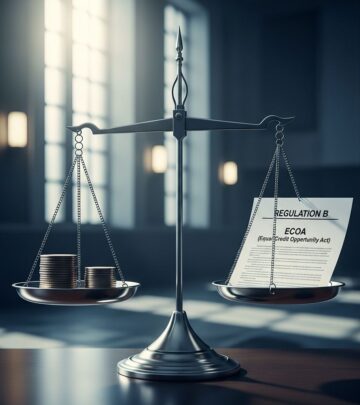
Equal Credit Opportunity Act: What Borrowers Need To Know
Discover how the Equal Credit Opportunity Act safeguards your right to fair lending and combats discrimination in credit decisions.

The
Equal Credit Opportunity Act (ECOA)
stands as a foundational federal law ensuring that credit access remains free from discriminatory practices. Enacted to promote fairness in lending, it prohibits creditors from denying loans or imposing unfavorable terms based on protected characteristics.Historical Foundations of Fair Lending
Before the 1970s, lending practices often favored certain demographics, leaving women and minorities at a disadvantage. Banks frequently dismissed women’s income contributions, particularly if they were married or of childbearing age, and single women faced higher denial rates. This systemic bias prompted legislative action.
Congress passed ECOA in October 1974 as Title VII of the Consumer Credit Protection Act, initially targeting discrimination by sex and marital status. By March 1976, amendments broadened its scope to include race, color, religion, national origin, age, public assistance receipt, and rights exercised under consumer protection laws.
Core Protections Under ECOA
ECOA applies to all credit extensions, including mortgages, auto loans, credit cards, student loans, and business financing. Creditors cannot discriminate in any aspect of the process—from application to terms offered.
Protected categories include:
- Race and color: No denials or worse terms due to racial background.
- Religion: Faith cannot influence credit decisions.
- National origin: Ancestry or birthplace is irrelevant.
- Sex and marital status: Gender or relationship status must not affect outcomes.
- Age: Provided the applicant can legally contract, age over 18 is protected (older applicants safeguarded unless creditworthiness justifies).
- Public assistance: Income from programs like SNAP, SSDI, or Social Security cannot be a basis for denial.
- Consumer rights exercise: Invoking protections under related laws is shielded.
Key Requirements for Creditors
Regulation B, issued by the Consumer Financial Protection Bureau (CFPB), operationalizes ECOA with detailed rules. Creditors must furnish clear notifications.
| Decision Type | Creditor Obligation |
|---|---|
| Denial | Written notice with specific reasons (e.g., low income, poor history) within 30 days. |
| Approval | Disclosure of terms like interest rates and fees for informed consent. |
| Counteroffer | Explanation if better terms were available to others. |
| Incomplete Application | Notice of needed information within 30 days. |
Prohibited actions encompass:
- Assuming a spouse’s signature unless jointly applying or state law mandates.
- Discounting public assistance or part-time income without business justification.
- Inquiring about childbearing plans or family status.
- Offering disparate terms without credit-based rationale.
Scope of Coverage: Who and What Qualifies
ECOA covers ”creditors”—any entity regularly extending credit, arranging it, or participating in decisions. This includes banks, credit unions, finance companies, retailers, and even some non-profits.
”Credit” broadly means deferring debt payment for purchases or services. Exemptions are narrow, like one-off transactions under $25,000 for agriculture if not tracked by race/sex.
Enforcement Mechanisms and Oversight
The Department of Justice (DOJ) handles pattern-or-practice cases, filing annual reports like the 2023 edition. Individuals report to regulating agencies:
- Banks: Office of the Comptroller of the Currency (OCC).
- Credit unions: National Credit Union Administration.
- Others: CFPB, FTC, or Federal Reserve.
CFPB enforces via Regulation B, including appraisal disclosures for home loans post-Dodd-Frank. Penalties range from cease-and-desist orders to damages.
Consumer Empowerment Strategies
Applicants gain leverage through ECOA. Request reasons for adverse actions; creditors must comply. Monitor for red flags like unexplained denials or spousal signature demands.
To assert rights:
- Review denial notices for accuracy.
- File complaints with the CFPB or regulator.
- Seek remedies like credit file corrections.
Special programs for underserved groups are permissible if compliant.
ECOA’s Broader Economic Influence
By leveling access, ECOA bolsters competition and economic stability. Lenders evaluate true creditworthiness, fostering informed credit use and reducing market distortions from bias.
Studies post-enactment show narrowed gender gaps in credit approval, enhancing women’s financial independence and homeownership.
Modern Challenges and Evolutions
While foundational, ECOA adapts via amendments. Dodd-Frank bolstered CFPB authority and valuation disclosures. Emerging issues like algorithmic bias prompt scrutiny, though ECOA’s principles apply to automated decisions if discriminatory effects appear.
Creditors must monitor models for disparate impact on protected groups.
Frequently Asked Questions
Does ECOA apply to all loans?
Yes, covering household, personal, and business credit like mortgages, cards, and autos.
What if a creditor asks about my marital status?
Permissible for certain accounts but cannot influence decisions.
Can age be a factor?
Only if it objectively affects repayment ability; otherwise prohibited.
How long to report discrimination?
Generally within 1-5 years depending on remedy sought.
Does ECOA cover renters or only loans?
No, focused on credit extensions, not housing directly (see Fair Housing Act).
Practical Steps for Credit Applicants
To maximize protections:
- Document all interactions.
- Compare offers across lenders.
- Build credit via responsible use.
- Report suspicions promptly to CFPB at consumerfinance.gov.
Understanding ECOA empowers informed navigation of lending, ensuring decisions rest on merit.
References
- The Equal Credit Opportunity Act — Department of Justice. 2023. https://www.justice.gov/crt/equal-credit-opportunity-act-3
- The Equal Credit Opportunity Act — National Fair Housing Alliance. Accessed 2026. https://nationalfairhousing.org/issues/the-equal-credit-opportunity-act/
- Leveling the Financial Playing Field: How the Equal Credit Opportunity Act Empowers You — MyCreditUnion.gov. Accessed 2026. https://mycreditunion.gov/about/news-blog/leveling-financial-playing-field-how-equal-credit-opportunity-act-empowers-you
- Equal Credit Opportunity Act (1974) — Teaching Legal History, University of Nebraska-Lincoln. Accessed 2026. https://teachinglegalhistory.unl.edu/s/oer/item/1327
- What You Need to Know About the Equal Credit Opportunity Act — Consumer Financial Protection Bureau. Accessed 2026. https://www.consumerfinance.gov/about-us/blog/what-you-need-know-about-equal-credit-opportunity-act-and-how-it-can-help-you-why-it-was-passed-and-what-it/
- Equal Credit Opportunity Act — Federal Trade Commission. Accessed 2026. https://www.ftc.gov/legal-library/browse/statutes/equal-credit-opportunity-act
- BANKWISE: Equal Credit Opportunity Act — Office of the Comptroller of the Currency. Accessed 2026. https://www.occ.treas.gov/publications-and-resources/publications/bankwise/files/pub-equal-credit-opportunity-act.pdf
Similar Articles








Read full bio of Sneha Tete